 Laisha
AI Operating System for Agriculture
Ask Laisha
Laisha
AI Operating System for Agriculture
Ask Laisha
Trialeurodes vaporariorum Trialeurodes vaporariorum (Westwood, 1856) · formerly or also: Aleurodes vaporariorum
The greenhouse whitefly is a tiny white sap-sucking insect found on the undersides of leaves of tomato, cucumber, beans, pepper, potato, many ornamentals and hundreds of other plants. Large colonies weaken plants and cover them with sticky honeydew on which black sooty mould grows, and the whitefly spreads viruses that yellow tomato and cucurbit leaves. It is the main whitefly of greenhouses in cool and temperate regions, and of field crops in tropical highlands.
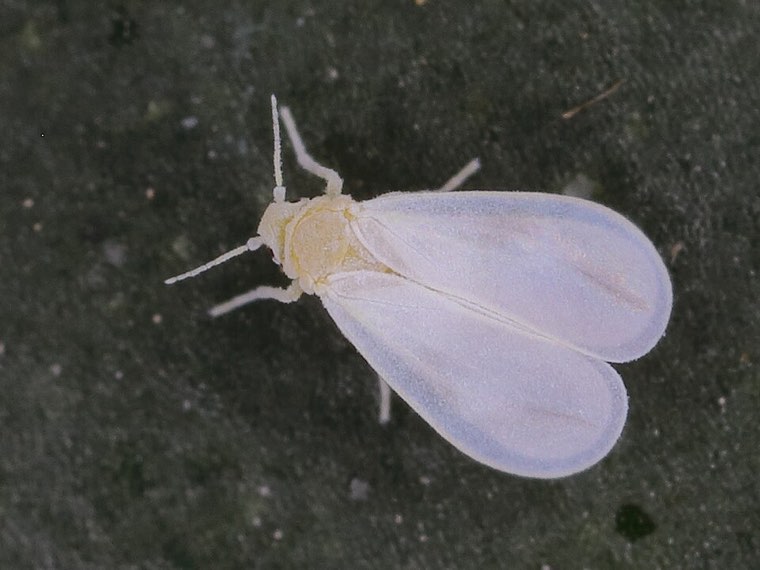
The scientific name of greenhouse whitefly is Trialeurodes vaporariorum Trialeurodes vaporariorum (Westwood, 1856), in the order Hemiptera, family Aleyrodidae.
Older or alternative scientific names: Aleurodes vaporariorum.
Found worldwide; in temperate regions mainly in greenhouses, where it can survive winter, and outdoors in summer. In the tropics it is most important at higher altitudes, such as the Andes and East African highlands, where it attacks field beans, potato and vegetables.
| Region | Status |
|---|---|
| Europe and North America | Widespread in greenhouses; outdoors in warm seasons |
| Latin America | Widespread; major in Andean highlands |
| Africa and Asia | Widespread, especially at higher altitudes |
| Oceania | Widespread |
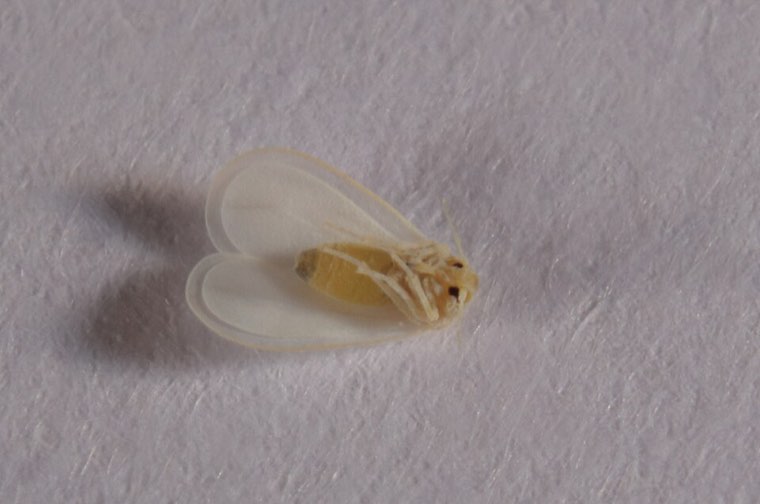
Adults are about 1-1.5 mm long, with four white, powdery wings held flat over the body and almost parallel to the leaf, so the body is hidden. Eggs are laid on young upper leaves, often in arcs or circles, and turn from pale yellow to grey-black. The last nymphal stage (often called the pupa) is oval and white, with straight vertical sides like a small cake and a fringe of waxy filaments.
| Crop stage | What you see |
|---|---|
| Young leaves | Clouds of white adults fly up when plants are disturbed; eggs on the undersides of the youngest leaves. |
| Older leaves | Flat, scale-like nymphs and pupae on leaf undersides; sticky honeydew and black sooty mould on lower leaves and fruit; yellowing and loss of vigour. |
| Virus symptoms | Interveinal yellowing and brittleness of older tomato leaves (tomato chlorosis and tomato infectious chlorosis viruses); yellowing of cucurbit leaves (beet pseudo-yellows virus). |
Females lay eggs on the youngest leaves. The first-instar nymph ('crawler') moves a short distance and then settles; the next instars do not move and feed on the phloem. The last instar stops feeding and develops into the adult, which emerges through a T-shaped slit. As plants grow, the stages are found in layers: eggs at the top, nymphs in the middle, and empty pupal cases lower down.
| Stage | Duration | Notes |
|---|---|---|
| Egg | About 7-10 days | Upright on a short stalk on young leaves. |
| Nymph (instars 1-3) | About 10-15 days | Only the first instar moves. |
| Fourth instar ('pupa') | About 6-8 days | Target of the parasitoid Encarsia formosa. |
| Adult | About 3-6 weeks | Females lay 100-300 eggs. |
Egg to adult takes about four weeks at 20-22 °C and longer in cool conditions; it develops well at moderate temperatures and suffers more than Bemisia whiteflies in hot, dry conditions.
Many overlapping generations in greenhouses; fewer outdoors in temperate regions.
Mild temperatures; continuous host crops in greenhouses; infested young plants; weeds and ornamentals in and around greenhouses; and broad-spectrum insecticides that kill natural enemies.
There is no single numeric threshold. Greenhouse growers use yellow sticky cards and leaf counts to decide when to release natural enemies or treat; where whitefly-transmitted viruses are present, very low numbers may justify action.
Thresholds are local. They depend on crop price, control cost, variety and natural-enemy activity, so use the figure your local extension service publishes where one exists.
Direct feeding reduces vigour and yield; honeydew and sooty mould soil fruit and ornamentals and reduce photosynthesis; and the viruses it transmits, including tomato chlorosis virus, tomato infectious chlorosis virus and beet pseudo-yellows virus, cause serious losses in tomato and cucurbits. In the Andes it transmits potato yellow vein virus.
Control works best as a sequence: prevent, monitor, then act only when a threshold or a risk forecast says so, using the least disruptive option that works.
Greenhouse whitefly has developed resistance to many insecticide groups; choose products compatible with biological control. What is registered differs by country and changes over time; follow the label and your local plant-protection authority.
| Scheme | Group | Mode of action | Notes |
|---|---|---|---|
| IRAC | 16 | Inhibitors of chitin biosynthesis, type 1 | Acts on nymphs; compatible with parasitoids. |
| IRAC | 7C | Juvenile hormone mimics | Acts on eggs and nymphs. |
| IRAC | 23 | Inhibitors of acetyl CoA carboxylase | Acts on nymphs. |
| IRAC | 9B | Chordotonal organ TRPV channel modulators | Feeding inhibitor. |
| IRAC | 4A | Nicotinic acetylcholine receptor competitive modulators (neonicotinoids) | Resistance common; toxic to pollinators. |
Several hundred plant species in many families, including tomato, cucumber and other cucurbits, beans, pepper, eggplant, potato, lettuce, strawberry, and ornamentals such as poinsettia, gerbera, fuchsia and lantana; also many weeds.
How to grow the crop well is the first line of defence. Laisha's free grow guides cover each crop from sowing to harvest:
Written by Laisha from the sources above, in its own words. This page is general reference, not a prescription: confirm identification locally and follow the label and your plant-protection authority.