 Laisha
AI Operating System for Agriculture
Ask Laisha
Laisha
AI Operating System for Agriculture
Ask Laisha
Phthorimaea absoluta (Meyrick, 1917) · formerly or also: Tuta absoluta, Scrobipalpula absoluta, Gnorimoschema absoluta
A tiny moth whose caterpillars tunnel inside tomato leaves, stems and fruit. Within a few generations a crop can look scorched and fruit becomes unsaleable. Native to South America, it spread from Spain in 2006 across the Mediterranean, Africa, the Middle East and Asia in little more than a decade, and is now one of the most serious threats to tomato production worldwide. The species was moved from the genus Tuta to Phthorimaea in 2023, but 'Tuta absoluta' remains the name most growers know.
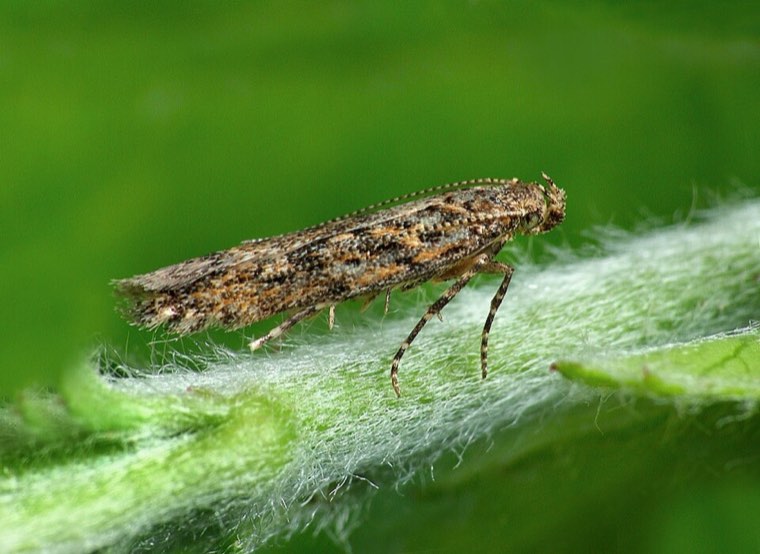
The scientific name of tomato leaf miner is Phthorimaea absoluta (Meyrick, 1917), in the order Lepidoptera, family Gelechiidae.
Older or alternative scientific names: Tuta absoluta, Scrobipalpula absoluta, Gnorimoschema absoluta.
Native to western South America, it spread through South America in the second half of the twentieth century. It was detected in eastern Spain in 2006 and within a decade had invaded most of the Mediterranean basin, Europe's protected tomato industry, sub-Saharan Africa, the Middle East, Central and South Asia. It is regulated or under official control in several regions.
| Region | Status |
|---|---|
| South America | Native; key pest of tomato since the 1960s-1980s |
| Europe and the Mediterranean basin | Invasive since 2006; established in field and protected tomato |
| Sub-Saharan Africa | Invasive since about 2012; widespread in East, West and southern Africa |
| Middle East, Central and South Asia | Invasive since about 2009-2014; spreading |
| East Asia | Recorded in parts of western China since 2017 |
Eggs are tiny, oval and cream to yellow, laid singly on leaves, stems and sepals. Larvae pass through four instars and grow to about 8 mm; they are cream when young and turn greenish or pinkish, with a narrow dark band across the back just behind the head. The adult is a slender silver-grey moth about 6-7 mm long with dark flecks on the forewings and long thread-like antennae; it hides in the canopy by day and flies at dawn and dusk.
| Crop stage | What you see |
|---|---|
| Seedling and transplant | Irregular, transparent blotch mines in leaves with dark frass inside; young plants can lose their growing tip. |
| Vegetative growth | Mines merge until leaflets dry and turn brown, so the crop looks scorched; larvae also bore into stems and apical shoots. |
| Flowering and fruit set | Larvae enter flowers and young fruit, often under the calyx. |
| Fruit development and harvest | Pinhole entry holes with frass, tunnels in the flesh and secondary rots; fruit is unmarketable. |
Females lay on average about 250 eggs over their life. Larvae mine for most of their development and can leave one mine to start another. Pupation happens in the mine, in a folded leaf or in the soil. Adults mostly mate and lay at night and early morning. A generation takes about 24-30 days at 25-27 °C and over two months near 14 °C, so populations explode in warm greenhouses and summers.
| Stage | Duration | Notes |
|---|---|---|
| Egg | About 4-6 days at 25 °C | Laid singly on the underside of leaves, stems and calyx. |
| Larva (4 instars) | About 10-15 days at 25 °C | Feeds inside leaves, stems, buds and fruit. |
| Pupa | About 9-11 days at 25 °C | In the mine, in leaf folds or in soil, inside a light cocoon. |
| Adult moth | About 10-15 days (females) | Nocturnal; can fly between greenhouses and fields. |
Development speeds up from a lower threshold of roughly 8-9 °C to an optimum near 25-30 °C. There is no true diapause; populations survive mild winters and continue breeding inside heated or unheated greenhouses.
About 10-12 generations a year where tomato is available continuously; fewer outdoors where winters are cold.
Continuous tomato cropping, overlapping plantings, unscreened greenhouses, nearby abandoned crops and solanaceous weeds, and warm dry weather. Movement of infested fruit, seedlings and packaging spreads the pest between regions. Over-reliance on one insecticide group accelerates resistance.
There is no internationally agreed numeric economic threshold. Pheromone trap catches are used as an early warning and to time the start of control, and scouting for fresh mines on leaves decides action. Several national and extension programmes publish local trap-catch or mines-per-plant action levels, and these differ with crop value and growing system; growers should use the figure for their region. Because damage moves to fruit quickly, most programmes act on the first sign of active mines in a fruiting crop.
Thresholds are local. They depend on crop price, control cost, variety and natural-enemy activity, so use the figure your local extension service publishes where one exists.
Each larva destroys leaf tissue from inside, reducing photosynthesis, and the attack moves to stems, growing points and fruit. Without effective management, yield losses of 50-100% have been reported in both field and protected tomato in South America, the Mediterranean and Africa. Damaged fruit is also rejected by markets and can carry the pest across borders.
Control works best as a sequence: prevent, monitor, then act only when a threshold or a risk forecast says so, using the least disruptive option that works.
Larvae inside mines and fruit are hard to reach, so chemical control works only when timed against eggs and young larvae and integrated with the measures above. Products differ widely in effect on mirid predators. What is registered differs by country and changes over time; follow the label and your local plant-protection authority.
| Scheme | Group | Mode of action | Notes |
|---|---|---|---|
| IRAC | 28 | Ryanodine receptor modulators (diamides) | Resistance documented in some Mediterranean populations. |
| IRAC | 5 | Nicotinic acetylcholine receptor allosteric modulators, site I (spinosyns) | Reduced susceptibility reported in some regions. |
| IRAC | 22A | Voltage-dependent sodium channel blockers (oxadiazines) | Larvicide. |
| IRAC | 6 | Glutamate-gated chloride channel allosteric modulators (avermectins) | Translaminar activity in leaves. |
| IRAC | 11A | Bacillus thuringiensis | Biological; young larvae only. |
Tomato is by far the preferred host, in the field and under protection. Potato foliage, eggplant, pepper, tobacco and cape gooseberry are attacked less often, and solanaceous weeds such as black nightshade and Datura species keep populations going between crops. A few non-solanaceous hosts, including common bean, have been recorded.
How to grow the crop well is the first line of defence. Laisha's free grow guides cover each crop from sowing to harvest:
Written by Laisha from the sources above, in its own words. This page is general reference, not a prescription: confirm identification locally and follow the label and your plant-protection authority.