 Laisha
AI Operating System for Agriculture
Ask Laisha
Laisha
AI Operating System for Agriculture
Ask Laisha
Maruca vitrata Maruca vitrata (Fabricius, 1787) · formerly or also: Maruca testulalis
The legume pod borer is a moth whose caterpillars web together the flowers, buds and young pods of cowpea, pigeon pea, mung bean, beans and other legumes, then bore into the pods and eat the seeds. It is one of the most damaging pests of cowpea in Africa and of pigeon pea and other pulses in Asia. Because the caterpillars feed hidden inside webbed flowers and pods, sprays must be well timed.
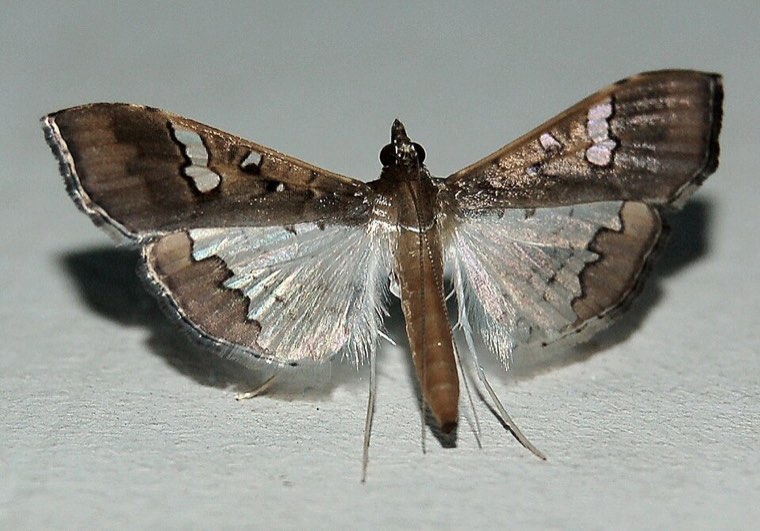
The scientific name of legume pod borer is Maruca vitrata Maruca vitrata (Fabricius, 1787), in the order Lepidoptera, family Crambidae.
Older or alternative scientific names: Maruca testulalis.
Found throughout the tropics and subtropics of Africa, Asia, the Americas and Oceania.
| Region | Status |
|---|---|
| Africa | Widespread; major pest of cowpea |
| South and South-East Asia | Widespread; major on pigeon pea and pulses |
| Americas | Present in tropical and subtropical areas |
| Oceania | Present |
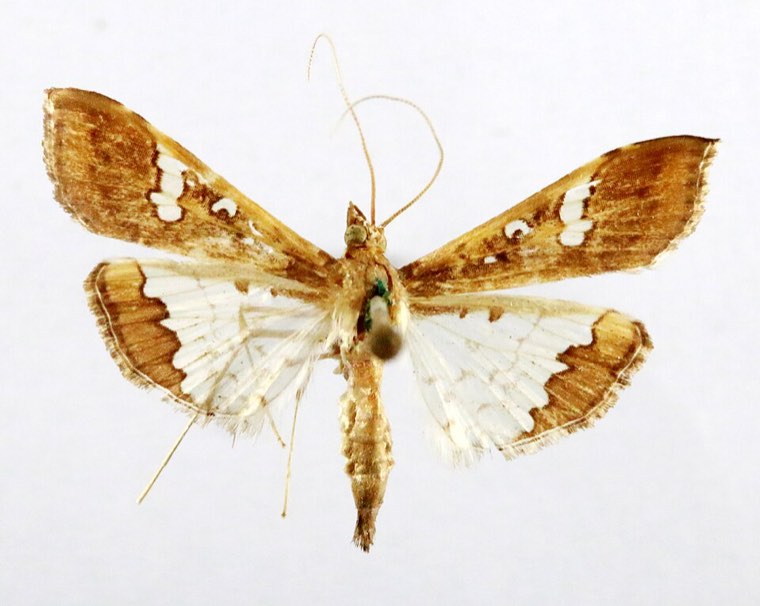
Moths have a wingspan of about 2.5 cm, brown forewings with white, see-through bands and spots, and whitish hindwings with a brown border; they rest with wings spread flat under leaves. Caterpillars are pale greenish-white with rows of paired dark spots on each segment, growing to about 1.8 cm.
| Crop stage | What you see |
|---|---|
| Flower buds and flowers | Flowers and buds webbed together with silk and droppings; flowers drop. |
| Pods | Pods webbed to each other or to leaves; round entry holes with droppings at the hole; seeds eaten inside. |
| Shoots | Webbed and bored tender shoots and leaves, especially in pigeon pea. |
Females lay eggs on flower buds, flowers and young leaves. Young caterpillars feed inside flowers, and older ones move to pods, webbing them together. There are five instars. Mature caterpillars pupate in a silk cocoon in webbed leaves or in the soil.
| Stage | Duration | Notes |
|---|---|---|
| Egg | About 2-3 days | On buds and flowers. |
| Caterpillar (5 instars) | About 8-14 days | Flowers first, then pods. |
| Pupa | About 6-9 days | In webbed leaves or soil. |
| Adult moth | About 1 week | Night-active; may migrate. |
Egg to adult takes about three to four weeks in warm weather; outbreaks follow the flowering of host crops, often in humid seasons.
Several generations per year, moving between cultivated and wild legumes.
Large areas of flowering legumes, staggered plantings, wild legume hosts near fields, warm humid weather and loss of natural enemies after broad-spectrum sprays.
There is no single international threshold. Programmes use counts of caterpillars per number of flowers or plants at flowering, which differ between countries and crops; check with your local extension service.
Thresholds are local. They depend on crop price, control cost, variety and natural-enemy activity, so use the figure your local extension service publishes where one exists.
Yield losses of 20-80% are reported in cowpea in Africa, and heavy losses in pigeon pea and mung bean in Asia, especially when flowering coincides with peak moth numbers.
Control works best as a sequence: prevent, monitor, then act only when a threshold or a risk forecast says so, using the least disruptive option that works.
Sprays are timed to the start of flowering and early podding, when caterpillars are small and exposed; repeated broad-spectrum sprays kill natural enemies. What is registered differs by country and changes over time; follow the label and your local plant-protection authority.
| Scheme | Group | Mode of action | Notes |
|---|---|---|---|
| IRAC | 28 | Ryanodine receptor modulators (diamides) | Rotate. |
| IRAC | 5 | Nicotinic acetylcholine receptor allosteric modulators, site I (spinosyns) | Selective. |
| IRAC | 6 | Glutamate-gated chloride channel allosteric modulators | Rotate. |
| IRAC | 11A | Microbial disruptors of insect midgut membranes (Bacillus thuringiensis) | Selective; best on young caterpillars. |
More than 30 legumes, including cowpea, pigeon pea, mung bean, black gram, common and lima beans, hyacinth bean, soybean, yard-long bean and wild legumes and shrubs that support it between seasons.
How to grow the crop well is the first line of defence. Laisha's free grow guides cover each crop from sowing to harvest:
Written by Laisha from the sources above, in its own words. This page is general reference, not a prescription: confirm identification locally and follow the label and your plant-protection authority.