 Laisha
AI Operating System for Agriculture
Ask Laisha
Laisha
AI Operating System for Agriculture
Ask Laisha
Thrips tabaci Lindeman, 1889
A tiny thrips that rasps the surface of onion, garlic and leek leaves, leaving silvery streaks that reduce bulb size, and that also attacks cabbage, cotton seedlings and many other crops. It transmits iris yellow spot virus in onion and, in some populations, tomato spotted wilt virus. Hot, dry weather favours it; heavy rain knocks numbers back.
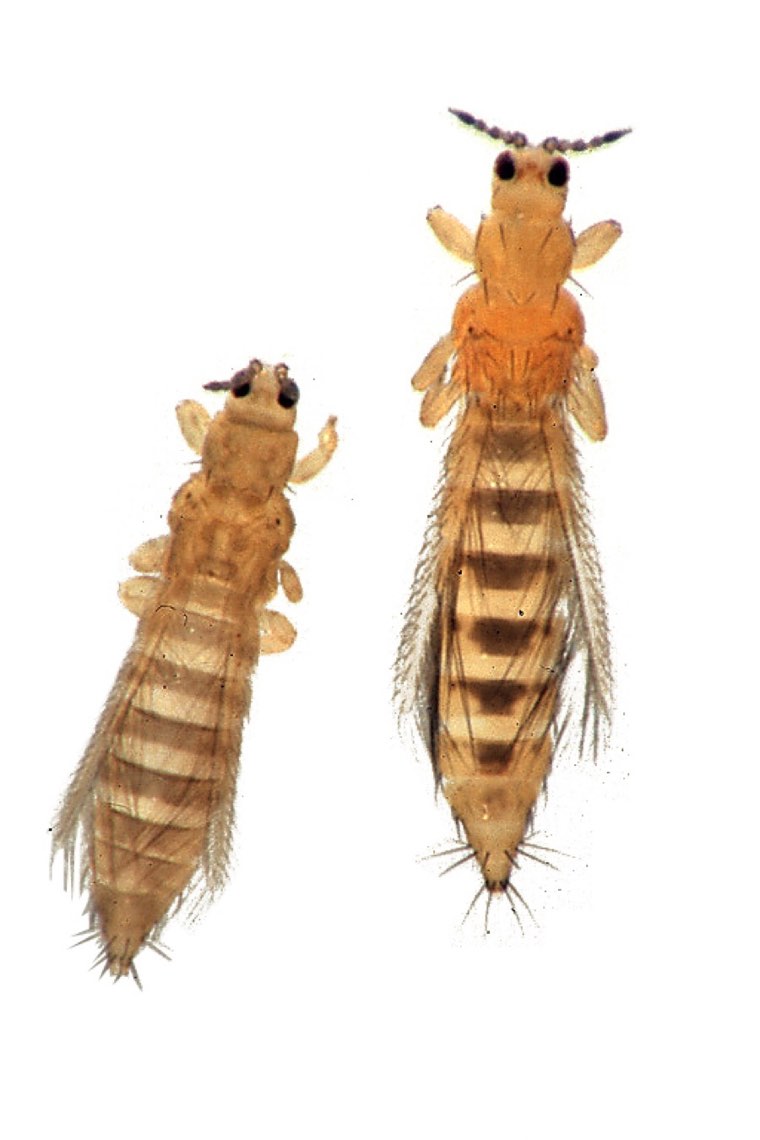
The scientific name of onion thrips is Thrips tabaci Lindeman, 1889, in the order Thysanoptera, family Thripidae.
Cosmopolitan: found in almost every agricultural region, from the tropics to cool temperate zones, outdoors and in greenhouses. Most field populations consist only of females that reproduce without mating.
| Region | Status |
|---|---|
| Asia | Widespread; key onion and garlic pest |
| Africa and the Middle East | Widespread; key onion pest in dry seasons |
| Europe | Widespread; pest of onion, leek and cabbage |
| Americas | Widespread; key onion pest |
| Oceania | Widespread |
Adults are about 1-1.3 mm long, pale yellow to grey-brown, slender, with narrow fringed wings. Larvae are wingless and pale yellow to white. They hide in the tightly folded inner leaves of onion and leek, at the base of the neck. Separation from western flower thrips and other species needs a microscope (for example, the pattern of bristles on the thorax).
| Crop stage | What you see |
|---|---|
| Seedling and early leaf growth | Silvery-white flecks and streaks on leaves, often with tiny black specks of excrement; seedlings of cotton show crinkled, cupped leaves. |
| Bulb initiation and bulking (onion, garlic) | Leaves become silvery, then brown and dry from the tips; plants look 'blasted'; bulbs remain small; diamond-shaped straw lesions of iris yellow spot virus on leaves and scapes. |
| Cabbage heading | Bronzed, warty patches on inner leaves of the head, which make heads unsaleable. |
Females insert eggs singly into leaf tissue. Two feeding larval stages live in the leaf folds; the non-feeding prepupa and pupa usually drop into the soil. Adults overwinter in crop debris, weeds and stored bulbs, or keep breeding in mild climates. Larvae acquire iris yellow spot virus from infected plants and transmit it as adults.
| Stage | Duration | Notes |
|---|---|---|
| Egg (in leaf tissue) | About 4-5 days at 25 °C | Not reached by contact sprays. |
| Larva (2 instars) | About 5-9 days at 25 °C | Feeds in the leaf folds. |
| Prepupa and pupa (soil) | About 4-7 days | Non-feeding. |
| Adult | About 2-4 weeks | Each female lays 50-100 eggs; mostly female populations. |
Egg to adult takes about 2-3 weeks at 25-30 °C and much longer in cool weather; development stops below about 10 °C. Populations explode during hot, dry spells.
From 5-10 generations in temperate climates to continuous breeding in the tropics.
Hot, dry weather; drought-stressed plants; onion fields next to cereals or weeds that dry down and release thrips; staggered onion plantings; and over-use of a few insecticides. Heavy rain or overhead irrigation washes thrips off leaves.
Onion thresholds are counts of thrips (adults plus larvae) per leaf, which allows for plant size; growers count all leaves on a sample of plants and divide by the number of leaves. Threshold-based programmes in North America controlled thrips as well as weekly spraying with about two fewer sprays per season. Values differ by region and season, and lower thresholds apply where iris yellow spot virus is a problem.
| Crop | Threshold | Unit | Crop stage | Region | Source |
|---|---|---|---|---|---|
| Onion & shallot | About 1 (0.6-1.0) | thrips per leaf (adults + larvae) | Early season to pre-bulbing | North America (New York, Great Lakes) | Cornell University onion thrips management guidance (Nault) |
| Onion & shallot | About 1-4, increasing with plant size and depending on the product group | thrips per leaf | Bulbing | North America (Michigan, New York) | Michigan State University and Cornell onion thrips recommendations |
Thresholds are local. They depend on crop price, control cost, variety and natural-enemy activity, so use the figure your local extension service publishes where one exists.
Feeding destroys leaf area and causes early leaf death, so bulbs are smaller; reported yield losses in heavily infested onion fields range up to about 30-50%, with greater losses in hot, dry seasons in South Asia, Africa and the Americas. Iris yellow spot virus adds further losses in onion seed and bulb crops. In cabbage, internal bronzing makes heads unmarketable.
Control works best as a sequence: prevent, monitor, then act only when a threshold or a risk forecast says so, using the least disruptive option that works.
Thrips hidden in the leaf folds are hard to reach, so sprays need high volume or wetting and should be timed to thresholds. What is registered differs by country and changes over time; follow the label and your local plant-protection authority.
| Scheme | Group | Mode of action | Notes |
|---|---|---|---|
| IRAC | 23 | Inhibitors of acetyl CoA carboxylase (tetramic acid derivatives) | Systemic; used early, on larvae. |
| IRAC | 6 | Glutamate-gated chloride channel allosteric modulators (avermectins) | Used at low-moderate pressure. |
| IRAC | 5 | Nicotinic acetylcholine receptor allosteric modulators, site I (spinosyns) | Used at higher pressure. |
| IRAC | 28 | Ryanodine receptor modulators (diamides, some members) | Used at higher pressure. |
Very wide: more than 300 plant species. Main crops are onion, garlic, leek and shallot; cabbage and other brassicas (where it causes internal 'bronzing' of heads), cotton seedlings, tobacco, beans, cucurbits, tomato and many ornamentals and weeds.
How to grow the crop well is the first line of defence. Laisha's free grow guides cover each crop from sowing to harvest:
Written by Laisha from the sources above, in its own words. This page is general reference, not a prescription: confirm identification locally and follow the label and your plant-protection authority.