 Laisha
AI Operating System for Agriculture
Ask Laisha
Laisha
AI Operating System for Agriculture
Ask Laisha
Diuraphis noxia Diuraphis noxia (Kurdjumov, 1913) · formerly or also: Brachycolus noxius, Cuernavaca noxia
The Russian wheat aphid is a small, lime-green, spindle-shaped aphid that feeds inside rolled leaves of wheat and barley. Its saliva causes white, yellow or purple streaks along the leaves, rolls them into tubes, and traps the emerging heads, so heavily infested crops yield poorly. Originally from Central Asia and the Middle East, it spread to South Africa, the Americas and Australia from the late 1970s onward.
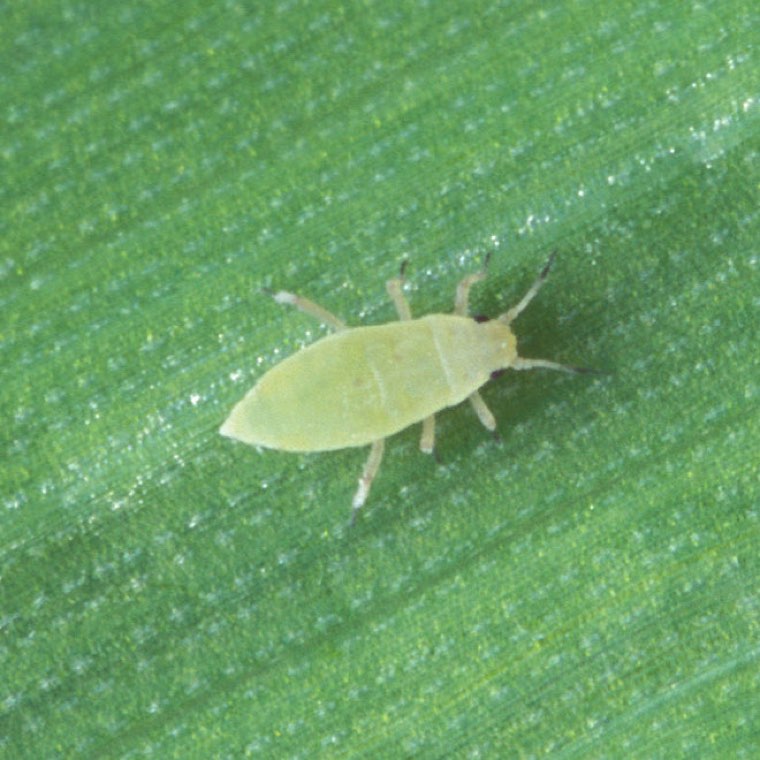
The scientific name of Russian wheat aphid is Diuraphis noxia Diuraphis noxia (Kurdjumov, 1913), in the order Hemiptera, family Aphididae.
Older or alternative scientific names: Brachycolus noxius, Cuernavaca noxia.
Native to southern Russia, Central Asia, the Middle East and the Mediterranean; recorded in South Africa (1978), Mexico (1980), the United States (1986), Canada and South America (late 1980s), and Australia (2016).
| Region | Status |
|---|---|
| Central and West Asia, Middle East | Native; widespread |
| Africa | North and East Africa; South Africa since 1978 |
| Americas | Established in North and South America |
| Oceania | Australia since 2016 |
Adults are about 1.5-2 mm long, elongated and lime- to grey-green with a waxy bloom. They have very short antennae, almost no visible cornicles (siphunculi), and a small projection above the tail that makes the rear look forked ('double-tailed'). Most are wingless females that give birth to live young without mating.
| Crop stage | What you see |
|---|---|
| Seedlings and tillering | White, yellow or purple streaks running the length of leaves; leaves roll tightly into tubes, hiding the colonies; plants lie flat. |
| Stem elongation to heading | Flag leaves stay rolled and trap the heads, which emerge bent ('fish-hook' heads) or stay inside the sheath; awns are trapped. |
| Grain fill | Fewer and smaller grains; patches of purplish, stunted plants. |
In most invaded regions populations consist only of females that give birth to live young without mating, producing a new generation every one to two weeks. Winged forms appear when colonies are crowded and spread to new fields on the wind. In parts of the native range sexual forms lay overwintering eggs. Between crops the aphid survives on volunteer cereals and wild grasses.
| Stage | Duration | Notes |
|---|---|---|
| Nymph (4 instars) | About 7-12 days | Feeds inside rolled leaves. |
| Wingless adult female | About 3-4 weeks | Gives birth to several young per day. |
| Winged adult | When crowded or plants decline | Spreads to new crops. |
| Survival between crops | Summer and winter | On volunteers and grasses. |
Develops at cool temperatures and tolerates cold; outbreaks follow mild winters and dry springs.
Many generations per year.
Dry conditions and drought-stressed crops, mild winters, volunteer cereals and grasses near fields, and early-sown winter cereals exposed to autumn flights.
There is no single international threshold. Regional thresholds exist and are usually expressed as the percentage of infested tillers or plants at a given growth stage, adjusted for crop value and control cost; values differ between regions. Check with your local extension service.
Thresholds are local. They depend on crop price, control cost, variety and natural-enemy activity, so use the figure your local extension service publishes where one exists.
Yield losses of 20-60% or more in heavily infested fields; large losses occurred in South Africa and the US Great Plains after its arrival. Russian wheat aphid can also transmit some cereal viruses, such as brome mosaic virus, but this is minor compared with direct damage.
Control works best as a sequence: prevent, monitor, then act only when a threshold or a risk forecast says so, using the least disruptive option that works.
Systemic treatments work better than contact sprays because the aphids feed inside rolled leaves. What is registered differs by country and changes over time; follow the label and your local plant-protection authority.
| Scheme | Group | Mode of action | Notes |
|---|---|---|---|
| IRAC | 4A | Nicotinic acetylcholine receptor competitive modulators (neonicotinoids), seed treatment | Protects seedlings in autumn; toxic to pollinators and other non-targets. |
| IRAC | 1B | Acetylcholinesterase inhibitors (organophosphates) | Systemic or vapour action reaches rolled leaves; highly toxic. |
| IRAC | 3A | Sodium channel modulators (pyrethroids) | Contact; poor reach into rolled leaves; harms natural enemies. |
Wheat and barley are the main hosts; triticale, rye and to a lesser extent oats, and many wild grasses (such as Bromus, Elymus and Agropyron species) also host it.
How to grow the crop well is the first line of defence. Laisha's free grow guides cover each crop from sowing to harvest:
Written by Laisha from the sources above, in its own words. This page is general reference, not a prescription: confirm identification locally and follow the label and your plant-protection authority.