Sunflower broomrape
Orobanche cumana Wallr. · formerly or also: Orobanche cernua subsp. cumana
- заразиха подсолнечная (zarazikha podsolnechnaya) · Russian, Russia, Ukraine and Central Asia
- orobanche du tournesol · French, France
- jopo del girasol · Spanish, Spain
- lupoaie · Romanian, Romania and Moldova
- 向日葵列当 (xiàngrìkuí lièdāng) · Chinese, Northern China
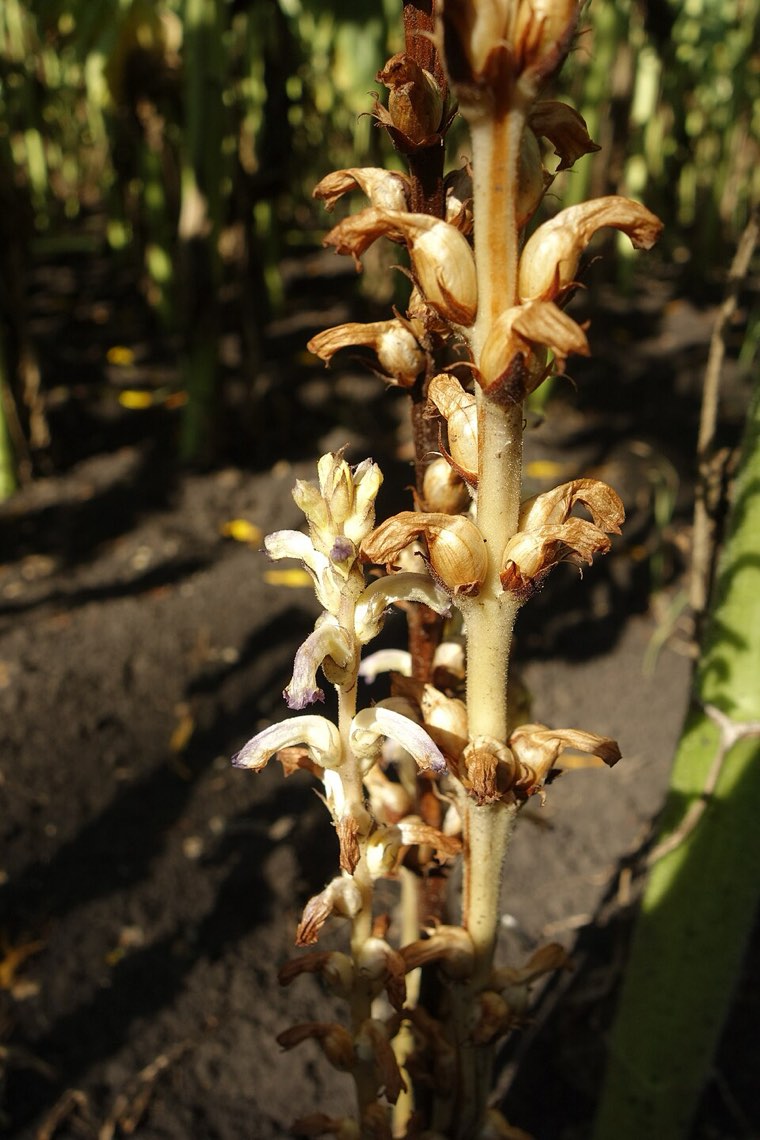
Sunflower broomrape is a leafless, yellowish-brown parasitic plant that attaches to sunflower roots underground and takes water, minerals and sugars from them. By the time its pale flowering spikes appear around the sunflower stems, most of the damage is already done. It is the most important biological constraint on sunflower in Eastern and Southern Europe, the Black Sea region and parts of Asia, where it can halve seed yield in susceptible hybrids. It keeps evolving new races that overcome resistant hybrids.
- Type
- Parasitic plant · Parasitic flowering plant (root parasite without chlorophyll)
- Classification
- Plantae › Magnoliopsida › Lamiales › Orobanchaceae
- Main crops
- Sunflower
- Found in
- Russia, Ukraine and the Black Sea region, South-eastern and Southern Europe, West and Central Asia, East Asia, Americas
- Chemical groups
- HRAC 2 (mode-of-action groups, not products)
- Last reviewed
- 2026-10-20
Sunflower broomrape scientific name, order and family
The scientific name of sunflower broomrape is Orobanche cumana Wallr., in the order Lamiales, family Orobanchaceae.
Older or alternative scientific names: Orobanche cernua subsp. cumana.
Where it occurs
Native to the steppes of south-eastern Europe and Central Asia. It was first seen on sunflower in the Volga region of Russia in 1866 and followed the crop as it spread through Eastern Europe in the late nineteenth and twentieth centuries. It is now present wherever sunflower is grown in Southern Europe and around the Black Sea, and in West, Central and East Asia. It has not been reported as established in the Americas.
| Region | Status |
|---|---|
| Russia, Ukraine and the Black Sea region | Widespread; the most virulent races (G and beyond) occur here |
| South-eastern and Southern Europe | Widespread in the Balkans and Romania; also in Spain and France |
| West and Central Asia | Present in Türkiye, Israel, Iran and Kazakhstan |
| East Asia | Present in northern China since the 1990s; races have increased in virulence |
| Americas | Not reported as established |
Symptoms and identification of sunflower broomrape
The plant
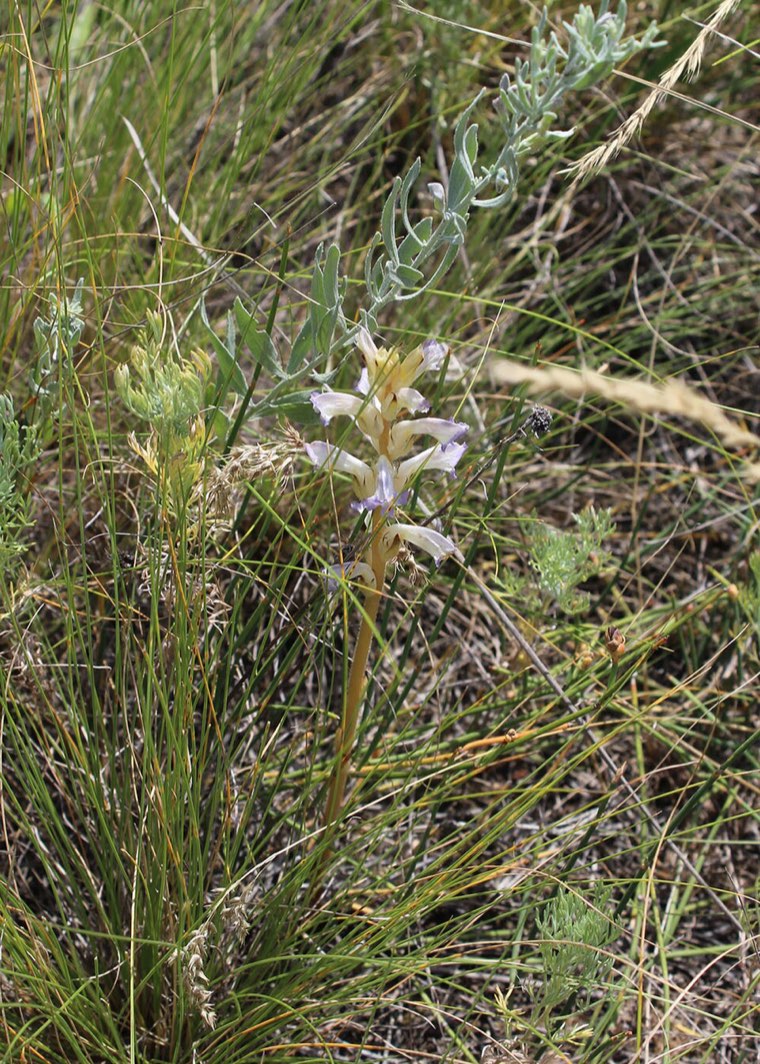
A plant without leaves or chlorophyll. The flowering shoot is a single unbranched, fleshy stem 10-40 cm tall, pale yellow to brown and slightly hairy, carrying scale-like leaves and blue to purple tubular flowers in a spike. Each shoot produces tens of thousands of dust-like seeds about 0.2-0.3 mm long. Underground, the parasite forms a swollen attachment (tubercle) on the sunflower root.
Signs in the crop, stage by stage
| Crop stage | What you see |
|---|---|
| Vegetative growth (below ground) | No obvious signs above ground; if roots are dug up carefully, small white to yellow nodules (tubercles) are found attached to them. |
| Budding to flowering | Infected sunflowers are shorter and thinner, may wilt in the heat of the day, and have smaller heads. Clusters of broomrape shoots emerge around the base of the stems, sometimes dozens per plant. |
| Seed filling | Heads are small with poorly filled, light seed; broomrape spikes turn brown and release seed. |
Life cycle of sunflower broomrape
Broomrape seeds remain dormant in the soil until they have been moist for some days (conditioning) and then sense chemicals released by sunflower roots, mainly sesquiterpene lactones. The germ tube grows a few millimetres towards the root and forms an attachment organ (haustorium) that joins the sunflower's vascular tissue. A tubercle develops, grows a shoot underground and finally pushes a flowering spike above the soil. Each spike sets large numbers of tiny seeds, which fall to the soil or are carried by wind, water, machinery, animals and contaminated crop seed.
| Stage | Duration | Notes |
|---|---|---|
| Dormant seed in soil | Viable for decades | Builds a long-lived seed bank. |
| Conditioning and germination | About 1-2 weeks of moist soil, then germination near host roots | Triggered by root exudates. |
| Attachment and tubercle | Several weeks below ground | Most of the damage is done in this phase. |
| Emergence and flowering | Around sunflower budding to flowering | Spikes appear around the host stem. |
| Seed set and dispersal | A few weeks after emergence | Tens of thousands of seeds per spike. |
Temperature
Development is governed by soil temperature, so emergence can be predicted from accumulated growing degree days after sowing; warm soils speed attachment and emergence. Thresholds are population- and region-specific.
Generations
One generation per sunflower crop.
Conditions that favour it
Short rotations with sunflower, which build up the seed bank; large areas of a single resistant hybrid, which select for new races; contaminated crop seed and machinery; and dry, warm conditions during seed filling, which make the water drain by the parasite more damaging.
Economic threshold level (ETL)
There is no numeric economic threshold. Decisions are made before sowing, based on whether the field is infested and which races occur locally; once the parasite has attached, damage cannot be reversed.
Thresholds are local. They depend on crop price, control cost, variety and natural-enemy activity, so use the figure your local extension service publishes where one exists.
Damage and yield loss from sunflower broomrape
Broomrape takes water and assimilates from the host and reduces head size and seed filling. When susceptible hybrids are grown on infested land, seed losses are above 50 % on average and frequently reach 100 % in heavily infested fields. The seed bank can make fields unsuitable for sunflower for many years.
Monitoring
- Walk fields at budding to flowering and count emerged broomrape shoots per plant on samples of 20-50 plants spread across the field.
- Map infested patches and record which hybrid was grown, because emergence on a resistant hybrid signals a new race.
- Send shoots or seed from suspicious fields to a laboratory for race identification on differential lines.
- Before sowing sunflower in an unknown field, ask about its history of broomrape.
How to control sunflower broomrape (integrated management)
Control works best as a sequence: prevent, monitor, then act only when a threshold or a risk forecast says so, using the least disruptive option that works.
Cultural control
- Grow sunflower in the same field no more than once every five to six years; long rotations slow seed-bank build-up but do not eliminate it.
- Use clean, certified sunflower seed and clean machinery after working in infested fields.
- Destroy emerged broomrape spikes before they set seed in lightly infested fields.
- Some trap crops, such as flax and certain cereals and legumes, stimulate germination of broomrape seed without being parasitised and have been studied for reducing the seed bank.
Mechanical and physical control
- Hand-pull or cut emerged spikes before seed set and remove them from the field; this protects future crops but not the current one.
Biological control
- No biological control is in practical use; some fungi and insects that attack broomrape are under study.
Host resistance
- Resistance genes (named Or1 to Or7 and others) have been bred into hybrids against successive races A to G; each new set of genes has eventually been overcome. Resistance to the latest races combines major genes with quantitative resistance and is the most important control.
- Herbicide-tolerant sunflower hybrids (tolerant to ALS-inhibiting herbicides) allow post-emergence treatment that kills attached broomrape.
Chemical control of sunflower broomrape — by mode-of-action group only
Selective herbicides are used only in hybrids bred to tolerate them, applied at the growth stage given on the label. What is registered differs by country and changes over time; follow the label and your local plant-protection authority.
| Scheme | Group | Mode of action | Notes |
|---|---|---|---|
| HRAC | 2 | Inhibition of acetolactate synthase (ALS) | Only in ALS-tolerant sunflower hybrids; broomrape populations with ALS-gene mutations that survive these treatments have been found. |
Resistance management
- Do not rely on a single resistance gene or on herbicide-tolerant hybrids alone; combine long rotations, clean seed, removal of spikes and hybrids with different resistance.
- Broomrape populations surviving ALS-inhibiting herbicides have been reported; alternate tolerant and non-tolerant hybrids and keep seed production to a minimum.
Look-alikes and how to tell them apart
- Branched broomrape (Phelipanche ramosa) — Shoots are branched with several spikes from the base; it attacks tomato, oilseed rape, tobacco and hemp rather than mainly sunflower.
- Downy mildew of sunflower — Plants are stunted with bleached leaf veins and white growth under the leaves, and no broomrape shoots appear around the stem.
- Charcoal rot — Plants wilt and the lower stem is grey with tiny black specks inside, but no parasitic shoots are present.
Host range
Almost exclusively sunflower among crops. In the wild it parasitises plants of the daisy family, especially Artemisia (wormwoods), from which it is thought to have moved onto sunflower in the nineteenth century. Reports on tobacco and some other crops are rare or doubtful.
What is still uncertain
- Race names are used inconsistently between countries, so 'race G' in one country may not equal 'race G' elsewhere; a coded international system has been proposed.
- How quickly races beyond G are spreading is not well known.
- Long-term field data on how much rotation and trap crops reduce the seed bank are limited.
Grow guides for its host crops
How to grow the crop well is the first line of defence. Laisha's free grow guides cover each crop from sowing to harvest:
Sources
- Orobanche cumana (sunflower broomrape) datasheet — CABI Compendium. https://doi.org/10.1079/cabicompendium.37745
- Orobanche cumana (ORAKM) — EPPO Global Database. https://gd.eppo.int/taxon/ORAKM
- History of the race structure of Orobanche cumana and the breeding of sunflower for resistance to this parasitic weed: a review — Spanish Journal of Agricultural Research (CSIC). https://doi.org/10.5424/sjar/2015134-8080
- Observations on the current status of Orobanche and Striga problems worldwide — Pest Management Science (Wiley). https://doi.org/10.1002/ps.1713
- International Herbicide-Resistant Weed Database — HRAC / WeedScience.org. https://www.weedscience.org/
Written by Laisha from the sources above, in its own words. This page is general reference, not a prescription: confirm identification locally and follow the label and your plant-protection authority.