Broomrapes of vegetables and legumes (branched, Egyptian and crenate broomrape)
Phelipanche ramosa, Phelipanche aegyptiaca and Orobanche crenata Phelipanche ramosa (L.) Pomel; P. aegyptiaca (Pers.) Pomel; Orobanche crenata Forssk. · formerly or also: Orobanche ramosa, Orobanche aegyptiaca
- orobanche rameuse · French, France and North Africa
- jopo de las habas · Spanish, Spain
- هالوك (halouk) · Arabic, North Africa and West Asia
- Ästige Sommerwurz · German, Central Europe
- succiamele delle fave · Italian, Italy
Broomrapes are leafless parasitic plants that attach to crop roots underground and live entirely on the host's water and food. Branched and Egyptian broomrape attack tomato, potato, eggplant, tobacco, carrot, oilseed rape, hemp, melons and many other crops; crenate broomrape is a major parasite of faba bean, pea and lentil. They are serious from the Mediterranean to the Middle East and Central Asia and have spread to other regions. Their tiny, long-lived seeds can make fields unprofitable for susceptible crops for many years.
- Type
- Parasitic plant · Parasitic flowering plants (root parasites without chlorophyll)
- Classification
- Plantae › Magnoliopsida › Lamiales › Orobanchaceae
- Main crops
- Tomato, Faba bean, Field pea, Lentil, Carrot, Eggplant, Potato, Tobacco, Rapeseed, Melon (cantaloupe)
- Found in
- Mediterranean Europe and North Africa, West and Central Asia, South Asia, Central and Western Europe, Americas and Oceania
- Chemical groups
- HRAC 2, HRAC 9 (mode-of-action groups, not products)
- Last reviewed
- 2026-10-20
Broomrapes of vegetables and legumes scientific name, order and family
The scientific name of broomrapes of vegetables and legumes is Phelipanche ramosa, Phelipanche aegyptiaca and Orobanche crenata Phelipanche ramosa (L.) Pomel; P. aegyptiaca (Pers.) Pomel; Orobanche crenata Forssk., in the order Lamiales, family Orobanchaceae.
Older or alternative scientific names: Orobanche ramosa, Orobanche aegyptiaca.
Where it occurs
All three are native to the Mediterranean and western Asia. Branched broomrape has spread with crop seed and machinery to parts of Africa, the Americas and Australia; Egyptian broomrape is widespread from the eastern Mediterranean to Central and South Asia; crenate broomrape is mostly confined to the Mediterranean and West Asia. Several regions regulate them as quarantine weeds.
| Region | Status |
|---|---|
| Mediterranean Europe and North Africa | All three widespread; crenate broomrape is the main parasite of faba bean and pea |
| West and Central Asia | Egyptian broomrape is widespread and severe on vegetables, melons and legumes |
| South Asia | Egyptian and branched broomrape present on tobacco, mustard and vegetables |
| Central and Western Europe | Branched broomrape increasing in oilseed rape and hemp |
| Americas and Oceania | Branched and Egyptian broomrape introduced in a few areas; under official control or eradication |
Symptoms and identification of broomrapes of vegetables and legumes
The plant
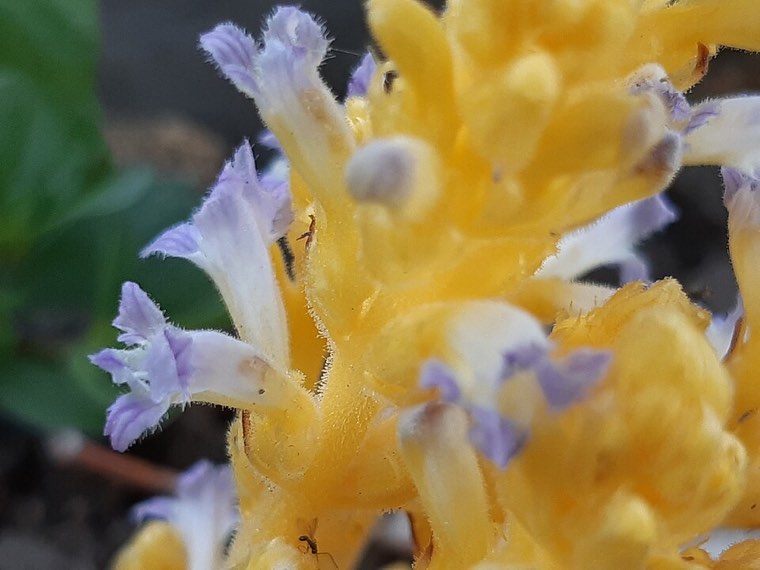
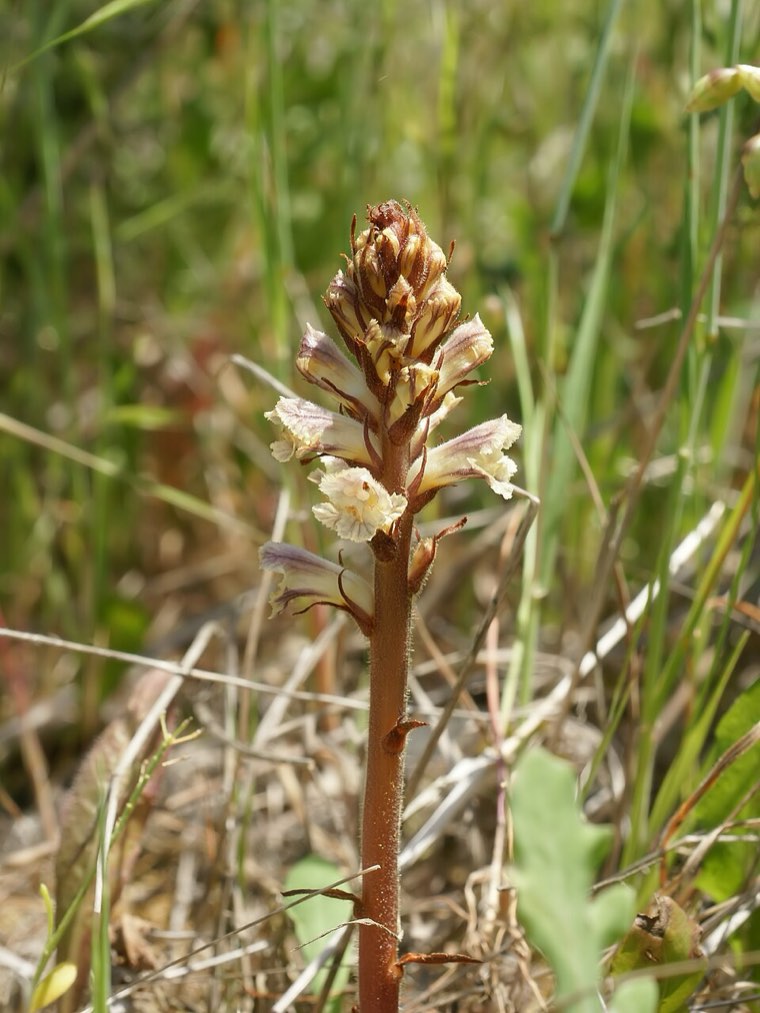
Plants without green leaves, with fleshy stems covered in scale leaves and spikes of tubular, two-lipped flowers. Branched and Egyptian broomrape usually branch from the base, are 10-30 cm tall and have blue to violet flowers. Crenate broomrape has a single, thicker stem up to about 60 cm or more, with white flowers marked with purple veins and a pleasant scent. All produce enormous numbers of dust-like seeds about 0.2-0.4 mm long. Below ground the parasite forms a swollen tubercle attached to the host root.
Signs in the crop, stage by stage
| Crop stage | What you see |
|---|---|
| Early crop growth (below ground) | No visible signs above ground; roots dug up carefully show small white tubercles attached to them. |
| Mid-season | Infected plants grow more slowly, look stressed or wilt at midday, and may yellow, while uninfected neighbours look normal; patches follow the infestation in the soil. |
| Flowering and fruiting | Broomrape spikes emerge around the base of host plants, often many per plant; host flowers and fruits are fewer and smaller and plants may die before harvest in heavy infestations. |
Life cycle of broomrapes of vegetables and legumes
Seeds in the soil need a period of moist, warm conditioning before they can respond to germination stimulants, mainly strigolactones released by host roots. The germ tube must reach a root within a few millimetres; it then forms a haustorium that connects to the host's vascular tissue. A tubercle develops and, after several weeks underground, produces shoots that emerge and flower. Each plant sets very large numbers of seeds that are spread by soil, water, machinery, animals, manure and contaminated crop seed.
| Stage | Duration | Notes |
|---|---|---|
| Dormant seed bank | Viable in soil for 10-20 years or more | Only a fraction germinates each season. |
| Conditioning and germination | Several days to 2 weeks of moist soil, then germination near host roots | Triggered by root exudates. |
| Attachment and tubercle growth | Several weeks below ground | Most damage occurs here. |
| Emergence and flowering | Mid to late crop season | Spikes appear around host stems. |
| Seed set | 2-4 weeks after emergence | Tens of thousands to hundreds of thousands of seeds per plant. |
Temperature
Parasite development follows soil temperature, so attachment and emergence can be predicted from accumulated growing degree days after planting; this is the basis of decision-support systems that time herbicide applications in tomato. Crenate broomrape is a cool-season parasite matched to winter legumes; branched and Egyptian broomrape develop in warm-season crops.
Generations
One generation per host crop; two hosts in a year can give two generations.
Conditions that favour it
Repeated cropping of susceptible hosts, early sowing of winter legumes (which gives crenate broomrape a longer time to attach), contaminated seed, manure, irrigation water and machinery, and dry, warm periods during host flowering.
Economic threshold level (ETL)
There is no numeric economic threshold. Infested fields are identified by their history and by seed-bank sampling, and control is planned before sowing. In regions where these broomrapes are quarantine weeds, finding them triggers official action.
Thresholds are local. They depend on crop price, control cost, variety and natural-enemy activity, so use the figure your local extension service publishes where one exists.
Damage and yield loss from broomrapes of vegetables and legumes
Broomrapes reduce the growth, flowering and fruit or pod set of their hosts. Losses range from a few per cent in light infestations to complete crop failure; in heavily infested faba bean and lentil fields around the Mediterranean, growers have abandoned the crops. In tomato and other vegetables the parasite reduces both yield and fruit size. The long-lived seed bank is the lasting damage.
Monitoring
- Inspect the base of host plants weekly from mid-season and record emerged broomrape spikes per plant or per square metre.
- Dig up a few plants carefully in suspect patches before emergence to look for tubercles on the roots.
- Use degree-day models, where they exist for the crop and broomrape species, to time inspections and treatments.
- Record and map infested fields so that susceptible crops are not grown there and machinery is cleaned after use.
How to control broomrapes of vegetables and legumes (integrated management)
Control works best as a sequence: prevent, monitor, then act only when a threshold or a risk forecast says so, using the least disruptive option that works.
Cultural control
- Do not grow susceptible crops on infested fields for several years; grow cereals, grasses and other non-hosts instead.
- Delay sowing of winter legumes where crenate broomrape is a problem; later sowing reduces infection, at some cost to yield potential.
- Use clean crop seed and transplants, avoid moving soil and manure from infested fields, and clean machinery.
- Trap crops (which make broomrape seed germinate without being parasitised) and catch crops (which are parasitised and then destroyed before broomrape sets seed) can reduce the seed bank over time.
- Intercropping legumes with fenugreek or oats has reduced crenate broomrape in experiments in the Mediterranean.
Mechanical and physical control
- Hand-pull emerged spikes before they set seed and remove them from the field; this protects later crops but not the current one.
- Soil solarisation under clear plastic in hot summers kills a large part of the seed bank in the top layer of soil in high-value vegetable fields.
Biological control
- The broomrape fly (Phytomyza orobanchia) feeds on broomrape capsules and seeds; fungi such as Fusarium species pathogenic to broomrape have been studied, but no biological control is widely used.
Host resistance
- Partial resistance to crenate broomrape is available in faba bean, pea, lentil and vetch, based mainly on lower stimulation of germination and on mechanisms that block attachment; resistance in vegetables is very limited.
Chemical control of broomrapes of vegetables and legumes — by mode-of-action group only
Herbicide programmes for broomrape need precise timing and are approved for only some crops in some countries. What is registered differs by country and changes over time; follow the label and your local plant-protection authority.
| Scheme | Group | Mode of action | Notes |
|---|---|---|---|
| HRAC | 2 | Inhibition of acetolactate synthase (ALS) | Pre-plant soil treatment and repeated low-dose chemigation in tomato, timed by degree days, and low doses in some legumes. |
| HRAC | 9 | Inhibition of enolpyruvyl shikimate phosphate synthase (EPSPS) | Very low doses sprayed on faba bean and some other legumes kill attached broomrape; crop tolerance is narrow. |
Resistance management
- Combine herbicides with rotation, clean seed and destruction of emerged spikes so that no broomrape seed is returned to the soil.
- Avoid repeated use of ALS-inhibiting herbicides alone; broomrape populations with ALS mutations surviving such treatments have been found in sunflower systems.
Look-alikes and how to tell them apart
- Sunflower broomrape — Unbranched spikes attached almost only to sunflower.
- Dodder — Thin orange or yellow threads twining around stems above ground, not fleshy spikes rising from the roots.
- Wilt diseases (Fusarium or Verticillium) — Wilting plants show brown streaks in the stem vascular tissue and no parasitic shoots or tubercles on the roots.
Host range
Branched broomrape (P. ramosa) and Egyptian broomrape (P. aegyptiaca) have very wide host ranges, including tomato, potato, eggplant, pepper, tobacco, carrot, celery, cabbage, oilseed rape, hemp, melon, cucumber, sunflower, chickpea, lentil and faba bean. Crenate broomrape (O. crenata) attacks mainly legumes, especially faba bean, pea, lentil, vetches and grass pea, and also carrot and celery.
What is still uncertain
- The separation of Phelipanche from Orobanche as a genus is accepted by many botanists but EPPO and some regulations still use Orobanche ramosa and O. aegyptiaca.
- Host-specialised populations exist within branched broomrape (for example on oilseed rape and hemp) and their spread is not fully mapped.
- Degree-day models developed for one broomrape species, crop and climate need recalibration elsewhere.
Grow guides for its host crops
How to grow the crop well is the first line of defence. Laisha's free grow guides cover each crop from sowing to harvest:
Sources
- Orobanche ramosa (branched broomrape) datasheet — CABI Compendium. https://doi.org/10.1079/cabicompendium.37747
- Orobanche crenata (crenate broomrape) datasheet — CABI Compendium. https://doi.org/10.1079/cabicompendium.37744
- Orobanche ramosa (ORARA) — EPPO Global Database. https://gd.eppo.int/taxon/ORARA
- Orobanche crenata (ORACR) — EPPO Global Database. https://gd.eppo.int/taxon/ORACR
- Evaluating branched broomrape (Phelipanche ramosa) management strategies in California processing tomato — Plants (MDPI, PMC). https://pmc.ncbi.nlm.nih.gov/articles/PMC8839415/
- Innovations in parasitic weeds management in legume crops. A review — Agronomy for Sustainable Development (Springer). https://doi.org/10.1007/s13593-011-0045-x
- Observations on the current status of Orobanche and Striga problems worldwide — Pest Management Science (Wiley). https://doi.org/10.1002/ps.1713
Written by Laisha from the sources above, in its own words. This page is general reference, not a prescription: confirm identification locally and follow the label and your plant-protection authority.