Sunflower downy mildew
Plasmopara halstedii (Farl.) Berl. & De Toni · formerly or also: Plasmopara helianthi
- mildiou du tournesol · French, Europe
- mildiú del girasol · Spanish, Spain and Latin America
- ложная мучнистая роса подсолнечника (lozhnaya muchnistaya rosa) · Russian, Eastern Europe and Central Asia
- falscher Mehltau der Sonnenblume · German, Central Europe
- míldio-do-girassol · Portuguese, Brazil and Portugal
Sunflower downy mildew is caused by a soil-borne water mould that infects seedlings through their roots in the first days after sowing. Infected plants are dwarfed, their leaves bleach along the veins and carry white downy growth underneath, and their heads stay small, point upwards and set little or no seed. It occurs in almost every sunflower-growing region and can destroy most of the crop in heavily infested, wet fields. New races repeatedly overcome resistant hybrids and seed treatments.
- Type
- Oomycete disease · Oomycete (water mould), not a true fungus
- Classification
- Stramenopila (Chromista) › Oomycetes › Peronosporales › Peronosporaceae
- Main crops
- Sunflower
- Found in
- North America, Europe and the Black Sea region, South America, Asia, Africa and Oceania
- Chemical groups
- FRAC 4, FRAC 49, FRAC 11 (mode-of-action groups, not products)
- Last reviewed
- 2026-10-20
What causes sunflower downy mildew?
Sunflower downy mildew is caused by Plasmopara halstedii (Farl.) Berl. & De Toni, an oomycete (water mould), not a true fungus (order Peronosporales, family Peronosporaceae).
Older or alternative scientific names: Plasmopara helianthi.
Where it occurs
Native to North America, where it was first described on wild sunflowers. It reached Russia and Western Europe around 1960, probably in infected seed, and is now recorded in sunflower areas on every continent where the crop is grown. It is a regulated organism in some regions, mainly to keep new races out.
| Region | Status |
|---|---|
| North America | Native; widespread on wild and cultivated sunflower, many races |
| Europe and the Black Sea region | Introduced around 1960; widespread from Spain and France to Russia and Ukraine, many races |
| South America | Present in the main sunflower areas of the Southern Cone and Brazil |
| Asia | Present in West, Central, South and East Asia |
| Africa and Oceania | Present in North, East and Southern Africa and in Australia and New Zealand |
Symptoms and identification of sunflower downy mildew
The organism
An oomycete that lives only in living sunflower tissue. Branched sporangiophores grow out through the leaf pores and carry lemon-shaped sporangia, which form the white downy layer on the underside of leaves. Each sporangium releases swimming zoospores in water. Thick-walled resting spores (oospores) form inside infected roots, stems and seeds and survive in soil.
Signs in the crop, stage by stage
| Crop stage | What you see |
|---|---|
| Emergence | Some seedlings die before or soon after they emerge (damping-off), leaving gaps in the row. |
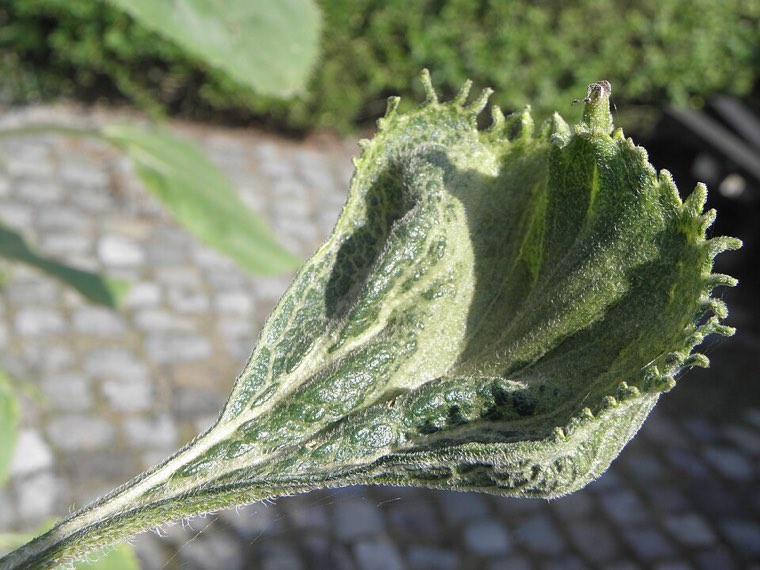
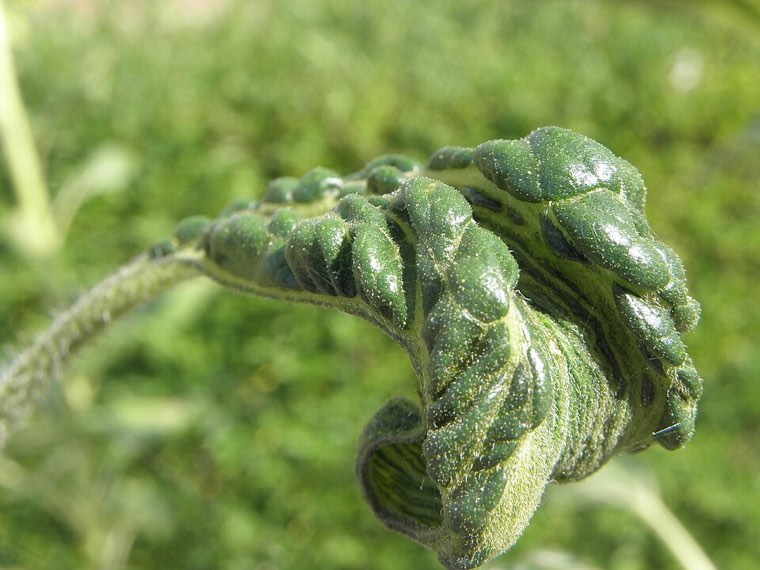
| Seedling to early bud (systemic infection) | Plants are stunted with short internodes. Leaves are thick and curled, with light green to yellow bleaching that starts along the main veins; in humid weather a white downy growth forms on the lower leaf surface and cotyledons. |
| Flowering | Systemically infected plants that survive stay very short, often only 15-60 cm tall; their small heads are held flat, facing the sky, and produce little or no viable seed. |
| Older plants (local infection) | Wind-borne spores can cause small angular leaf spots or basal stem galls on older plants; these rarely reduce yield. |
Disease cycle of sunflower downy mildew
Oospores in the soil germinate in spring and produce sporangia that release zoospores. When the soil is wet, the zoospores swim to the roots and hypocotyl of germinating sunflower seedlings and infect them. Infection is most efficient in the first five days after the seed germinates and is possible until about the four-leaf stage. The pathogen then grows systemically through the plant. In cool, humid weather it sporulates on leaves and the spores spread by wind and rain splash to cause new, mostly local, infections. Oospores form in infected tissue, return to the soil and can also be carried in seed.
| Stage | Duration | Notes |
|---|---|---|
| Oospores in soil and seed | Survive many years in soil | Main source of primary infection. |
| Zoospore infection of roots and hypocotyl | First 5 days after germination is most efficient; possible up to about 2-3 weeks | Needs free water in the soil. |
| Systemic colonisation | 1-3 weeks to visible symptoms | Stunting and vein bleaching. |
| Sporulation on leaves and secondary spread | Overnight in high humidity; sporulates readily at 18-20 °C in the laboratory | Wind and rain splash. |
| Oospore formation in roots and stems | Late season | Returns to soil with crop debris. |
Temperature
Primary root infection needs saturated soil soon after sowing; cool, wet conditions in the week after planting give the most infection. Sporulation needs very high humidity and is abundant around 18-20 °C.
Generations
One soil-borne primary cycle per crop, followed by a few secondary leaf cycles in humid weather.
Conditions that favour it
Heavy rain or irrigation within about a week of sowing, waterlogged or poorly drained soils, short rotations with sunflower, infested volunteer and wild sunflowers, and sowing infected seed or hybrids whose resistance has been overcome by local races.
Economic threshold level (ETL)
There is no numeric economic threshold; once seedlings are infected the damage cannot be reversed. Control decisions are made before sowing, based on the field's history, the races known in the area and the resistance of the chosen hybrid.
Thresholds are local. They depend on crop price, control cost, variety and natural-enemy activity, so use the figure your local extension service publishes where one exists.
Damage and yield loss from sunflower downy mildew
Systemically infected plants yield little or no seed, so loss is close to the percentage of infected plants. Under current control methods the disease costs an estimated 3.5 % of global production, but losses in heavily contaminated fields can approach 100 %, and some fields have been taken out of sunflower altogether. Neighbouring healthy plants partly compensate by producing larger heads, so the loss in a field depends on how many plants are infected and how they are spread; patches in low, wet spots often look as if they had never been sown and fill with weeds.
Monitoring
- Count stunted, bleached seedlings in several 10-metre lengths of row at the 2-8 leaf stage, especially in low, wet parts of the field.
- Turn leaves over on humid mornings to look for the white downy growth that confirms the disease.
- Send samples from fields where resistant hybrids are infected to a laboratory for race testing, because this shows that local races have changed.
- Record the history of each field and the races identified, to guide hybrid choice in future seasons.
How to control sunflower downy mildew (integrated management)
Control works best as a sequence: prevent, monitor, then act only when a threshold or a risk forecast says so, using the least disruptive option that works.
Cultural control
- Rotate so that sunflower is grown in the same field no more than once every four to five years; rotation alone does not eliminate the long-lived oospores but reduces inoculum build-up.
- Control volunteer sunflowers and wild Helianthus near fields.
- Avoid sowing just before heavy rain or irrigating heavily soon after sowing; improve drainage of wet spots.
- Use certified seed, because infected seed can carry new races into a region.
Biological control
- No biological control is in practical use.
Host resistance
- Dominant Pl resistance genes are the main control; more than 20 have been described, but most have been overcome by new races within a few years of wide use. Combining several Pl genes and adding quantitative resistance is the current breeding strategy.
Chemical control of sunflower downy mildew — by mode-of-action group only
Seed treatment is the only practical chemical control, and it works only where local races are sensitive. What is registered differs by country and changes over time; follow the label and your local plant-protection authority.
| Scheme | Group | Mode of action | Notes |
|---|---|---|---|
| FRAC | 4 | Phenylamides (PA) | Seed treatment; resistant races are widespread in North America and Europe since the late 1990s. |
| FRAC | 49 | Oxysterol binding protein homologue inhibitors (OSBPI) | Seed treatment; very effective in field trials, medium-high resistance risk. |
| FRAC | 11 | Quinone outside inhibitors (QoI, strobilurins) | Used in some seed-treatment packages. |
Resistance management
- Do not rely on a single seed-treatment group; combine groups with different modes of action and use resistant hybrids.
- Rotate hybrids with different Pl genes and avoid growing the same resistance in the same field year after year, which selects for new races.
Look-alikes and how to tell them apart
- Nitrogen or sulphur deficiency — Yellowing is uniform or starts on older or younger leaves, plants are not severely dwarfed, and there is no white growth under the leaves.
- Herbicide injury — Follows sprayer passes or drift patterns, leaves may be cupped or strapped, and no downy growth appears.
- Sclerotinia white mould — Causes wilting with tan stem lesions and black sclerotia in the stem or head, not dwarfing with vein bleaching.
Host range
Cultivated and wild annual sunflowers (Helianthus annuus and other annual Helianthus species) are the main hosts. It has also been reported on some other plants of the daisy family, such as Bidens, Xanthium and Artemisia species, which may keep inoculum alive near fields.
What is still uncertain
- The number of races differs between counts and countries; at least 36 pathotypes have been described worldwide and new ones continue to appear.
- How long oospores survive in different soils is not well measured; grower guides quote figures of up to ten years.
- The role of wild daisy-family hosts as inoculum sources is uncertain.
Grow guides for its host crops
How to grow the crop well is the first line of defence. Laisha's free grow guides cover each crop from sowing to harvest:
Sources
- Plasmopara halstedii (downy mildew of sunflower) datasheet — CABI Compendium. https://doi.org/10.1079/cabicompendium.41911
- Plasmopara halstedii (PLASHA) — EPPO Global Database. https://gd.eppo.int/taxon/PLASHA
- The sunflower downy mildew pathogen Plasmopara halstedii — Molecular Plant Pathology (PMC). https://pmc.ncbi.nlm.nih.gov/articles/PMC6638465/
- Downy mildew — National Sunflower Association. https://sunflowernsa.com/growers/diseases/downy-milldew/
- FRAC Code List — FRAC. https://www.frac.info/fungicide-resistance-management/by-frac-mode-of-action-group
Written by Laisha from the sources above, in its own words. This page is general reference, not a prescription: confirm identification locally and follow the label and your plant-protection authority.