 Laisha
AI Operating System for Agriculture
Ask Laisha
Laisha
AI Operating System for Agriculture
Ask Laisha
Leptosphaeria maculans Leptosphaeria maculans (Desm.) Ces. & De Not., 1863 (asexual stage Plenodomus lingam) · formerly or also: Plenodomus lingam, Phoma lingam
Blackleg, or Phoma stem canker, is the most important disease of oilseed rape (canola) in Europe, Australia and Canada. The fungus first causes pale leaf spots dotted with tiny black fruiting bodies, then grows inside the leaf stalk to the stem base, where it forms a dark canker that girdles the stem. Plants lodge or ripen early, and yields fall. A related, less damaging species, Leptosphaeria biglobosa, causes similar symptoms and is the main species in China.
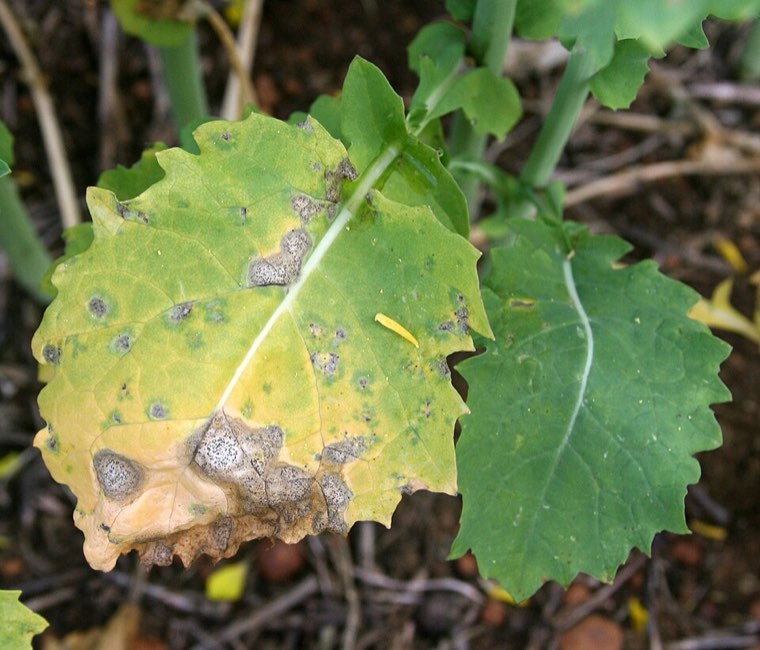
Blackleg of canola is caused by Leptosphaeria maculans Leptosphaeria maculans (Desm.) Ces. & De Not., 1863 (asexual stage Plenodomus lingam), a fungus (ascomycete) (order Pleosporales, family Leptosphaeriaceae).
Older or alternative scientific names: Plenodomus lingam, Phoma lingam.
Found wherever oilseed rape and other brassicas are grown, with the aggressive L. maculans dominant in Europe, Australia and North America, and L. biglobosa more common in parts of Asia.
| Region | Status |
|---|---|
| Europe | Widespread; major in oilseed rape |
| Oceania | Widespread; major in Australian canola |
| North America | Widespread in Canadian and US canola |
| Asia | Mainly L. biglobosa; L. maculans is regulated in some countries |
A fungus that forms pycnidia (asexual fruiting bodies) in leaf lesions and stem cankers, and pseudothecia (sexual fruiting bodies) on crop stubble. Ascospores from stubble are blown long distances and start new infections. Populations carry different avirulence genes, which determine which resistance genes in the crop are effective. Seed-borne infection is one route by which the aggressive species has reached new regions, so seed is regulated in some countries.
| Crop stage | What you see |
|---|---|
| Cotyledons and leaves | Round pale grey to off-white lesions with many tiny black pycnidia; lesions of L. biglobosa are smaller and darker with fewer pycnidia. |
| Stem base (crown) | Dark brown to black canker at the stem base, often with a purple margin; stem girdled and cracked; inside the stem, dark discoloured tissue. |
| Late season | Lodging and premature ripening; upper stem lesions and pod lesions in some seasons. |
The fungus survives on infected stubble for several years. Ascospores released from stubble infect cotyledons and young leaves. The fungus then grows without symptoms down the leaf stalk into the stem and forms a canker at the stem base. It also survives and spreads in infected seed.
| Stage | Duration | Notes |
|---|---|---|
| Survival on stubble | Two to four years | Pseudothecia release ascospores. |
| Leaf infection | Seedling to rosette stage | After rain. |
| Symptomless growth to the stem | Weeks to months | Down the leaf stalk. |
| Stem canker | Late season | Causes yield loss. |
Ascospore release and leaf infection follow rain; warmer temperatures speed the growth from leaf to stem.
One main cycle per crop, with spores released over many weeks.
Short rotations with canola, nearby stubble from the previous season, early infection of seedlings after rain, susceptible varieties or varieties whose resistance genes have been overcome.
There is no numeric economic threshold; management decisions use variety resistance ratings, rotation history, distance from last year's stubble and regional risk forecasts.
Thresholds are local. They depend on crop price, control cost, variety and natural-enemy activity, so use the figure your local extension service publishes where one exists.
Stem cankers reduce yield and cause lodging; severe epidemics have caused large losses in Australia, Europe and Canada, especially when widely grown resistance genes were overcome. The main yield loss comes from stem cankers that restrict water flow during pod filling.
Control works best as a sequence: prevent, monitor, then act only when a threshold or a risk forecast says so, using the least disruptive option that works.
Fungicide seed treatments, in-furrow treatments and early foliar sprays reduce leaf infection in high-risk situations. What is registered differs by country and changes over time; follow the label and your local plant-protection authority.
| Scheme | Group | Mode of action | Notes |
|---|---|---|---|
| FRAC | 3 | Demethylation inhibitors (DMI) | Seed, in-furrow and foliar uses. |
| FRAC | 7 | Succinate dehydrogenase inhibitors (SDHI) | Foliar, often in mixtures. |
| FRAC | 11 | Quinone outside inhibitors (QoI) | Use in mixtures. |
Oilseed rape and canola (Brassica napus and B. rapa), mustards, cabbage, cauliflower, broccoli, kale, turnip and other crucifers.
How to grow the crop well is the first line of defence. Laisha's free grow guides cover each crop from sowing to harvest:
Written by Laisha from the sources above, in its own words. This page is general reference, not a prescription: confirm identification locally and follow the label and your plant-protection authority.