 Laisha
AI Operating System for Agriculture
Ask Laisha
Laisha
AI Operating System for Agriculture
Ask Laisha
Lipaphis erysimi Lipaphis erysimi (Kaltenbach, 1843) · formerly or also: Lipaphis pseudobrassicae (used by some authors for populations outside Europe)
The mustard aphid is a small grey-green aphid with a waxy coating that forms dense colonies on the flowering shoots, pods and stems of rapeseed, mustard, cabbage, radish, turnip and other crucifers. It is the most important pest of rapeseed-mustard in South Asia, where heavy colonies on the inflorescence stop flowering and pod set and greatly reduce seed yield and oil content. It also spreads several plant viruses.
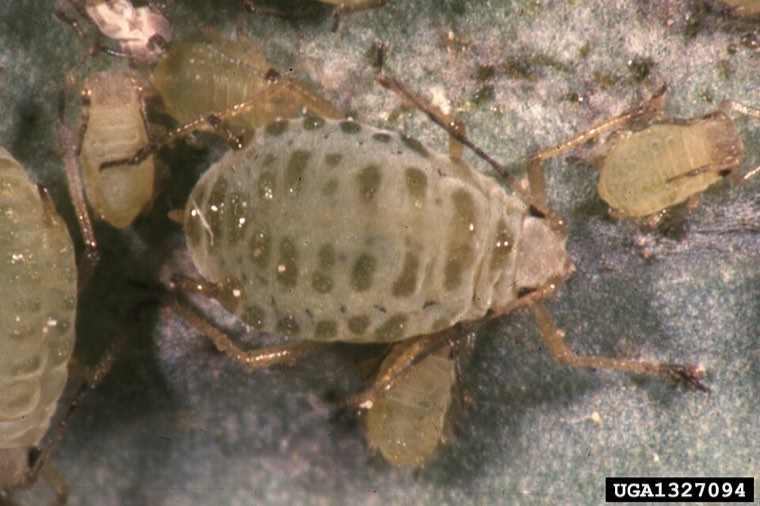
The scientific name of mustard aphid is Lipaphis erysimi Lipaphis erysimi (Kaltenbach, 1843), in the order Hemiptera, family Aphididae.
Older or alternative scientific names: Lipaphis pseudobrassicae (used by some authors for populations outside Europe).
Found worldwide; a key pest of rapeseed-mustard in South Asia and of crucifers in East Asia, Africa and the Americas.
| Region | Status |
|---|---|
| South Asia | Widespread; key pest of rapeseed-mustard |
| East and South-East Asia | Widespread |
| Africa and the Middle East | Present |
| Americas, Europe and Oceania | Present |
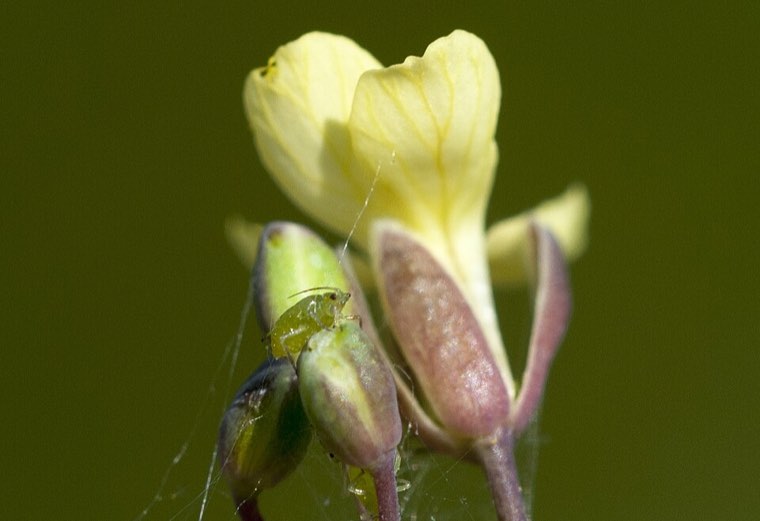
Wingless adults are about 1.5-2.5 mm long, olive to greyish-green with a light dusting of white wax and dark bands or patches on the back; cornicles are short and dark-tipped. Winged adults have a dark head and thorax. Colonies are almost all female and multiply by live birth. Aphids that settle on the flowering shoot tip are the most damaging, which is why monitoring focuses on the top 10 cm of the main shoot.
| Crop stage | What you see |
|---|---|
| Vegetative stage | Colonies on the undersides of leaves; curling and yellowing of leaves. |
| Flowering | Dense grey-green colonies covering flower stalks and buds; flowers drop and the inflorescence stops growing. |
| Pod stage | Colonies on pods and stems; small, shrivelled pods with few seeds; honeydew and sooty mould. |
In South Asia the aphid breeds without mating on cruciferous crops during the cool season, with a generation taking about a week to ten days. Numbers rise sharply in cool, cloudy, humid weather around flowering, and winged forms spread to new fields. Populations fall as temperatures rise and crops mature, and survive the hot season at low levels on other hosts or at higher altitudes.
| Stage | Duration | Notes |
|---|---|---|
| Nymph (4 instars) | About 5-10 days | Faster in mild weather. |
| Wingless adult female | About 2-3 weeks | Gives birth to many young. |
| Winged adult | When crowded | Spreads to new fields. |
Populations build up fastest at about 15-25 °C, with cloudy, humid weather; heavy rain and high temperatures reduce them.
Many generations during the cool season.
Late sowing, cool and cloudy weather with high humidity during flowering, heavy nitrogen fertilisation, and loss of natural enemies after broad-spectrum sprays.
There is no single international threshold. South Asian programmes use action levels based on aphids per main shoot tip or the share of infested plants, which differ between states; check with your local extension service.
Thresholds are local. They depend on crop price, control cost, variety and natural-enemy activity, so use the figure your local extension service publishes where one exists.
Avoidable seed-yield losses of about a quarter were measured in unprotected Indian mustard in a two-season field study in Haryana (about 26%), and losses are heavier in late-sown crops and severe outbreaks; seed weight and quality also fall.
Control works best as a sequence: prevent, monitor, then act only when a threshold or a risk forecast says so, using the least disruptive option that works.
Sprays are applied when local thresholds are reached around flowering, preferably in the afternoon when bees are less active. What is registered differs by country and changes over time; follow the label and your local plant-protection authority.
| Scheme | Group | Mode of action | Notes |
|---|---|---|---|
| IRAC | 4A | Nicotinic acetylcholine receptor competitive modulators (neonicotinoids) | Toxic to bees; avoid spraying in full bloom. |
| IRAC | 9B | Chordotonal organ TRPV channel modulators | Feeding inhibitor. |
| IRAC | 29 | Chordotonal organ modulators, undefined target site | Selective. |
Plants of the cabbage family, including Indian mustard, rapeseed, toria, cabbage, cauliflower, radish, turnip and cruciferous weeds.
How to grow the crop well is the first line of defence. Laisha's free grow guides cover each crop from sowing to harvest:
Written by Laisha from the sources above, in its own words. This page is general reference, not a prescription: confirm identification locally and follow the label and your plant-protection authority.