 Laisha
AI Operating System for Agriculture
Ask Laisha
Laisha
AI Operating System for Agriculture
Ask Laisha
Plutella xylostella (Linnaeus, 1758) · formerly or also: Plutella maculipennis
The most destructive insect of cabbage, cauliflower, broccoli, mustard and other brassicas worldwide. Its small green caterpillars eat holes in leaves and bore into heads, and it breeds so fast and has been sprayed so often that it was the first crop pest to resist Bacillus thuringiensis in the field and has resisted almost every insecticide group used against it. Natural enemies and careful use of selective groups are the basis of control.
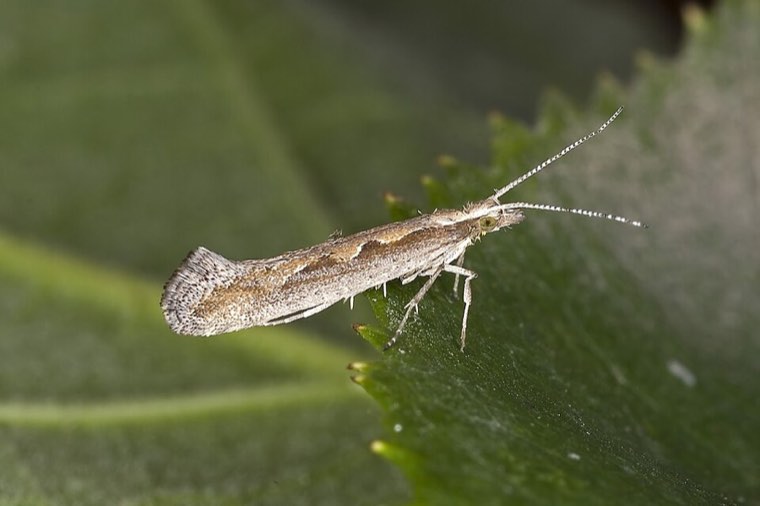
The scientific name of diamondback moth is Plutella xylostella (Linnaeus, 1758), in the order Lepidoptera, family Plutellidae.
Older or alternative scientific names: Plutella maculipennis.
Found wherever brassicas grow, on every inhabited continent; probably the most widely distributed lepidopteran pest. It breeds year-round in the tropics and subtropics and migrates long distances into cooler regions each spring, where it may not survive winter.
| Region | Status |
|---|---|
| South and Southeast Asia | Widespread; most severe in highland and lowland year-round brassica production |
| East Asia | Widespread; migrant in the north |
| Africa | Widespread in vegetable and canola production |
| Americas | Widespread; migrant into northern areas |
| Europe | Widespread; periodic mass immigration in north-western Europe |
| Oceania | Widespread; pest of canola and vegetables |
Eggs are tiny, oval, pale yellow and laid singly or in small groups along leaf veins. Larvae are pale to bright green, up to about 1 cm long, tapered at both ends, with a pair of prolegs at the rear forming a V; when disturbed they wriggle violently backwards and drop on a silk thread. Pupae lie in a loose, open-mesh white cocoon on the leaf. The moth is slender, grey-brown, about 6-8 mm long; at rest the males show a row of pale diamond shapes along the back where the wings meet.
| Crop stage | What you see |
|---|---|
| Seedling | First instars mine inside the leaf; later 'windows' of transparent epidermis; growing points of seedlings may be destroyed. |
| Vegetative (before heading or cupping) | Irregular holes and windowpanes on outer leaves; larvae and cocoons on leaf undersides. |
| Heading, curd or pod stage | Larvae and frass inside cabbage heads and broccoli or cauliflower florets; contamination makes produce unsaleable; in canola, damage to flowers and pods. |
Females lay 150-300 eggs. Larvae pass through four instars; the first mines the leaf and the rest feed on the surface, mainly on the underside. The whole cycle can be as short as two weeks in hot weather, which, combined with constant spraying, explains how quickly resistance appears.
| Stage | Duration | Notes |
|---|---|---|
| Egg | About 3-6 days at 20-25 °C | Along leaf veins, mostly on the underside. |
| Larva (4 instars) | About 8-14 days at 20-25 °C | First instar mines inside the leaf. |
| Pupa in cocoon | About 5-10 days | Open-mesh cocoon on the leaf. |
| Adult moth | About 1-3 weeks | Weak flier but carried long distances by wind. |
Development runs from a lower threshold of about 7-8 °C to an upper limit near 32-35 °C; a generation takes about 14-21 days at 25 °C and over 6 weeks in cool weather. There is no diapause.
Up to about 20 generations a year in the tropics; 4-6 in temperate regions.
Dry, warm weather (heavy rain washes larvae off and drowns them), continuous brassica production with overlapping plantings, infested transplants, and broad-spectrum sprays that destroy parasitoids.
Thresholds use the percentage of plants with larvae, and are higher before heading or cupping, when outer leaves can be lost without yield loss, than afterwards, when larvae contaminate the marketable part. Values come from a few regions and should be adapted locally.
| Crop | Threshold | Unit | Crop stage | Region | Source |
|---|---|---|---|---|---|
| Cabbage | 50% of plants with 5 or more larvae each | % of plants infested | Before cupping | North America (Upper Midwest) | Pacific Northwest Insect Management Handbook (citing University of Minnesota thresholds) |
| Cabbage | 10% of plants with 1 or more larvae | % of plants infested | After cupping to harvest | North America (Upper Midwest) | Pacific Northwest Insect Management Handbook (citing University of Minnesota thresholds) |
| Cabbage | About 51% of plants infested (0.5-0.8 larvae per plant) | % of plants; larvae per plant | Winter-spring crop | Southern Africa | Journal of Economic Entomology (2023), sampling plans for diamondback moth in cabbage |
Thresholds are local. They depend on crop price, control cost, variety and natural-enemy activity, so use the figure your local extension service publishes where one exists.
Feeding reduces head weight and quality, and larvae, pupae and frass in heads and florets cause rejection by markets. In tropical and subtropical regions, losses of 50-90% have been reported in unprotected crops, and the pest is estimated to cost several billion US dollars a year worldwide in losses and control.
Control works best as a sequence: prevent, monitor, then act only when a threshold or a risk forecast says so, using the least disruptive option that works.
Use only when thresholds are exceeded and choose groups that spare parasitoids. Never use the same group on consecutive generations. What is registered differs by country and changes over time; follow the label and your local plant-protection authority.
| Scheme | Group | Mode of action | Notes |
|---|---|---|---|
| IRAC | 11A | Microbial disruptors of insect midgut membranes (Bacillus thuringiensis) | Selective; resistance documented in some populations. |
| IRAC | 5 | Nicotinic acetylcholine receptor allosteric modulators, site I (spinosyns) | Resistance documented in parts of Asia. |
| IRAC | 28 | Ryanodine receptor modulators (diamides) | High-level resistance documented in Asia and the Americas. |
| IRAC | 22A | Voltage-dependent sodium channel blockers (oxadiazines) | Larvicide. |
| IRAC | 6 | Glutamate-gated chloride channel allosteric modulators (avermectins) | Larvicide. |
| IRAC | 15 | Inhibitors of chitin biosynthesis, CHS1 (benzoylureas) | Acts on larvae at moulting. |
Restricted to plants of the cabbage family (Brassicaceae) and a few related families that contain glucosinolates: cabbage, cauliflower, broccoli, kale, Brussels sprouts, Chinese cabbage, mustards, oilseed rape and canola, radish, turnip and cruciferous weeds.
How to grow the crop well is the first line of defence. Laisha's free grow guides cover each crop from sowing to harvest:
Written by Laisha from the sources above, in its own words. This page is general reference, not a prescription: confirm identification locally and follow the label and your plant-protection authority.