 Laisha
AI Operating System for Agriculture
Ask Laisha
Laisha
AI Operating System for Agriculture
Ask Laisha
Frankliniella occidentalis (Pergande, 1895)
A thrips barely visible to the eye that lives in flowers and young leaves of vegetables, fruit and ornamentals. It scars fruit and petals and, more importantly, spreads tomato spotted wilt virus and related tospoviruses. Since the 1980s it has been carried around the world on ornamental plants and is now one of the hardest greenhouse pests to control, because it hides in flowers and in the soil and resists many insecticides.
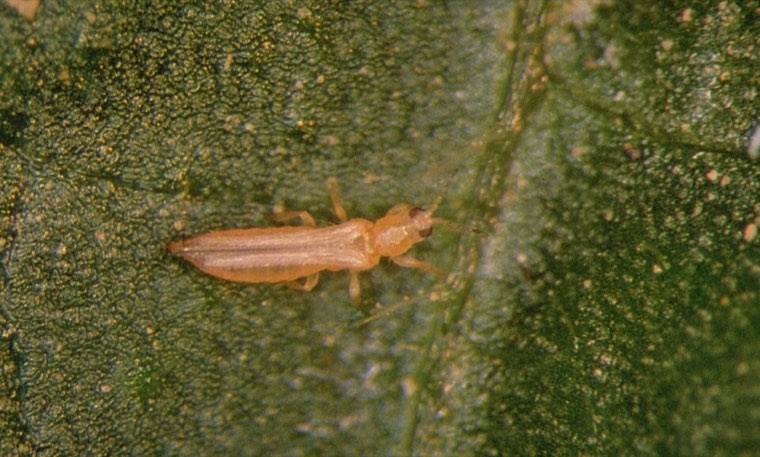
The scientific name of Western flower thrips is Frankliniella occidentalis (Pergande, 1895), in the order Thysanoptera, family Thripidae.
Native to western North America. From the late 1970s it spread with the international trade in ornamental cuttings and is now present on every continent, outdoors in warm regions and in greenhouses almost everywhere.
| Region | Status |
|---|---|
| North America | Native to western North America; widespread elsewhere |
| Europe | Invasive since the 1980s; key greenhouse pest; outdoors in the south |
| Mediterranean and Middle East | Widespread in protected and open-field vegetables |
| East and South Asia | Invasive since the 2000s in several countries; spreading |
| Africa | Present in horticultural production in several regions |
| Latin America and Oceania | Widespread |
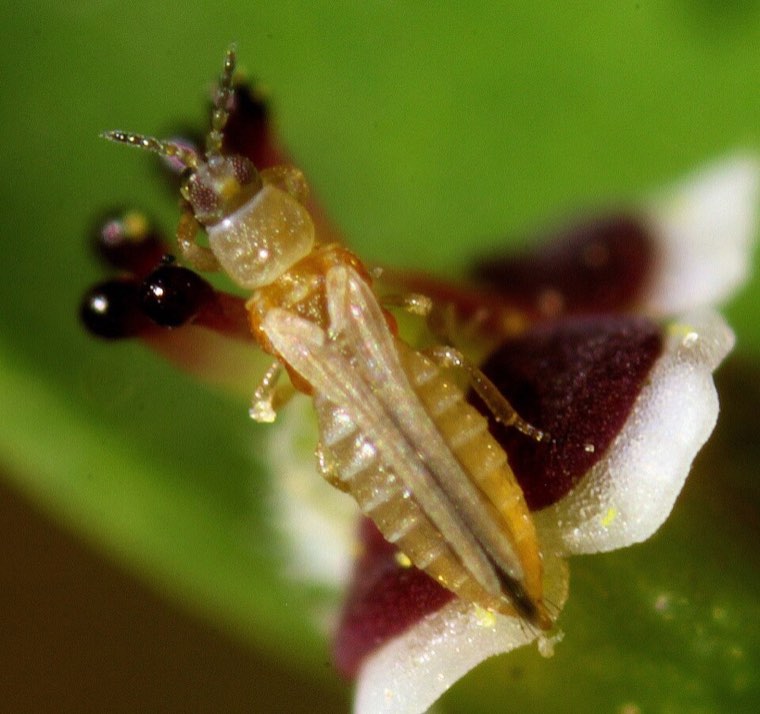
Adults are 1-2 mm long, slender, with two pairs of narrow wings fringed with long hairs; females vary from pale yellow to dark brown, males are smaller and pale. Larvae are wingless, pale yellow to white. Under a hand lens, a pair of long bristles on the front corners of the thorax and a comb on the eighth abdominal segment separate it from many other thrips, but reliable identification needs a microscope.
| Crop stage | What you see |
|---|---|
| Seedling and young plants | Silvery or bronzed patches with tiny black specks of excrement on leaves; distorted young leaves; early tospovirus symptoms (bronzing, ring spots, stunting). |
| Flowering | Thrips in flowers; streaked, deformed petals; flower and bud drop in some crops. |
| Fruit set and development | Scarring and russeting of fruit (for example around the calyx in pepper and strawberry); halo spots on tomato fruit where eggs were laid; ring spots and uneven ripening from virus. |
Females insert eggs into leaves, flowers and fruit. The two larval stages feed on the plant; the prepupa and pupa do not feed and usually drop to the soil or growing medium, or stay deep in flowers. Unmated females produce males only. Tospoviruses are picked up only by larvae and transmitted by the adults they become, for life.
| Stage | Duration | Notes |
|---|---|---|
| Egg (inside plant tissue) | About 3-5 days at 25 °C | Protected from sprays. |
| Larva (2 instars) | About 4-7 days at 25 °C | Acquires tospovirus from infected plants. |
| Prepupa and pupa | About 4-6 days at 25 °C | In soil, growing medium or flowers; non-feeding. |
| Adult | About 3-6 weeks | Females lay 40-100 or more eggs; transmit virus. |
Egg to adult takes about 2 weeks at 25-30 °C and nearly 6 weeks at 15 °C; development stops below about 9-10 °C. Populations explode in warm greenhouses and dry, warm field seasons.
Continuous generations year-round in greenhouses (15 or more); fewer outdoors in temperate regions, where adults overwinter in sheltered places.
Warm, dry conditions; continuous flowering crops and ornamentals; weeds that flower around greenhouses; movement of infested cuttings and transplants; and broad-spectrum sprays that remove predatory bugs and mites.
There is no general numeric economic threshold. In crops at risk of tospoviruses, very low thrips numbers can cause serious loss, so prevention starts before planting. In other crops, growers use local action levels based on sticky-card counts or thrips per flower, which differ widely by crop, market and region.
Thresholds are local. They depend on crop price, control cost, variety and natural-enemy activity, so use the figure your local extension service publishes where one exists.
Feeding scars reduce the market value of fruit and flowers, and heavy infestation reduces yield. Tomato spotted wilt virus, which this thrips is the main vector of, has caused losses of 50-90% in tomato, pepper, lettuce and groundnut in outbreak seasons in several regions, and is one of the most damaging plant viruses worldwide.
Control works best as a sequence: prevent, monitor, then act only when a threshold or a risk forecast says so, using the least disruptive option that works.
Thrips are hard to reach in flowers and as eggs inside tissue, and resistance develops fast, so sprays must be timed and rotated and should be compatible with biological control. What is registered differs by country and changes over time; follow the label and your local plant-protection authority.
| Scheme | Group | Mode of action | Notes |
|---|---|---|---|
| IRAC | 5 | Nicotinic acetylcholine receptor allosteric modulators, site I (spinosyns) | Widely used; resistance documented in several regions. |
| IRAC | 6 | Glutamate-gated chloride channel allosteric modulators (avermectins) | Used on larvae. |
| IRAC | 13 | Uncouplers of oxidative phosphorylation via disruption of the proton gradient | Used in some greenhouse programmes. |
| IRAC | 28 | Ryanodine receptor modulators (diamides, some members) | Systemic uses suppress thrips in some crops. |
Recorded on more than 250 plant species in over 60 families: sweet and hot pepper, tomato, cucumber, melon, eggplant, strawberry, lettuce, beans, groundnut, stone fruit and grapes in some regions, and many ornamentals such as chrysanthemum, rose and gerbera.
How to grow the crop well is the first line of defence. Laisha's free grow guides cover each crop from sowing to harvest:
Written by Laisha from the sources above, in its own words. This page is general reference, not a prescription: confirm identification locally and follow the label and your plant-protection authority.