 Laisha
AI Operating System for Agriculture
Ask Laisha
Laisha
AI Operating System for Agriculture
Ask Laisha
Zeugodacus cucurbitae (Coquillett, 1899) · formerly or also: Bactrocera cucurbitae, Dacus cucurbitae
A fruit fly whose maggots rot the young fruit of bitter gourd, cucumber, melon, pumpkin and other cucurbits. It is the most damaging pest of cucurbit vegetables in much of tropical Asia and Africa, often destroying a third or more of the harvest. Collecting infested fruit, protein baits and male lures are the basis of control.
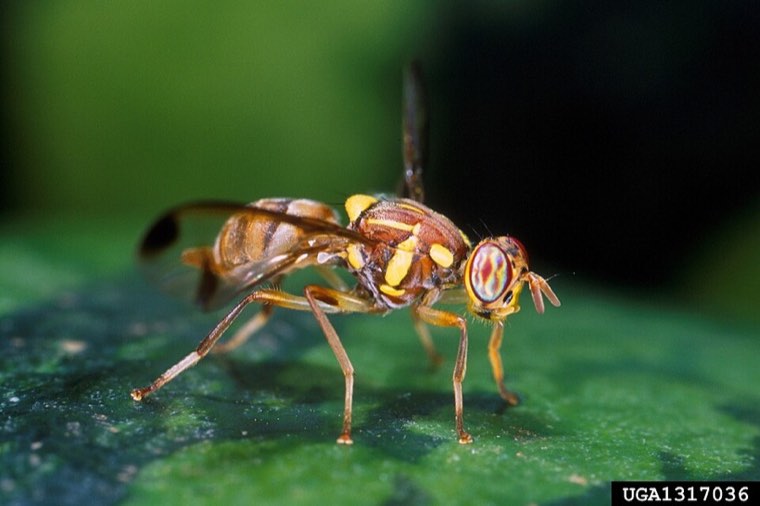
The scientific name of melon fly is Zeugodacus cucurbitae (Coquillett, 1899), in the order Diptera, family Tephritidae.
Older or alternative scientific names: Bactrocera cucurbitae, Dacus cucurbitae.
Probably native to South Asia, it is widespread across tropical and subtropical Asia, much of sub-Saharan Africa and the Indian Ocean islands, Hawaii and several Pacific islands. It is a quarantine pest elsewhere, and outbreaks in some Pacific islands and in Japan's southern islands were eradicated with sterile flies.
| Region | Status |
|---|---|
| South and Southeast Asia | Native or long established; key cucurbit pest |
| East Asia | Present in the south; eradicated from Japan's Okinawa islands (1993) |
| Sub-Saharan Africa | Widespread in cucurbit-growing areas |
| Pacific and Indian Ocean islands | Established in Hawaii and several island groups |
| Europe and the Americas | Absent; quarantine pest |
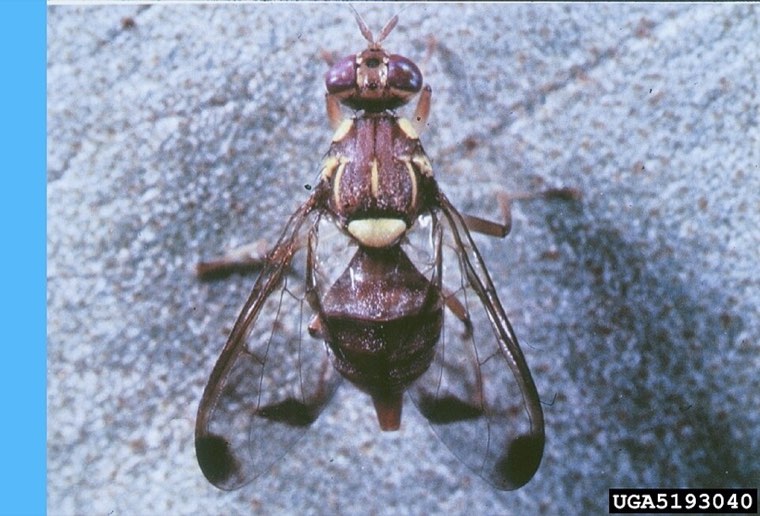
Adults are about 7-8 mm long, reddish-brown with yellow markings on the thorax. The wings are distinctive: a broad dark band runs along the front edge to a dark spot at the tip, with a dark mark across the middle of the wing and a dark streak near its base. Larvae are cream-coloured legless maggots up to about 10 mm, which leave fruit and jump.
| Crop stage | What you see |
|---|---|
| Flowering and fruit set | Females sting flowers and very young fruit; stung young fruit become distorted, shrivel and drop. |
| Fruit development | Brownish sting marks with resin-like exudate; soft, water-soaked areas; maggots and rot inside when fruit is cut. |
| Mature fruit | Fruit collapses and rots on the vine or after harvest; occasionally maggots in stems and roots of some hosts. |
Females prefer young, tender fruit and lay clutches of eggs into the flesh, up to about 1,000 eggs in a life of several months. Larvae feed inside the fruit for a few days to two weeks, then leave and pupate in the soil under the plants. Adults rest on surrounding tall vegetation and visit the crop to feed and lay.
| Stage | Duration | Notes |
|---|---|---|
| Egg | About 1-2 days at 25-30 °C | In young fruit, flowers or stems. |
| Larva (3 instars) | About 4-10 days at 25-30 °C | Longer in cool weather or hard fruit. |
| Pupa in soil | About 7-13 days | Near the base of host plants. |
| Adult | Several months; egg laying begins after about 1-2 weeks | Males strongly attracted to the lure cue-lure. |
Development is fastest at about 25-30 °C; a generation then takes about 3-5 weeks. Development slows greatly below about 15 °C. Hot, humid weather in the rainy season gives the highest populations.
Up to 8-10 overlapping generations a year in the tropics.
Warm, humid weather; continuous or staggered cucurbit planting; fallen and culled fruit left in the field; tall maize or hedges near fields that provide adult resting sites.
There is no practical numeric economic threshold: any maggot-infested fruit is lost, so management is preventive from flowering. Male-lure trap catches indicate population pressure and the success of area-wide control, and in free areas any detection triggers official measures.
Thresholds are local. They depend on crop price, control cost, variety and natural-enemy activity, so use the figure your local extension service publishes where one exists.
Losses of 30-100% of cucurbit fruit have been reported in South Asia, Southeast Asia and Africa, depending on crop and season; bitter gourd, cucumber and melon are among the most affected. Quarantine restrictions also limit exports of cucurbits from infested areas.
Control works best as a sequence: prevent, monitor, then act only when a threshold or a risk forecast says so, using the least disruptive option that works.
Full-cover insecticide sprays are inefficient against this pest; bait sprays to adult resting sites and male-annihilation stations are preferred. What is registered differs by country and changes over time; follow the label and your local plant-protection authority.
| Scheme | Group | Mode of action | Notes |
|---|---|---|---|
| IRAC | 5 | Nicotinic acetylcholine receptor allosteric modulators, site I (spinosyns) | Used in protein bait formulations. |
| IRAC | 3A | Sodium channel modulators (pyrethroids) | Used with lures in male-annihilation devices in some programmes. |
| IRAC | 1B | Acetylcholinesterase inhibitors (organophosphates) | Historically used; restricted in many countries. |
Recorded from more than 100 plants, mostly in the cucurbit family: bitter gourd, cucumber, melon, watermelon, pumpkin and squash, ridge and sponge gourds, bottle gourd, snake gourd, ivy gourd and chayote. Tomato, beans, papaya and some other fruits are minor hosts.
How to grow the crop well is the first line of defence. Laisha's free grow guides cover each crop from sowing to harvest:
Written by Laisha from the sources above, in its own words. This page is general reference, not a prescription: confirm identification locally and follow the label and your plant-protection authority.