Purple blotch of onion
Alternaria porri (Ellis) Cif. · formerly or also: Macrosporium porri
- mancha púrpura de la cebolla · Spanish, Latin America and Spain
- taches pourpres de l'oignon · French, France and Francophone Africa
- बैंगनी धब्बा (baingani dhabba) · Hindi, South Asia
- Purpurfleckenkrankheit · German, Central Europe
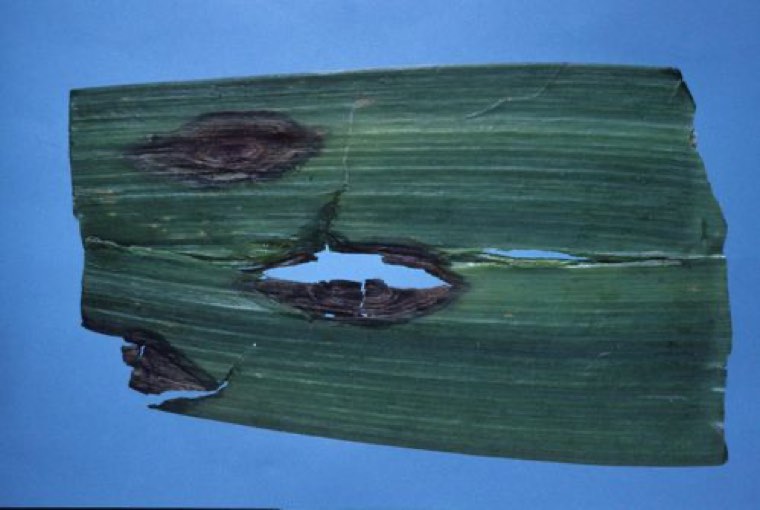
Purple blotch is a leaf disease of onion, garlic, leek and shallot that produces sunken, purple-brown blotches with pale rings on leaves and flower stalks. Leaves above large blotches collapse, so bulbs are smaller, and the fungus can also rot bulbs at the neck after harvest. It is most damaging in warm, humid regions and in seasons with heavy dew, and it is often worse on leaves already damaged by thrips.
- Type
- Fungal disease · Fungus (leaf-spotting mould)
- Classification
- Fungi › Dothideomycetes › Pleosporales › Pleosporaceae
- Main crops
- Onion & shallot, Garlic, Leek, Spring onion
- Found in
- South and South-east Asia, Pacific Islands, Sub-Saharan Africa, The Americas, Europe and the Mediterranean
- Chemical groups
- FRAC M03, FRAC M05, FRAC 3, FRAC 7, FRAC 11 (mode-of-action groups, not products)
- Last reviewed
- 2026-10-20
What causes purple blotch of onion?
Purple blotch of onion is caused by Alternaria porri (Ellis) Cif., a fungus (leaf-spotting mould) (order Pleosporales, family Pleosporaceae).
Older or alternative scientific names: Macrosporium porri.
Where it occurs
Found wherever onions are grown, but serious mainly in warm, humid regions and in irrigated crops where dew is heavy. It is one of the commonest onion leaf diseases in the tropics.
| Region | Status |
|---|---|
| South and South-east Asia | Widespread and important on bulb and seed crops |
| Pacific Islands | The most common onion disease in some islands, with losses above 40 % |
| Sub-Saharan Africa | Widespread on onion and shallot |
| The Americas | Common in warm onion-growing areas |
| Europe and the Mediterranean | Present, mainly on leek and in warm, wet summers |
Symptoms and identification of purple blotch of onion
The organism
A fungus that produces large, dark brown, club-shaped spores divided by cross and lengthwise walls and ending in a long beak. The spores form in dark, velvety rings in the centre of the lesions in humid weather and are spread by wind and rain.
Signs in the crop, stage by stage
| Crop stage | What you see |
|---|---|
| Early leaf infection | Small, water-soaked spots with white centres on older leaves, often where thrips have fed. |
| Developing lesions | Spots enlarge into oval, sunken blotches several centimetres long, purple to brown with concentric light and dark rings and a yellow halo; dark spore masses form in the centre when the weather is moist. |
| Advanced disease | Blotches merge or girdle leaves and flower stalks, so the parts above them yellow, fall over and die; leaf tips blacken and hang down. Seed heads on infected stalks may break off. |
| Harvest and storage | A watery, yellow to wine-red rot of the bulb neck and outer scales, starting from infected necks. |
Disease cycle of purple blotch of onion
The fungus survives between crops on infected onion debris in or on the soil and on volunteer and cull onions; seed transmission has been reported but is probably rare. Spores formed on debris are carried by wind and rain splash to onion leaves. They need a film of water to germinate and infect, and older leaves and leaves injured by thrips or other damage are infected most easily. Lesions produce new spores on humid nights, so the disease can spread through a field several times in a season.
| Stage | Duration | Notes |
|---|---|---|
| Survival on debris, volunteers and culls | At least one year on debris | Main source of first infections. |
| Spore germination and infection | About 8 hours or more of leaf wetness | Older and thrips-damaged leaves are most susceptible. |
| Lesion development | A few days to visible spots in warm weather | Spots expand into blotches over one to two weeks. |
| Sporulation and spread | On humid nights; repeated through the season | Wind and rain splash. |
Temperature
Favoured by warm temperatures, roughly 20-30 °C, combined with long periods of leaf wetness from dew, fog, rain or overhead irrigation. Spores form at night when humidity is very high and are released as leaves dry in the morning.
Generations
Many repeating spore cycles in a season while weather is warm and humid.
Conditions that favour it
Warm days with cool nights that give heavy dew, frequent rain or overhead irrigation, dense crops, high thrips populations, excess nitrogen, and onion debris, volunteers or cull piles near the field. Damage is often greater in the dry season with heavy dews than in the wet season.
Economic threshold level (ETL)
There is no published numeric economic threshold. Protective sprays are started when weather favours infection or at the first lesions, and are often combined with thrips control.
Thresholds are local. They depend on crop price, control cost, variety and natural-enemy activity, so use the figure your local extension service publishes where one exists.
Damage and yield loss from purple blotch of onion
Loss of leaf area reduces bulb size and yield, and infection of flower stalks reduces seed yield in seed crops. Reported losses exceed 40 % in onion crops in the Pacific Islands, and in some years severe outbreaks in South-east Asia have caused large reductions in the area planted to onion. Neck and scale rots add post-harvest losses.
Monitoring
- Inspect at least 50 plants across the field weekly, looking at the older leaves for white-centred spots and purple blotches.
- Keep records of dew, rain and leaf-wetness hours; long wet periods in warm weather signal high risk.
- Monitor thrips at the same time, because thrips feeding increases infection.
- Check stored bulbs for neck rot and remove affected ones.
How to control purple blotch of onion (integrated management)
Control works best as a sequence: prevent, monitor, then act only when a threshold or a risk forecast says so, using the least disruptive option that works.
Cultural control
- Use healthy seed and transplants; discard nursery seedlings with leaf spots.
- Rotate so there are at least three years between onion or other Allium crops in the same field.
- Remove or plough in crop debris, cull piles and volunteer onions.
- Use drip or furrow irrigation rather than overhead sprinklers, or irrigate early in the day so leaves dry quickly.
- Avoid excess nitrogen, keep thrips under control, and harvest in dry weather and cure bulbs well before storage.
Biological control
- Antagonists such as Trichoderma species and some Bacillus bacteria have reduced purple blotch in experiments, but are not yet reliable field controls.
Host resistance
- Partial resistance has been reported in some onion and garlic lines; no fully resistant commercial onion is available, and red and yellow types differ in susceptibility between regions.
Chemical control of purple blotch of onion — by mode-of-action group only
Foliar fungicides are applied protectively when the weather favours disease, alternating groups. What is registered differs by country and changes over time; follow the label and your local plant-protection authority.
| Scheme | Group | Mode of action | Notes |
|---|---|---|---|
| FRAC | M03 | Dithiocarbamates and relatives (multi-site) | Protectant. |
| FRAC | M05 | Chloronitriles (multi-site) | Protectant. |
| FRAC | 3 | Demethylation inhibitors (DMI, triazoles) | Systemic. |
| FRAC | 7 | Succinate dehydrogenase inhibitors (SDHI) | Use in mixtures; medium-high resistance risk. |
| FRAC | 11 | Quinone outside inhibitors (QoI) | High resistance risk in Alternaria species. |
Resistance management
- Alternate or mix single-site groups (3, 7, 11) with multi-site protectants and limit the number of applications of each group per season; QoI resistance is common in other Alternaria species.
Look-alikes and how to tell them apart
- Stemphylium leaf blight — Tan to brown, elongated lesions, often at leaf tips, that turn olive-brown to black, without the magenta-purple colour and target rings of purple blotch; the two often occur together.
- Onion downy mildew — Pale, elongated patches with a fine grey-violet fuzz on otherwise green leaves, and no sunken ringed blotches.
- Thrips damage — Silvery streaks and flecks on leaves with thrips visible between the leaves, but no purple blotches.
Host range
Onion, garlic, leek, shallot, Welsh onion and chives, and other cultivated and wild Allium species. It is not a significant pathogen of plants outside the Allium genus.
What is still uncertain
- Some authors treat Alternaria porri and A. allii as the same species; EPPO currently keeps them separate.
- The share of losses due to purple blotch versus Stemphylium leaf blight is hard to separate because the two diseases look alike and often occur together.
- Resistance to single-site fungicide groups in A. porri has not been surveyed in most regions.
Grow guides for its host crops
How to grow the crop well is the first line of defence. Laisha's free grow guides cover each crop from sowing to harvest:
Sources
- Alternaria porri (purple blotch) datasheet — CABI Compendium. https://doi.org/10.1079/cabicompendium.4522
- Alternaria porri (ALTEPO) — EPPO Global Database. https://gd.eppo.int/taxon/ALTEPO
- Onion purple blotch (Fact Sheet 151) — Pacific Pests, Pathogens and Weeds (Lucid). https://apps.lucidcentral.org/pppw_v13/text/web_full/entities/onion_purple_blotch_151.htm
- Purple blotch and Stemphylium leaf blight — Utah State University Extension. https://extension.usu.edu/vegetableguide/onion/purple-blotch-stemphylium-leaf-blight
- Stemphylium leaf blight of onion — Cornell University (Vegetables). https://www.vegetables.cornell.edu/?p=4529
Written by Laisha from the sources above, in its own words. This page is general reference, not a prescription: confirm identification locally and follow the label and your plant-protection authority.