Dodder (field dodder and relatives)
Cuscuta campestris Yunck. · formerly or also: Cuscuta pentagona var. calycina, Cuscuta arvensis (misapplied)
- amarbel (अमरबेल) · Hindi, South Asia
- cuscute · French, France and Francophone Africa
- cuscuta, barba de viejo · Spanish, Spain and Latin America
- повилика (povilika) · Russian, Eastern Europe and Central Asia
- Seide · German, Central Europe
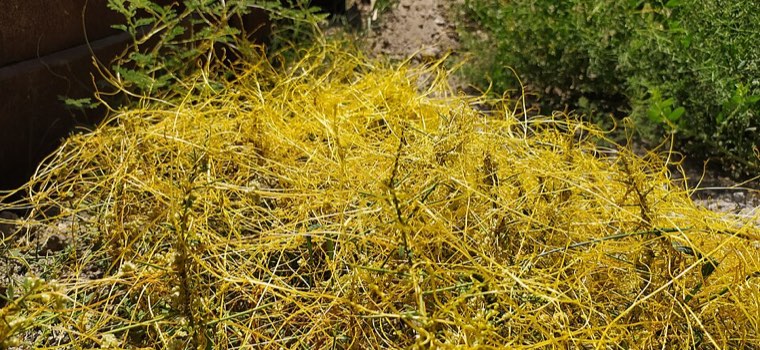
Dodders are leafless, thread-like parasitic plants that twine around the stems of crops and weeds and draw water and food from them through small pegs called haustoria. They form dense yellow or orange tangles that weaken and can kill their hosts. Field dodder, Cuscuta campestris, is the most widespread species in agriculture, attacking lucerne, clover, onion, carrot, sugar beet, tomato, chickpea and many others. Its hard seeds travel with crop seed and survive in soil for decades.
- Type
- Parasitic plant · Parasitic flowering plant (stem parasite with little or no chlorophyll)
- Classification
- Plantae › Magnoliopsida › Solanales › Convolvulaceae
- Main crops
- Alfalfa, Onion & shallot, Carrot, Sugar beet, Tomato, Chickpea, Lentil, Niger seed
- Found in
- North America, Europe and the Mediterranean, West, Central and South Asia, Africa, South America and Oceania
- Chemical groups
- HRAC 3, HRAC 9, HRAC 22 (mode-of-action groups, not products)
- Last reviewed
- 2026-10-20
Dodder scientific name, order and family
The scientific name of dodder is Cuscuta campestris Yunck., in the order Solanales, family Convolvulaceae.
Older or alternative scientific names: Cuscuta pentagona var. calycina, Cuscuta arvensis (misapplied).
Where it occurs
There are more than 150 Cuscuta species worldwide, most diverse in the Americas. Field dodder is native to North America and has been spread with contaminated lucerne, clover and other crop seed to every continent except Antarctica; it is now the commonest agricultural dodder almost everywhere. Many regions set zero or very low tolerances for dodder seed in certified crop seed.
| Region | Status |
|---|---|
| North America | Native; common in lucerne, tomato and vegetable fields |
| Europe and the Mediterranean | Introduced and widespread in lucerne, sugar beet and vegetables |
| West, Central and South Asia | Widespread in lucerne, pulses, oilseeds and vegetables; giant dodder on trees and hedges in South Asia |
| Africa, South America and Oceania | Introduced; locally serious in lucerne and vegetables |
Symptoms and identification of dodder
The plant
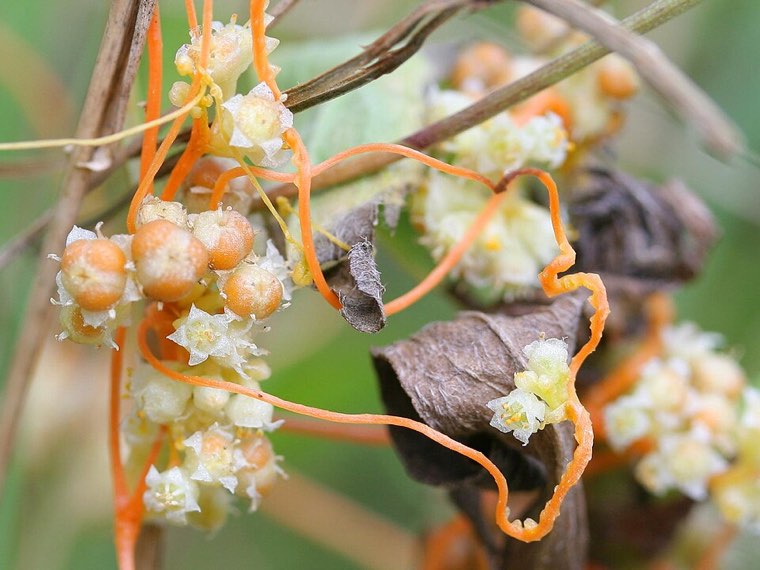
Slender, twining, leafless stems, pale yellow to bright orange, with tiny scale leaves. Small bell-shaped white to cream flowers grow in dense clusters along the stems from early summer to autumn; each produces a capsule with 2-4 hard, rough, round seeds about 1-1.5 mm across. The seedling is a short, rootless yellow thread that must find a host within days.
Signs in the crop, stage by stage
| Crop stage | What you see |
|---|---|
| Seedling crop | Thin yellow threads coil around young stems; heavily attached seedlings are stunted and may die. |
| Established crop | Circular patches of yellow-orange tangles spread outward through the crop; host plants inside the patch are weakened, yellowed and lower yielding. |
| Late season | Masses of dodder flowers and seed capsules cover the patch; badly parasitised plants die and the patch becomes a dense mat. |
Life cycle of dodder
Dodder is an annual. Seeds germinate at or near the soil surface in spring when soil warms to about 15 °C, independently of any host. The seedling grows towards nearby plants, twines around a stem and pushes haustoria into the host's vascular tissue; its connection with the soil then withers. From then on it lives on the host, growing and reattaching from plant to plant. It flowers from late spring to autumn and sets large amounts of hard seed, most of which remains dormant in the soil for years.
| Stage | Duration | Notes |
|---|---|---|
| Dormant hard seed | Viable for more than 20 years in soil | About 5 % germinates the year after it is shed. |
| Germination and free-living seedling | Seedling survives about 5-10 days without a host | Soil at about 15 °C or warmer. |
| Attachment and parasitic growth | Several weeks to months | Stems reattach repeatedly, forming patches. |
| Flowering and seed set | Late spring to autumn | Several thousand seeds per plant. |
Temperature
Germination starts when the soil surface reaches about 15 °C and continues over a long period in spring and summer, so new seedlings keep appearing. Growth is fastest in warm, sunny weather; shade reduces twining and attachment.
Generations
One generation per year; perennial hosts such as lucerne can carry living dodder stems from one cutting to the next.
Conditions that favour it
Sowing crop seed contaminated with dodder seed, broadleaf crops grown repeatedly on infested land, broadleaf weeds that act as bridge hosts, and movement of soil, hay, manure and machinery from infested fields. Thin or patchy crop stands let dodder seedlings reach hosts easily.
Economic threshold level (ETL)
There is no numeric economic threshold. In seed crops any dodder is unacceptable because seed lots are certified against dodder; in other crops, patches are treated as soon as they are found to stop seed production.
Thresholds are local. They depend on crop price, control cost, variety and natural-enemy activity, so use the figure your local extension service publishes where one exists.
Damage and yield loss from dodder
Dodder weakens and stunts its hosts, reduces flowering and fruit set, and can kill seedlings or whole patches of crop. Damage is greatest when it attaches to seedlings; established plants usually survive a single attachment but not multiple ones. In lucerne it reduces forage yield and quality and contaminates seed, and in tomato, onion and carrot it can cause severe yield loss in infested patches. Dodder can also carry some plant viruses and phytoplasmas from one host to another.
Monitoring
- Walk fields weekly from emergence in late spring, looking for yellow threads on young plants and for small orange patches, especially along field edges and in thin areas.
- Mark and measure each patch so that it can be treated and checked again for regrowth.
- Inspect crop seed lots and buy only seed certified free of dodder.
- Check broadleaf weeds on field margins, which often carry the first dodder of the season.
How to control dodder (integrated management)
Control works best as a sequence: prevent, monitor, then act only when a threshold or a risk forecast says so, using the least disruptive option that works.
Cultural control
- Sow certified seed that is free of dodder; seed laws in many regions set very strict limits.
- On infested land, grow grasses, cereals, maize or other non-hosts for several years, and control broadleaf weeds that can act as hosts.
- Clean machinery, and do not move hay, manure or soil from infested fields to clean fields.
- Establish dense, vigorous crop stands; shade reduces dodder attachment.
Mechanical and physical control
- Cultivate or hand-weed dodder seedlings before they attach; once attached, cultivation is not effective.
- Cut, mow closely, flame or remove infested patches together with the host plants before dodder flowers, and remove the material from the field.
Biological control
- Several fungi (Alternaria, Colletotrichum and Fusarium species among them) attack dodder, and a Colletotrichum-based bioherbicide has been used against dodder in East Asia, but no biological control is widely available.
Host resistance
- Some tomato cultivars and wild tomato relatives resist field dodder through a hypersensitive-like reaction at the attachment site, and the genetic basis has been studied; in most crops no resistance is available.
Chemical control of dodder — by mode-of-action group only
Pre-emergence herbicides that stop dodder seedlings establishing are the main chemical tool in lucerne and some vegetables; after attachment, most herbicides that kill dodder also injure the host. What is registered differs by country and changes over time; follow the label and your local plant-protection authority.
| Scheme | Group | Mode of action | Notes |
|---|---|---|---|
| HRAC | 3 | Inhibition of microtubule assembly (dinitroanilines) | Pre-emergence before dodder germinates. |
| HRAC | 9 | Inhibition of enolpyruvyl shikimate phosphate synthase (EPSPS) | Low doses on tolerant or herbicide-resistant crops after attachment. |
| HRAC | 22 | PS I electron diversion | Contact spot treatment of patches; kills the host tissue it touches. |
Resistance management
- Herbicide resistance in dodder has not been widely reported, but rely on clean seed, rotation and patch destruction rather than repeated herbicide use alone.
Look-alikes and how to tell them apart
- Broomrapes — Fleshy, upright spikes rising from the roots at the base of the host, not thin threads twining around stems.
- Field bindweed — A twining plant with green arrow-shaped leaves and roots in the soil; it is not parasitic.
- Love vine (Cassytha) — A similar-looking stem parasite of the laurel family on trees and shrubs in tropical regions, with small fleshy fruits; rarely a crop pest.
Host range
Dodders as a group parasitise hundreds of plant species. Field dodder attacks mainly broadleaf plants: lucerne and clovers, onion, garlic, carrot, sugar beet, tomato, potato, pepper, eggplant, melons, chickpea, lentil, niger and safflower, many ornamentals and broadleaf weeds such as pigweeds and bindweed. Grasses and most other monocots are poor hosts. Other species, such as giant dodder (C. reflexa) in South and South-east Asia, attack shrubs and trees.
What is still uncertain
- Species identification of dodders needs flowers and is difficult; older records of 'C. pentagona' and 'C. arvensis' in many regions refer to C. campestris.
- How long seed survives varies with soil and burial depth; figures from a few years to several decades are reported.
- The importance of dodder in transmitting viruses and phytoplasmas between crops in the field is not well quantified.
Grow guides for its host crops
How to grow the crop well is the first line of defence. Laisha's free grow guides cover each crop from sowing to harvest:
Sources
- Cuscuta campestris (field dodder) datasheet — CABI Compendium. https://doi.org/10.1079/cabicompendium.17111
- Cuscuta campestris (CVCCA) — EPPO Global Database. https://gd.eppo.int/taxon/CVCCA
- Pest Notes: Dodder — UC IPM. https://ipm.ucanr.edu/PMG/PESTNOTES/pn7496.html
- Cuscuta (dodder) datasheet — CABI Compendium. https://doi.org/10.1079/cabicompendium.17108
- International Herbicide-Resistant Weed Database — HRAC / WeedScience.org. https://www.weedscience.org/
Written by Laisha from the sources above, in its own words. This page is general reference, not a prescription: confirm identification locally and follow the label and your plant-protection authority.