 Laisha
AI Operating System for Agriculture
Ask Laisha
Laisha
AI Operating System for Agriculture
Ask Laisha
Scirtothrips dorsalis Scirtothrips dorsalis Hood, 1919 · formerly or also: castor thrips, Assam thrips
Chilli thrips is a tiny, pale yellow thrips that feeds on the youngest leaves, buds and fruit of more than 100 plants, including chilli, mango, citrus, strawberry, tea, cotton and groundnut. Its feeding makes young chilli leaves curl upward and turn brittle, scars fruit, and bronzes leaves and shoots. Native to South Asia, it has spread to East Asia, Africa, Australia and the Americas, where it is now a major pest of fruit, vegetables and ornamentals.
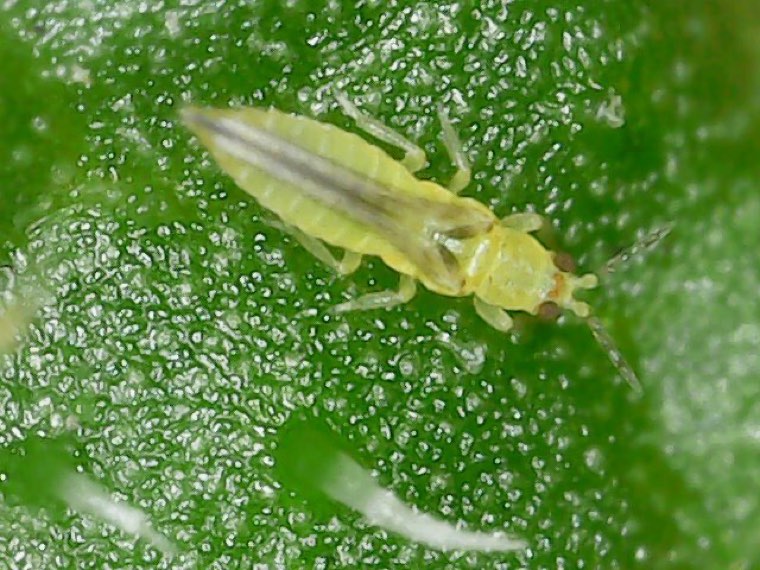
The scientific name of chilli thrips is Scirtothrips dorsalis Scirtothrips dorsalis Hood, 1919, in the order Thysanoptera, family Thripidae.
Older or alternative scientific names: castor thrips, Assam thrips.
Native to South Asia; recorded across East and South-East Asia, Africa, Australia, the Caribbean, and North, Central and South America, where it established in Florida and the Caribbean in the early 2000s. It is a regulated pest in parts of Europe.
| Region | Status |
|---|---|
| South and East Asia | Widespread and long established |
| Africa | Present |
| Americas | Established in the Caribbean, the southern US and parts of Latin America |
| Oceania | Present in Australia and Pacific islands |
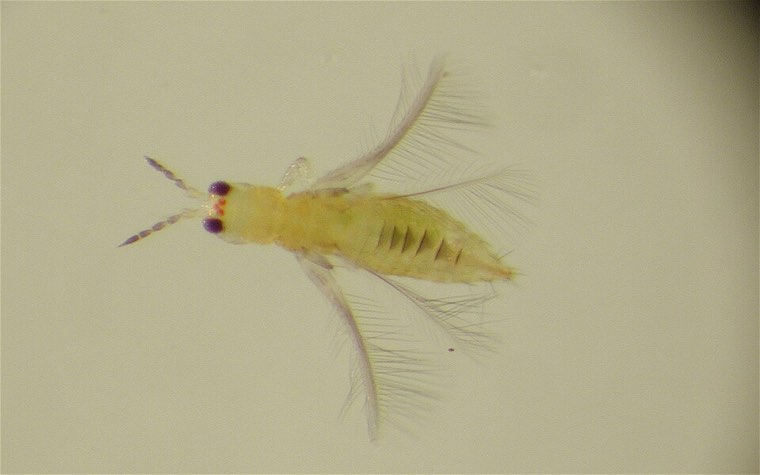
Adults are about 1 mm long or less, pale yellow, with dark wings and dark brownish bands across the upper side of the abdomen, which give a striped look under a hand lens. Larvae are pale and wingless. Accurate identification needs a microscope, because several similar Scirtothrips species exist; recent studies show that S. dorsalis is a complex of closely related species.
| Crop stage | What you see |
|---|---|
| Young leaves and shoots | Leaves curl upward and become small, thick and brittle; silvering and bronzing along veins; shoots stunted. |
| Flowers and buds | Bud and flower drop; brown, scarred flower parts. |
| Fruit | Corky, brown or silvery scarring on chilli, citrus, mango and strawberry fruit; deformed fruit. |
Females insert eggs into young leaves, buds and fruit. The two larval stages feed on soft new growth. The prepupa and pupa do not feed and shelter in leaf litter, in curled leaves or in crevices on the plant. Generations follow each other quickly in warm weather.
| Stage | Duration | Notes |
|---|---|---|
| Egg (inside plant tissue) | About 3-7 days | Protected from contact sprays. |
| Larva (2 instars) | About 5-8 days | Feeds on young tissue. |
| Prepupa and pupa | About 3-5 days | Non-feeding; in litter or on the plant. |
| Adult | About 2-3 weeks | Females lay about 50-60 eggs. |
Egg to adult takes about two weeks at 25-28 °C; populations build up fastest in warm, dry weather and decline in heavy rain.
Many overlapping generations in the tropics and in greenhouses.
Warm, dry weather; continuous availability of flushing young growth; overuse of broad-spectrum insecticides that kill predators; and nearby infested hosts such as ornamentals or castor.
There is no single international threshold. Some crops and regions use local action levels based on thrips counts per leaf, flower or shoot, which differ by crop, stage and market; check with your local extension service.
Thresholds are local. They depend on crop price, control cost, variety and natural-enemy activity, so use the figure your local extension service publishes where one exists.
In chilli, heavy infestations reduce yield by 30-50% or more; leaf curl in chilli often results from chilli thrips and broad mite together. In fruit crops, scarring lowers market grade. Chilli thrips also transmits some tospoviruses, including groundnut bud necrosis virus, and helps spread tobacco streak virus.
Control works best as a sequence: prevent, monitor, then act only when a threshold or a risk forecast says so, using the least disruptive option that works.
Sprays target young growth where the thrips feed; eggs inside tissue and pupae are protected, so repeated, well-timed applications are needed. Resistance to several groups has been reported. What is registered differs by country and changes over time; follow the label and your local plant-protection authority.
| Scheme | Group | Mode of action | Notes |
|---|---|---|---|
| IRAC | 5 | Nicotinic acetylcholine receptor allosteric modulators, site I (spinosyns) | Resistance reported; rotate. |
| IRAC | 28 | Ryanodine receptor modulators (diamides) | Systemic uses. |
| IRAC | 13 | Uncouplers of oxidative phosphorylation | Contact. |
| IRAC | 23 | Inhibitors of acetyl CoA carboxylase | Systemic; slow-acting. |
| IRAC | 6 | Glutamate-gated chloride channel allosteric modulators | Also active on mites. |
More than 100 plant species in about 40 families, including chilli and sweet pepper, mango, citrus, grape, strawberry, tea, cotton, groundnut, castor, eggplant, onion, rose and other ornamentals.
How to grow the crop well is the first line of defence. Laisha's free grow guides cover each crop from sowing to harvest:
Written by Laisha from the sources above, in its own words. This page is general reference, not a prescription: confirm identification locally and follow the label and your plant-protection authority.