 Laisha
AI Operating System for Agriculture
Ask Laisha
Laisha
AI Operating System for Agriculture
Ask Laisha
Trichoplusia ni Trichoplusia ni (Hübner, [1803])
The cabbage looper is the caterpillar of a grey-brown moth. It moves by arching its back into a loop, because it has fewer pairs of legs on its abdomen than most caterpillars. It chews large holes in the leaves of cabbage, broccoli, lettuce, spinach, tomato, cotton, soybean and many other crops, and contaminates leafy vegetables with its body and droppings. It migrates long distances each year and is also a serious pest in greenhouses.
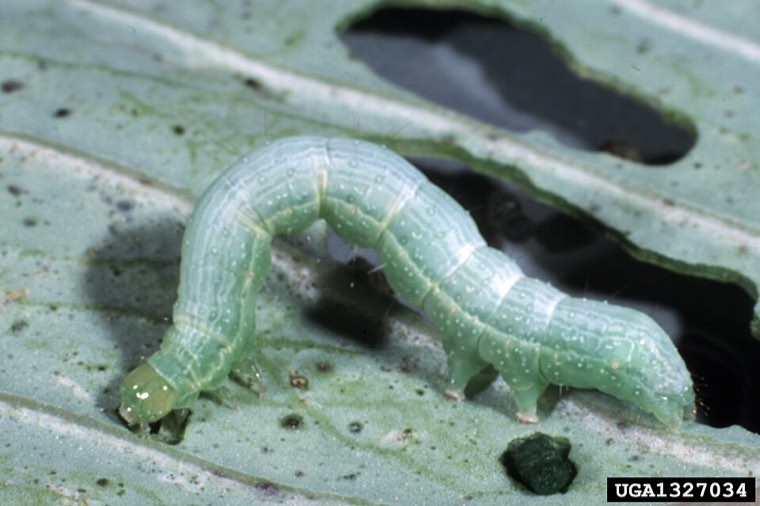
The scientific name of cabbage looper is Trichoplusia ni Trichoplusia ni (Hübner, [1803]), in the order Lepidoptera, family Noctuidae.
Found throughout the Americas, Africa, southern Europe, the Middle East and much of Asia. In North America it cannot survive cold winters and migrates north from southern areas each year; it also persists year-round in greenhouses.
| Region | Status |
|---|---|
| Americas | Widespread; seasonal migrant in cold regions |
| Africa and the Middle East | Widespread |
| Europe | Mainly southern Europe; migrant further north |
| Asia | Widespread |
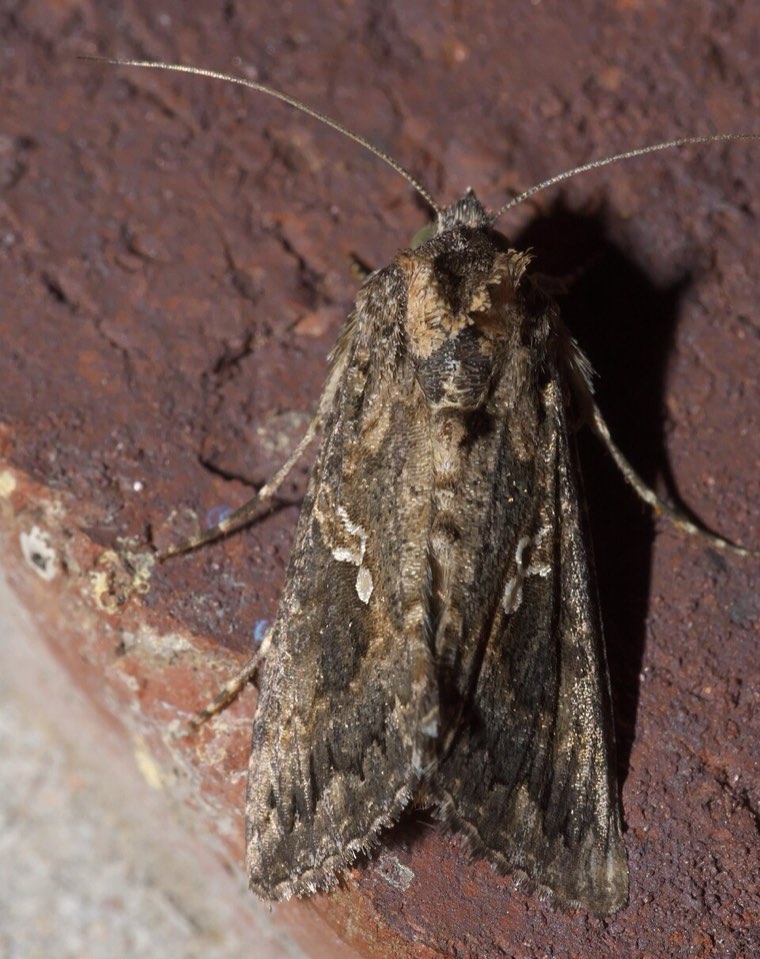
Moths are grey-brown with a wingspan of about 3-4 cm and a small silvery-white mark shaped like a figure 8 or a U on each forewing; they fly at night. Eggs are round, ridged and pale, laid singly on leaf undersides. Caterpillars are pale green with thin white lines along the sides, grow to about 3-4 cm, and have only two pairs of prolegs in the middle of the body plus a pair at the end, which gives the looping walk.
| Crop stage | What you see |
|---|---|
| Young caterpillars | Small, irregular feeding patches on leaf undersides, leaving the upper surface as a thin window. |
| Older caterpillars | Large ragged holes in leaves; feeding in the heads of lettuce and cabbage; droppings between leaves. |
| Fruiting crops | Occasional shallow feeding on tomato fruit; heavy defoliation of cotton and soybean in outbreaks. |
Females lay several hundred eggs singly on the leaves of host plants. Caterpillars feed for two to four weeks through five or more instars and then spin a thin, loose silk cocoon on the underside of a leaf, where they pupate. Moths emerge after about one to two weeks, mate and lay eggs within days.
| Stage | Duration | Notes |
|---|---|---|
| Egg | About 3-5 days | Laid singly on leaf undersides. |
| Caterpillar (usually 5 instars) | About 2-4 weeks | Older caterpillars cause most damage. |
| Pupa (in loose cocoon on leaves) | About 1-2 weeks | Not in the soil. |
| Adult moth | About 1-3 weeks | Night-flying; migrates. |
Egg to adult takes about 3-4 weeks in warm weather; it does not survive cold winters outdoors and does best around 25-30 °C.
Two to three generations in northern areas after migrants arrive, and up to seven or more in warm areas and greenhouses.
Warm weather, large areas of host crops, migrant moth flights, greenhouses with year-round crops, and loss of natural enemies after broad-spectrum sprays.
There is no single international threshold. Extension services set action levels by crop and stage, such as the percentage of plants infested in heading brassicas and lettuce, which are lower near harvest for fresh-market crops; check with your local extension service.
Thresholds are local. They depend on crop price, control cost, variety and natural-enemy activity, so use the figure your local extension service publishes where one exists.
Defoliation reduces yield in brassicas, lettuce and soybean, and contaminated or damaged heads are rejected by fresh markets; in greenhouses it damages vegetables and flowers.
Control works best as a sequence: prevent, monitor, then act only when a threshold or a risk forecast says so, using the least disruptive option that works.
Sprays work best against young caterpillars; older caterpillars are harder to kill. Resistance to several groups is known. What is registered differs by country and changes over time; follow the label and your local plant-protection authority.
| Scheme | Group | Mode of action | Notes |
|---|---|---|---|
| IRAC | 11A | Microbial disruptors of insect midgut membranes (Bacillus thuringiensis) | Selective; rotate strains and groups. |
| IRAC | 5 | Nicotinic acetylcholine receptor allosteric modulators, site I (spinosyns) | Selective. |
| IRAC | 18 | Ecdysone receptor agonists (diacylhydrazines) | Selective; acts on caterpillars. |
| IRAC | 28 | Ryanodine receptor modulators (diamides) | Rotate with other groups. |
More than 160 plants in many families, especially crucifers, lettuce, spinach, celery, tomato, potato, cucurbits, beans, soybean, cotton and greenhouse vegetables and flowers.
How to grow the crop well is the first line of defence. Laisha's free grow guides cover each crop from sowing to harvest:
Written by Laisha from the sources above, in its own words. This page is general reference, not a prescription: confirm identification locally and follow the label and your plant-protection authority.