A maize plant tells you what it is short of, if you know how to read its leaves.
Yellow in a V down the middle of an old leaf,
brown along the edges, purple on a young seedling, white bands beside the midrib: each pattern points to a different nutrient.
Read them right, and you can correct the problem this season or plan the fix for the next.
Read them wrong, and you may spend money on the wrong fertiliser.
In this video: the one rule that narrows the search, the signs of nitrogen, phosphorus, potassium, sulphur, magnesium and zinc deficiency, the look-alikes that fool people, and how to confirm a diagnosis with tissue and soil tests before you act.
Deficiencies look the same on every continent,
although which ones are common depends on your soils.
Start with one question.
Are the symptoms on the older, lower leaves, or on the youngest leaves at the top?
Some nutrients are mobile inside the plant. When they run short, the plant moves them from old leaves to new growth, so the old leaves show the symptoms first.
Nitrogen, phosphorus, potassium and magnesium are mobile. Other nutrients cannot be moved easily, so the youngest leaves suffer first. Sulphur, zinc, iron, manganese and boron behave this way.
Then look at the pattern on the leaf: the tip, the midrib, the edges, stripes between the veins, or the colour of the whole leaf.
And look at the pattern in the field: patches, rows, low spots, sandy knolls, or the whole field.
Together, these three clues usually point to one or two possible causes.
Nitrogen deficiency is the most common, and the most costly.
The older leaves turn yellow, starting at the tip and running down the midrib in a V shape, while the edges stay green longer. In severe cases the lower leaves die from the tip back, which is often called firing, and the whole plant is pale and thin, with small ears.
It is common after heavy rain, which washes nitrate below the roots or causes nitrogen to be lost from waterlogged soil, on sandy soils, after a cereal crop whose straw ties up nitrogen,
and wherever the rate was simply too low.
Maize takes up most of its nitrogen in the weeks of rapid growth before tasselling, so a side-dressing before that period can still rescue yield.
Phosphorus deficiency shows mainly on young plants.
Leaves turn dark green, with purple or reddish edges and tips,
and the plants are stunted. It is common in cold, wet springs, when roots take up phosphorus slowly, in compacted soils, and in acid soils with high aluminium, or in very alkaline soils, where phosphorus is bound up.
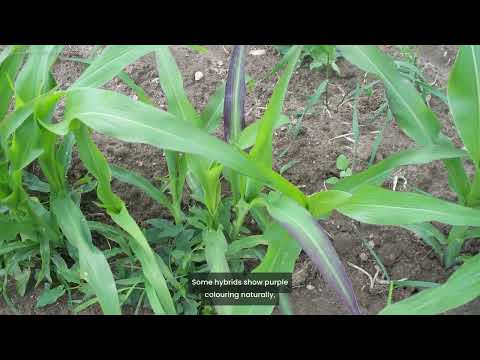
Be careful: purpling alone is not proof.
Some hybrids show purple colouring naturally,
and cold nights can purple seedlings that recover once the soil warms. Persistent stunting with purple edges, in a field with a low soil-test phosphorus, is the real warning.
Banding phosphorus near the seed at planting is the best prevention.
Potassium deficiency also starts on the older leaves, but on the edges, not the midrib. The leaf margins turn yellow and then brown and dry, starting at the tip, while the centre of the leaf stays green.
Later in the season, weak stalks that lodge easily,
and ears with poorly filled tips, are typical.
It is common on sandy and acid soils, on soils that have grown crops for many years without potassium, and where whole crops are removed for silage or fodder.
Compaction and dry soil make it worse, because potassium moves to the roots through the soil water.
Sulphur deficiency looks a bit like nitrogen deficiency, but it shows on the young, upper leaves, which turn pale yellow-green overall, often with faint striping. It is increasingly common, on sandy soils low in organic matter, and in cool, wet springs.
Magnesium deficiency shows on the older leaves, as yellow to white stripes between the green veins, sometimes looking like a string of beads, and in severe cases the leaves turn reddish-purple. It is typical of acid, sandy soils, and of soils very high in potassium or calcium.
Using a magnesium-containing liming material, such as dolomitic lime, corrects both the acidity and the magnesium.
Zinc deficiency shows on the youngest leaves.
Look for broad white to pale yellow bands on each side of the midrib, starting near the base of the leaf, while the midrib and the leaf edges stay green.
The plants are short, because the internodes do not lengthen,
and in severe cases the new leaves emerge almost white.
It is common in high-pH and calcareous soils,
sandy soils, soils where the topsoil has been removed by levelling or erosion, after very high phosphorus applications, and in cold, wet early seasons.
A zinc fertiliser applied to the soil, or a foliar zinc spray on the young crop, corrects it; check local recommendations for the rate and product.
Several things mimic nutrient deficiency.
Herbicide injury can cause striping, yellowing or purpling, often in patterns that follow the sprayer. Leaf diseases such as grey leaf spot and northern leaf blight make lesions that can merge into yellow and brown areas. Some hybrids carry genetic stripes.
Waterlogging, compaction, cold and drought all limit nutrient uptake, so the plant shows a deficiency even though the soil holds enough.
So confirm before you act.
Compare good and poor areas of the same field.
Take a plant tissue sample, for example the leaf below and opposite the ear at silking, or whole young plants early in the season, from both areas, and send them to a laboratory with a soil sample from each.
Tissue tests show what the plant actually took up;
soil tests show whether the problem is in the soil or in the roots.
To recap.
First ask: old leaves or new?
Old leaves point to nitrogen, phosphorus, potassium or magnesium;
new leaves point to sulphur, zinc and the other micronutrients.
A yellow V down the midrib means nitrogen.
Brown edges on old leaves mean potassium.
Purple edges on stunted seedlings suggest phosphorus.
Pale young leaves suggest sulphur.
Stripes between the veins of old leaves suggest magnesium.
White bands beside the midrib on young leaves mean zinc. Rule out herbicides, disease and waterlogging,
and confirm with tissue and soil tests.
For more on crop nutrition, visit laisha.ai. Thank you for watching.