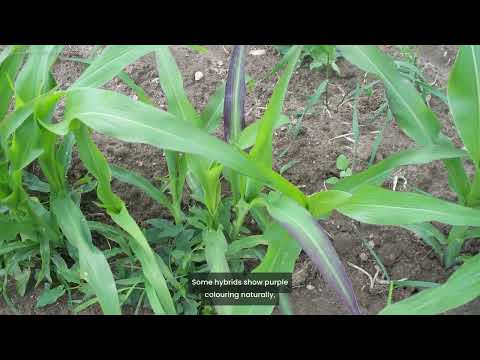
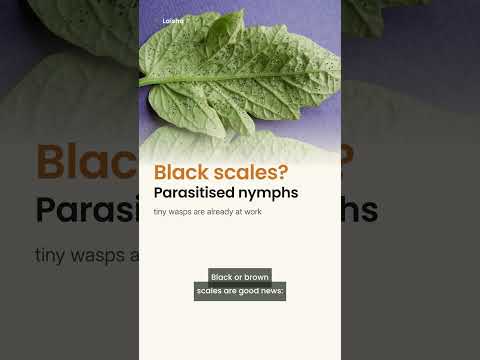
Onion bulbs are built by their leaves.
Every green leaf feeds the bulb, and every leaf lost early means a smaller bulb at harvest.
Two fungal leaf diseases cause much of that loss in warm, humid onion regions around the world: purple blotch and Stemphylium leaf blight. They often appear together, they can look alike, and they are managed in similar ways, with some important differences.
In this video: how to recognise each one, how to tell them apart from each other and from downy mildew, the weather that drives them, how to prevent them, how to use fungicides by FRAC group, and how to protect the bulbs at harvest.
The advice is general and global.
Your local extension service and product labels always come first.
Purple blotch is caused by the fungus Alternaria porri. It attacks onion, garlic, leek and other alliums, and it is especially damaging in warm regions, and in seed crops, where it can break the flower stalks.
It begins as small, water-soaked, whitish flecks. These grow into oval or elliptical lesions with a purple to reddish-brown centre, often with a yellow border that runs up and down the leaf. In humid weather, dark brown to black spores form on the lesion, often in rings, like the rings of a target.
Large lesions girdle the leaf, and the leaf above them dries and falls over. The disease favours older leaves, and leaves already wounded by thrips.
Stemphylium leaf blight is caused by the fungus Stemphylium vesicarium.
It has become a major problem in several onion regions in recent years, from North America to South Asia and Europe.
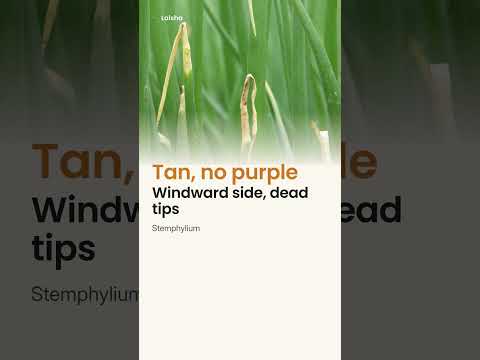
Its lesions start small, yellow to tan and water-soaked, and grow into elongated tan to brown patches.
They often appear first on the side of the leaf facing the prevailing wind, and on tissue that is already dying or damaged:
leaf tips, old lesions of purple blotch, hail or sunburn damage, or thrips feeding scars.
As the lesions age, they turn olive-brown to black as the fungus forms its spores.
In bad years, the whole canopy browns from the tips down, weeks before it should.
So how do you tell them apart in the field?
Purple blotch lesions usually have a purple centre and target-like rings.
Stemphylium lesions are tan to brown, without the purple, and often sit on the windward side or on dead tissue. The two are frequently found together on the same leaf, and the spores look different under a microscope, so when it matters, send samples to a diagnostic laboratory.
A third disease is often confused with both.
Downy mildew, caused by Peronospora destructor, forms pale, elongated patches with a fine grey-violet fuzz in cool, moist weather, usually in the early morning. It is a water mould, not a true fungus, and it needs different fungicides.
And not every brown tip is a disease.
Drought, salt, herbicide injury and plain old age also kill leaf tips.
Both diseases need long periods of leaf wetness. Purple blotch is favoured by warm weather, roughly twenty to thirty degrees Celsius, with heavy dew, fog, rain or overhead irrigation that keeps the leaves wet for many hours at a time.
Stemphylium is favoured by similar wet periods at somewhat milder temperatures.
That is why outbreaks often follow a run of humid nights, or a monsoon spell, and why the dense canopy of a well-grown crop can be at higher risk than a thin one.
Some regions run forecasting models for these diseases, based on hours of leaf wetness and temperature. Where one is available, use it to time the first spray, rather than a fixed calendar.
Prevention comes first.
Rotate away from onion, garlic and leek for at least two to three years, because both fungi survive on infected crop debris.
Bury or remove the old leaves and cull onions after harvest, and keep volunteer onions and allium weeds out of nearby fields.
Use clean seed and healthy transplants.
Plant so that the canopy dries quickly.
Where possible, run the rows in the direction of the prevailing wind, avoid very dense planting, and use drip irrigation, or irrigate early in the day so that the leaves dry before night.
Give the crop balanced nutrition.
Too much nitrogen makes soft, crowded growth that stays wet longer, while a crop under stress loses its leaves sooner. And control thrips, because their feeding wounds are an open door for both diseases.
Scout every week from the time the bulbs begin to form, and after every spell of wet weather.
Look at the older leaves and the windward side of the field first.
Fungicides work best as protectants, applied before the disease builds up, and repeated at the interval on the label while the weather stays wet.
Choose them by FRAC group, the mode-of-action code on the label.
Multi-site protectants, in the M groups, carry a low risk of resistance and are a common backbone where they are registered.
Single-site groups used against these diseases include group three, the DMIs, group seven, the SDHIs, group eleven, the strobilurins, group nine together with group twelve in some mixtures, and group two. Because Stemphylium in particular has become resistant to group eleven, and in some areas to group seven, in many onion fields, use single-site products in mixtures or alternations,
rotate groups from spray to spray, and never exceed the number of applications on the label.
Remember that downy mildew needs products that are active against water moulds. A fungicide chosen for purple blotch may do nothing for it.
Registrations differ from country to country, and some products are restricted in some regions.
Use only products registered for onion, at the label rate, and respect the pre-harvest interval.
Leaf diseases can also follow the crop into storage.
Purple blotch can enter the neck of the bulb and cause a dark, watery rot.
Let the tops fall over and the necks dry naturally where you can. Lift the bulbs in dry weather, cure them well, in the field or in a dry, airy shed, until the necks are tight and the outer skins rustle. Handle them gently, and store only sound, well-cured bulbs in a cool, dry, ventilated store. Then clear the debris from the field, so that this season's spores do not start next season's crop.
To recap.
Purple blotch has a purple centre with target-like rings.
Stemphylium is tan to brown, often on the windward side and on dead tissue.
Downy mildew has a grey-violet fuzz and needs different fungicides.
Both leaf diseases follow long hours of leaf wetness. Rotate for two to three years, clear debris and volunteers, let the canopy dry, balance the nitrogen and control thrips.
Spray protectants before the disease builds, choose by FRAC group, and mix and rotate, because Stemphylium resists some groups. And cure the bulbs well before storage.
For more on onion diseases, and on every other crop disease, visit laisha.ai. Thank you for watching.