The pink bollworm is one of the most damaging pests of cotton in the world. It spends almost its whole life hidden inside flower buds, flowers and bolls, eating the seeds and staining the lint. From outside, a heavily infested field can look healthy until the bolls open badly. It is found in cotton regions across Asia, Africa and the Americas.
In parts of Asia it has become resistant to Bt cotton, while in the United States and northern Mexico it was eradicated after decades of area-wide work.
In this video: how to recognise the pink bollworm and its damage, its life cycle and how it survives between seasons, how to monitor it, and how to manage it with crop timing,
clean-up after harvest, pheromones, Bt cotton used correctly,
and insecticides chosen by IRAC group. The advice is general and global.
Your local extension service and product labels always come first.
The adult is a small, greyish-brown moth, about eight to nine millimetres long, that flies at night and is rarely seen.
The female lays her eggs on flower buds and young bolls, often tucked under the bracts or the calyx.
The young larvae are white and bore straight inside within hours.
Older larvae are up to about one and a half centimetres long, with broad pink bands across each segment, which give the pest its name.
Inside a boll they move from seed to seed. When fully grown, a larva either chews a small round exit hole and drops to the soil to pupate, or stays inside the seed or boll to rest.
The best-known early sign is the rosette flower. A larva inside the flower bud ties the petals together with silk, so the flower cannot open properly and looks twisted, like a rosette. Infested flower buds and young bolls may also drop.
In green bolls, look for tiny entry holes that heal over and are hard to see,
and later, round exit holes. Cut open a sample of green bolls, and you find tunnels, eaten seeds, pink larvae, and lint that is stained yellow or brown.
Infested bolls often open early or only partly,
and rot fungi follow.
The result is lower yield, poorer lint quality, and damaged seed with less oil.
The pink bollworm survives between cotton crops as a resting larva. When days shorten and the crop matures, many larvae enter this resting state, called diapause, inside seeds, often in two seeds joined together, or in bolls left on the stalks or on the ground. They can stay alive there for many months.
Cotton seed and gin trash carry them too, which is why ginneries and seed stores are often sources of early infestations.
When the next crop flowers, the moths emerge and lay eggs on the new buds.
This carry-over is the pest's weak point.
Every larva destroyed after harvest is one moth fewer next season.
Monitor from the start of flowering.
Pheromone traps, baited with the female's sex scent, catch male moths and show when the flight begins and whether numbers are rising.
Check the flowers for rosettes. And once bolls form, sample green bolls regularly, for example twenty bolls from across the field each week: cut them open and count those with larvae.
Many advisories use a threshold based on moths per trap over several nights, or on the share of infested bolls, for example around one in ten.
Use the threshold recommended for your region.
Cultural control is the backbone of pink bollworm management. Sow within the recommended window, together with your neighbours, and prefer varieties that mature on time. A long, staggered season gives the pest more generations.
End the season on time.
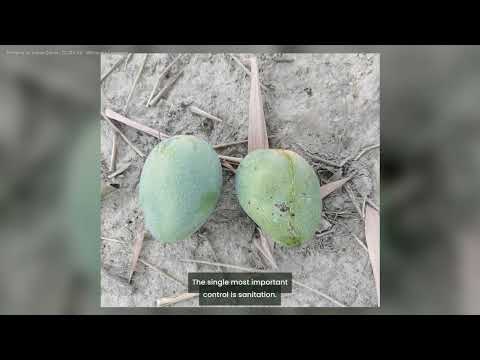
Do not keep the crop going for an extra flush, stop irrigation as advised so that the plants mature, and harvest promptly. Then destroy the crop residues straight away:
shred the stalks, plough in or remove the remaining bolls, and graze or clear the field.
Do not store stalks with bolls on them for fuel near the next crop. Where your region has a cotton-free period, keep to it.
Around ginneries and seed stores, destroy gin trash and keep seed in closed stores.
Seed treatments or proper delinting and drying used in some regions also kill resting larvae.
Pheromones can do more than monitor.
In mating disruption, dispensers release so much of the female's scent across a field, or a whole area, that males cannot find the females, so fewer eggs are laid. It works best over large, coordinated areas, applied at the start of flowering.
Bt cotton produces proteins that kill bollworm larvae,
and it has been a powerful tool. But in parts of Asia, pink bollworm populations have become resistant to the Bt proteins in widely grown varieties.
Resistance develops faster when refuges, areas of non-Bt cotton or the refuge seed mixed into the bag, are not planted, and when the season is extended. So plant the refuge as required, use Bt cotton together with all the cultural steps, and do not rely on it alone.
Because the larvae live inside flowers and bolls,
sprays mainly hit the moths, the eggs, and young larvae before they bore in. Time sprays to the flowering and boll-forming period, when trap catches and boll samples pass the threshold.
Groups used against pink bollworm include the pyrethroids in group three A and organophosphates in group one B, which are broad-spectrum and hard on natural enemies; the diamides in group twenty-eight; the spinosyns in group five; emamectin benzoate in group six;
and indoxacarb in group twenty-two A. Rotate groups between sprays and seasons to slow resistance,
protect natural enemies where you can, follow the label and the pre-harvest interval, and use only products registered for cotton in your country.
To recap.
The pink bollworm hides inside flowers and bolls.
Look for rosette flowers, and cut open green bolls to find pink larvae,
eaten seeds and stained lint. It carries over as resting larvae in seeds,
bolls, stalks and gin trash, so end the season on time, destroy residues promptly, and keep a cotton-free period.
Monitor with pheromone traps and boll sampling.
Use mating disruption over large areas, and Bt cotton with its refuge, never alone.
And when you must spray, time it to the threshold, choose by IRAC group, and rotate.
For more on cotton, and on every other crop pest, visit laisha.ai. Thank you for watching.