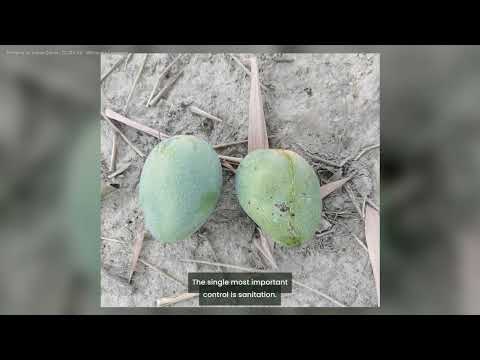
A mango that looks perfect on the tree, and turns to rot in the market.
Inside it, maggots. That is the work of fruit flies, among the most damaging pests of fruit and vegetables in warm regions.
With fruit flies, there is no safe level of damage.
One maggot makes a fruit unsaleable, and for export, the tolerance is zero. Because they are serious quarantine pests, their presence can close export markets even where crop losses are small.
In this video: the three main fruit flies and how to tell them apart, their life cycle, the signs and the losses, trapping, the sanitation that matters most, bagging and natural enemies, baits and insecticides chosen by IRAC group, and safety.
The advice is general and global.
Your local extension service and plant protection authority come first.
The oriental fruit fly, Bactrocera dorsalis, is about seven to eight millimetres long, with a mostly dark thorax bearing two yellow side stripes, and clear wings with a narrow dark band along the front edge. It is recorded from more than four hundred host plants, including mango, guava, papaya and citrus.
Native to Asia, it invaded Africa in the early two thousands and has become the most damaging pest of mango there.
The Mediterranean fruit fly, or medfly, Ceratitis capitata, is smaller than a house fly, with a shiny black thorax patterned in silver and yellow, and bold yellow-brown bands on its wings.
It attacks more than three hundred fruits, from citrus and stone fruit to figs and coffee, in almost every warm region except most of Asia.
And the melon fly, Zeugodacus cucurbitae, is reddish-brown,
with a broad dark band along the front of each wing ending in a dark spot at the tip. Its maggots rot the young fruit of bitter gourd, cucumber, melon, pumpkin and other cucurbits, across much of tropical Asia and Africa.
Do not confuse them with tiny vinegar flies, with red eyes and plain wings, which mostly breed in fruit that is already damaged or overripe.
The female fly lays her eggs under the skin of the fruit: an oriental fruit fly female can lay more than a thousand eggs in her life.
The eggs hatch within one to three days in warm weather. The maggots feed inside the fruit, which usually falls.
Then the mature larvae leave the fruit and pupate in the top few centimetres of soil, under the tree or the vines.
Adults need sugars and protein to mature their eggs. That is why protein baits attract the females.
At twenty-five to thirty degrees Celsius, a generation takes only about three to five weeks, so in the tropics, where one host fruit follows another through the year, there can be eight to twelve overlapping generations.
Development slows sharply in cool weather, and cold winters limit these flies in temperate regions.
Look for tiny sting marks where eggs were laid,
sometimes with oozing sap, gum or a darkened halo. In citrus, a hard, discoloured ring forms around the sting.
Later, soft, water-soaked patches collapse over the tunnels,
and when you cut the fruit, there are maggots in the flesh.
Infested fruit often drops early, and fruit that looked sound at harvest rots in transit and in the market.
On cucurbits, stung young fruit become distorted, shrivel and drop.
The losses are large. In unmanaged mango orchards in sub-Saharan Africa,
thirty to eighty per cent of fruit has commonly been reported lost.
Unprotected stone fruit and mandarins in Mediterranean climates can suffer thirty to one hundred per cent late in the season.
And melon fly losses of thirty to one hundred per cent of cucurbit fruit have been reported in Asia and Africa.
You cannot manage what you do not measure.
Male fruit flies are strongly attracted to particular lures:
methyl eugenol for the oriental fruit fly, cue-lure for the melon fly, and a male lure for the medfly.
Traps baited with these show when flies are present.
Traps with protein or food baits catch both males and females.
Check traps weekly, and record the catch as flies per trap per day. Act when catches rise before the fruit begins to change colour. And cut open a sample of fallen and ripening fruit every week to look for maggots. In cucurbits, inspect young fruit twice a week for stings.
In quarantine areas and export programmes, follow the official trapping grid. Any detection in a fly-free area triggers official measures.
The single most important control is sanitation.
Collect fallen and infested fruit every few days, at least twice a week, and destroy it, so the larvae cannot pupate. Bury it deeply, seal it in black plastic bags in the sun, or feed it to animals.
Never leave it lying under the trees.
Harvest promptly and completely, and where the market allows, pick at the mature-green stage, before fruit is most attractive.
Remove abandoned host trees and wild hosts near the orchard. Prune trees to a manageable height, so that baits and inspections can reach the canopy.
In cucurbits, remove the crop and its residues at the end of the season,
and dig or plough the soil under the vines to expose the pupae.
And work together.
Flies move between farms, so area-wide action across neighbouring farms works far better than control on one farm alone.
For high-value fruit, physical barriers work extremely well.
Bagging individual fruit with paper or fabric bags gives near-complete protection.
For bitter gourd, gourds and melons, wrap the young fruit soon after fruit set.
Fine netting protects small orchards and home gardens.
Natural enemies help too.
Parasitoid wasps, such as Fopius arisanus and Diachasmimorpha longicaudata, attack fruit flies, and have been released in several regions.
In mango orchards in Africa and Asia, weaver ants reduce fruit fly infestation.
On a larger scale, governments use the sterile insect technique:
mass-reared males, sterilised by radiation,
are released to mate with wild females, which then lay no viable eggs.
Combined with male annihilation, using lures in bait stations, it eradicated the melon fly from Japan's southern islands,
and it keeps the medfly out of some fruit-exporting regions.
Laisha names insecticides only by their IRAC group. Against fruit flies, full-cover sprays are inefficient.
Insecticide is used mainly in protein bait sprays,
spot-sprays of a protein bait mixed with a small amount of insecticide on a few leaves per tree, or on the border vegetation where melon flies rest.
And in male-annihilation stations, where a lure is combined with a toxicant.
The groups in Laisha's encyclopedia are IRAC group five, the spinosyns, used in protein bait formulations.
Group three A, the pyrethroids, used in some bait stations and attract-and-kill devices.
And group one B, the organophosphates, used historically in baits, but now restricted or withdrawn in many countries.
Resistance to groups one B and three A, and reduced susceptibility to group five baits, have been documented in some populations.
So keep baits to a small area, and lean on sanitation and natural enemies.
Use only products registered for your crop in your country, at the label dose.
For export, post-harvest heat or cold treatments are used. For mango, a hot-water treatment of around fifty-two degrees for about five minutes is common.
Now, safety.
Read the label before you buy, mix or apply any bait. Wear what the label asks for, and gloves matter most, because most farm poisoning happens through the skin. Mix outdoors, and do not eat, drink or smoke while you work. Keep bait stations out of reach of children and animals.
Store pesticides locked, in their original containers, away from food and feed.
Triple-rinse empty containers, puncture them, and never reuse them. Respect the pre-harvest interval.
And if someone is exposed, wash the skin with plenty of water, and get medical help at once, taking the label with you.
To recap.
One maggot spoils a fruit, and export tolerance is zero.
Know your fly: oriental fruit fly on mango and guava, medfly on citrus and stone fruit, melon fly on cucurbits.
Trap weekly with male lures and food baits, and act when catches rise before colour break.
Collect and destroy fallen fruit at least twice a week, harvest promptly, and remove wild hosts.
Bag high-value fruit, protect natural enemies, and work area-wide with your neighbours. If you use insecticide, use it in baits, by IRAC group, and follow the label.
For every pest and disease, and full grow guides, visit laisha.ai. Thank you for watching.