Of all the pests that attack a crop, weeds can take the most. If they were never controlled, they would cost around a third of the attainable yield in major crops, more than insects or diseases.
In wheat, the damage is done early and quietly, by plants that often look just like the crop.
In this video: the weeds of wheat, the weeks when they do the most harm, how a strong crop and a hoe do much of the work, and how to choose herbicides by their HRAC group, with examples of active ingredients, the right timing, the dose, resistance, and safe spraying.
The advice is general.
Registrations differ by country, so your local extension service and the product label always come first.
Wheat weeds fall into two broad groups: grass weeds and broadleaf weeds. Broadleaf weeds are easy to see. The grass weeds are the dangerous ones, because when they are young they look almost the same as wheat. Little seed canary grass, Phalaris minor, is a major weed of the rice and wheat fields of north-west India, and wild oats infest wheat in many countries.
Learn to tell your own crop's leaf from the weed while there is still time to pull it. If you are not sure, ask an experienced farmer to show you once.
Weeds also build up in the soil.
One weed left to set seed can shed thousands of seeds, and the old saying is true: one year's seeding means seven years' weeding.
Weeds do not hurt the crop equally all season.
Weed scientists call the window that matters the critical period of crop and weed competition.
Before it starts, small weeds and a small crop share plenty of water, light and nutrients.
After it ends, the crop canopy is big enough to shade out late weeds.
In wheat, weeds hurt most in the first six to eight weeks.
And weeds that come up with the crop, or before it, do far more damage than weeds that come up a few weeks later. So the rule is simple: keep the crop clean from the start, through the first two months. The exact window shifts with your field. It is shorter when the crop is vigorous, well fed and sown thick, and longer with heavy weed pressure, a patchy stand or drought.
The best weed control in wheat is a thick, even crop that closes over the ground. Bare gaps are where weeds live.
So prevention starts before sowing.
Sow clean seed, and keep machinery clean, so you do not bring weed seed in.
Compost manure well enough to kill the weed seeds in it. Use big, plump seed, which comes up faster and beats the weeds.
Sow on time and evenly, in rows if you can. Rows let you weed later without trampling the crop.
A stale seedbed also helps: let a flush of weeds come up before sowing and kill it. And rotate crops, because a rotation breaks the cycle of weeds adapted to one crop.
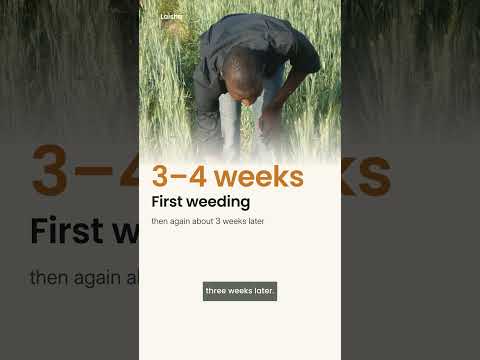
Weed by hand or with a small hoe about three to four weeks after the crop comes up. Weed a second time about three weeks later if weeds are still coming. That puts your work right inside the critical period.
Hand and mechanical weeding leave no residues,
and suit small fields. They do cost labour, and they need dry weather. Whatever method you use, pull weeds before they make seed.
And if your stand has bare gaps, weed those gaps now:
bare soil that grows weeds is worse than bare soil alone.
Herbicides used in wheat are selective.
They kill the weeds and spare the crop, mostly because wheat breaks them down faster than the weed does. The Herbicide Resistance Action Committee, HRAC, groups them by mode of action, and many labels print the group number.
Here are the groups that Laisha's herbicide guide lists, with example active ingredients.
Group one: ACCase inhibitors, such as clodinafop,
fenoxaprop and pinoxaden.
They kill grass weeds.
In wheat, clodinafop is sold together with a safener,
cloquintocet-mexyl, which switches on the crop's own detox enzymes but does not protect the weed.
Group two: ALS inhibitors, such as metsulfuron. They work at very low doses, and resistance to them is common.
Group three: microtubule inhibitors, such as pendimethalin.
It is used pre-emergence, after sowing and before the crop and the weeds come up, against small-seeded weeds germinating near the surface.
Group four: synthetic auxins, such as two four D and MCPA.
They control broadleaf weeds in cereals.
And group five: photosystem two inhibitors, such as isoproturon. This is the group to which Phalaris minor became resistant,
as you will see in a moment.
Which of these are registered for wheat, and at what dose, depends on your country.
Check the label, and never buy by brand name alone.
Selectivity holds only within a window.
The label tells you the crop, the growth stage, the dose and the timing, and you must follow all four. A pre-emergence herbicide goes on after sowing and before emergence.
A post-emergence herbicide goes on emerged weeds, while they are small and inside the critical period.
Wheat sprayed at the wrong stage, or at the wrong dose, can still be injured, even by a herbicide that is selective in wheat.
Do not spray a crop stressed by drought, frost or waterlogging. It breaks the herbicide down more slowly and is more easily injured. Pre-emergence herbicides are more active on light soils with little organic matter, so rates are often lower there.
The dose on the label is useless if you do not know what your sprayer delivers.
To calibrate a knapsack sprayer, spray a measured area of ten by ten metres with water, at your normal walking speed. If you use four litres, you are spraying four hundred litres per hectare. Here is the dose sum from Laisha's herbicide guide, as a worked example only. If a label gives one kilogram of active ingredient per hectare,
and the product holds three hundred and thirty grams per litre, you need about three litres of product per hectare. With your label, use your own numbers.
Finally, check the rotation restrictions.
Some persistent herbicides, such as certain group two and group four products, can injure the next crop.
Phalaris minor in north-west India is the classic warning.
It was controlled with isoproturon, a group five herbicide, year after year, and in the nineteen nineties it became resistant.
Worldwide, hundreds of weed species are now resistant to at least one herbicide.
Resistance is evolution in your own field. Every spray kills the plants it can, and the survivors seed the next generation.
To slow it down, rotate and mix HRAC groups, not brand names: two brands with the same group number count as one. Spray only when needed, at the full label rate and with good coverage.
If a product stops working, do not double the dose. Switch to an effective product from a different group.
And combine herbicides with a competitive crop, hoeing and clean seed, which weeds cannot resist in the same way. Above all, do not let survivors set seed.
Now, safety.
Read the label before you buy, mix or spray.
Wear what the label asks for: chemical-resistant gloves, long sleeves and trousers, boots and eye protection.
Gloves matter most, because most farm poisoning happens through the skin,
and handling the concentrate while mixing is the riskiest step. Mix outdoors, measure carefully, and do not eat, drink or smoke while you work.
Wash afterwards.
Use flat-fan nozzles, which are standard for herbicides,
and the coarsest droplets that still give good cover.
Spray when the wind is light and steady, and leave a buffer zone near water.
Store herbicides locked, in their original containers, away from food, feed, children and animals.
Triple-rinse empty containers into the spray tank, puncture them, and never reuse them for food or water.
If someone is exposed, remove contaminated clothing, wash the skin with plenty of water, and get medical help at once, taking the label with you.
To recap.
Grass weeds that look like wheat are the hardest to spot, so learn your crop's leaf.
Weeds hurt wheat most in the first six to eight weeks. A thick, even, on-time crop is your first weed control.
Hoe at three to four weeks, and again three weeks later. If you use herbicides, choose by HRAC group, follow the label for stage, dose and timing, and calibrate your sprayer. Rotate groups, never let weeds set seed, and spray safely.
For more on wheat, and on every crop, visit laisha.ai. Thank you for watching.