A few aphids on a cereal, or a few caterpillars on a cabbage, cost less than the spray that would kill them. Yet for decades, farmers were told to spray on a fixed calendar, whether pests were there or not.
And it backfired.
Integrated pest management, or IPM, is the answer that replaced it. It combines every suitable method, biological, cultural, physical and chemical, to keep pests below the level that causes economic harm, with the lowest possible risk to people and the environment.
In this video: why calendar spraying failed, the four building blocks of IPM, how to decide when to act, a full season of IPM in one crop, and safety. The advice is general and global. Your local extension service and the product label always come first.
After the Second World War, cheap synthetic insecticides made calendar spraying the norm.
Within two decades, its problems were obvious.
Textbooks call it the pesticide treadmill.
First, resistance.
Pests evolved resistance to one product after another, so more sprays and new chemicals were needed. Second, resurgence.
Spraying killed natural enemies along with the pest, so pest numbers bounced back higher than before.
Third, secondary pests.
Species that natural enemies had kept in check became pests once those enemies were gone.
Spider mites and whiteflies are common examples.
Add residues, harm to workers, consumers, pollinators, birds, fish and water, and rising costs with falling returns.
The classic case is the brown planthopper in tropical Asian rice, in the nineteen seventies and eighties. Heavy insecticide use killed the spiders and other predators that normally controlled it, and severe outbreaks followed. Programmes that cut insecticide use, used resistant varieties,
and trained farmers to recognise natural enemies brought the outbreaks under control.
In nineteen fifty-nine, four scientists, Stern, Smith, van den Bosch and Hagen, proposed integrated control:
combining biological and chemical control, guided by economic thresholds.
It broadened into IPM in the nineteen seventies, and today it is the basis of plant protection policy in many countries and in international guidance from FAO and WHO.
Behind the official definition sit three simple ideas.
Prevent first.
Decide with information.
And when you must act, use the least disruptive method that works.
Think of a pyramid: broad layers of prevention at the base, and chemical control at the narrow top, used only when monitoring shows it is needed.
The first building block is to grow a crop that pests find hard to exploit.
Resistant and tolerant varieties are the cheapest and most compatible tool. A resistant plant may harm the pest's survival or growth, which is called antibiosis.
It may be unattractive for feeding or egg-laying, called antixenosis. Or it may simply yield despite the pest, which is tolerance.
Then cultural practices: crop rotation, sowing dates that escape peak pest periods, destroying crop residues and volunteer plants,
clean seed and planting material, proper spacing and irrigation,
and balanced fertiliser.
Excess nitrogen makes many crops more attractive to sucking pests.
Habitat management shelters natural enemies with field margins,
flowering strips and hedges.
The push-pull system intercrops maize with a repellent legume and borders it with an attractive grass, so stemborer moths are pushed away from the crop and pulled to the border.
And quarantine rules keep new pests out in the first place.
The second building block is monitoring.
Without it, there is no IPM, because the decision to act must rest on what is actually in the field.
Scout regularly, counting pests, damage and natural enemies, walking a zigzag or W pattern across the field. Use traps: pheromone traps for one species, light traps, and coloured sticky traps.
And where they exist, use forecasts based on weather and degree-days.
Then compare your counts with a threshold.
The economic injury level is the lowest pest density at which the crop you save is worth the cost of control. The economic threshold, or action threshold, is set below it, because control takes time to arrange and to work, while the pest keeps multiplying.
Here is the worked example from Laisha's guide.
Each caterpillar per square metre cuts a grain crop's yield by twelve kilograms per hectare. The grain is worth half a currency unit per kilogram.
Treatment costs twenty-four units per hectare, and prevents eighty per cent of the injury. The injury level is twenty-four, divided by half times twelve times zero point eight. That is five caterpillars per square metre. So you might act at four.
And if the grain price doubles, the injury level halves, to two and a half. Thresholds move with prices.
Feeding thresholds do not suit everything.
A single insect carrying a virus can do great damage, so vector control is preventive.
Quarantine pests have zero tolerance.
And for fresh produce, a few blemishes can make it unsaleable.
The third building block is non-chemical intervention.
Biological control comes in three forms.
Conservation protects the natural enemies already present, by avoiding broad-spectrum sprays and providing habitat.
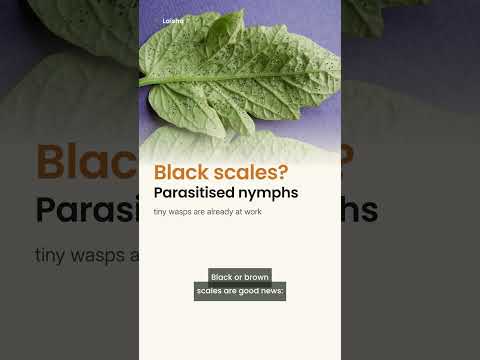
Ladybirds, hoverfly larvae, spiders and tiny parasitic wasps suppress many pests continuously, and for free.
Augmentation releases reared natural enemies, such as Trichogramma wasps that lay their eggs inside moth eggs, or predatory mites in greenhouses.
And classical biological control brings in a natural enemy from a pest's home region. The first great success was the vedalia beetle,
introduced against cottony cushion scale in California citrus in eighteen eighty-eight and eighty-nine.
Biopesticides are based on bacteria such as Bacillus thuringiensis, on fungi, viruses and nematodes, or on plants.
Pheromones disrupt mating or mass-trap moths.
And physical methods include nets, row covers, barriers, hand-picking, sticky bands and light traps.
The fourth building block is chemical control,
used only when monitoring shows a threshold has been reached and other measures are not enough.
Choose selective products that spare natural enemies and pollinators where possible. Rotate modes of action, using the IRAC groups for insecticides,
FRAC for fungicides and HRAC for herbicides, to slow resistance.
Apply only where needed, with spot or band treatments, at the correct timing and the label dose.
Follow the label, the re-entry interval and the pre-harvest interval.
And use only products approved in your country, because registrations differ and change over time.
Here is a season of IPM from Laisha's guide. A smallholder grows cabbage, attacked mainly by the diamondback moth, a pest notorious for resistance to many insecticides.
Before planting, rotate away from brassicas,
plant healthy seedlings raised under netting, destroy old crop residues, and plant a flowering border to support parasitic wasps. Twice a week, walk a zigzag across the field, examine a fixed number of plants, and check pheromone traps for moth flights. While counts stay below the local action threshold, do nothing except keep scouting.
Parasitoids may be keeping the pest in check.
If the threshold is reached, use a Bacillus thuringiensis product first, because it is selective and spares most natural enemies.
If a chemical is needed, choose a different IRAC group from the last one used,
and never repeat the same group in successive generations of the pest. Then record what you found, what you did and the result.
Compared with weekly calendar spraying, programmes like this commonly cut insecticide applications substantially while maintaining yield, with lower costs and less resistance.
IPM is knowledge-intensive.
It needs farmers who can recognise pests and natural enemies,
thresholds that fit local conditions, and advice that is independent of product sales.
Farmer field schools, where a group of farmers studies one field through a whole season, began with rice IPM in Asia and have been used across Asia, Africa and Latin America to build exactly these skills.
When a spray is justified, do it safely.
Read the label before you buy, mix or spray.
Wear what the label asks for: chemical-resistant gloves, long sleeves and trousers, boots and eye protection.
Gloves matter most, because most farm poisoning happens through the skin,
and handling the concentrate while mixing is the riskiest step. Mix outdoors, measure carefully, and do not eat, drink or smoke while you work.
Calibrate your sprayer, spray when the wind is light, and leave a buffer zone near water.
Store pesticides locked, in their original containers, away from food, feed, children and animals.
Triple-rinse empty containers, puncture them, and never reuse them. If someone is exposed, remove contaminated clothing, wash the skin with plenty of water, and get medical help at once, taking the label with you.
To recap.
Calendar spraying caused resistance, resurgence and secondary pests.
IPM prevents first, with resistant varieties, good cultural practice and habitat for natural enemies.
It monitors, and acts only at the threshold.
It uses biological, behavioural and physical methods first.
And when chemicals are justified, it chooses selective products, rotates IRAC, FRAC or HRAC groups, sprays only where needed, and follows the label.
For pest guides and the full IPM explainer, visit laisha.ai. Thank you for watching.