The diamondback moth is the most destructive insect of cabbage,
cauliflower, broccoli and the other brassicas worldwide.
Its caterpillar is barely a centimetre long. But it breeds so fast, and has been sprayed so often, that it was the first crop pest to resist Bacillus thuringiensis in the field,
and it has resisted almost every insecticide group used against it.
In this video: how to tell it from the other cabbage caterpillars, why it multiplies so fast, how to scout it, the threshold that changes when the head starts to form, the prevention that starts in the nursery, its natural enemies, and a spray plan that does not breed resistance.
The advice is general and global.
Your local extension service and the product label always come first.
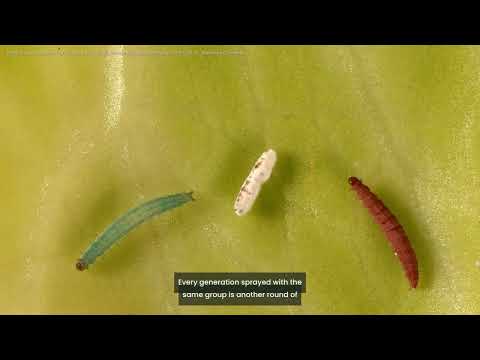
Start with identification, because three different caterpillars chew cabbage leaves, and they are not managed the same way.
The diamondback caterpillar is small: pale to bright green, up to about one centimetre, and tapered at both ends, with the last pair of legs forming a V at the rear.
Touch it, and it wriggles violently backwards and drops off the leaf on a silk thread. That is the wriggle test. Its pupa sits in a loose, open-mesh white cocoon on the leaf.
The moth is slender and grey-brown, six to eight millimetres long,
and resting males show a row of pale diamonds along the back.
The cabbage looper is much bigger, three to four centimetres, pale green with thin white lines along the sides.
It walks by arching its back into a loop, and it does not wriggle backwards.
The imported cabbageworm, the caterpillar of the small white butterfly, is velvety green with a faint yellow line down the back, and it moves slowly.
The damage depends on the stage of the crop. In seedlings, the first young caterpillars mine inside the leaf,
and they can destroy the growing point. Before heading, they leave irregular holes and windowpanes,
where only a thin transparent skin of the leaf is left, mostly on the outer leaves.
Then, at heading, the caterpillars, their droppings and cocoons end up inside cabbage heads and in broccoli and cauliflower florets. That contamination is what makes produce unsaleable.
In tropical and subtropical regions, losses of fifty to ninety per cent have been reported in unprotected crops.
The secret of this pest is speed.
A female lays one hundred and fifty to three hundred eggs, tiny and pale yellow, along the leaf veins,
mostly on the underside.
The caterpillars feed for about eight to fourteen days at twenty to twenty-five degrees.
A whole generation takes about two to three weeks at twenty-five degrees,
and as little as two weeks in hot weather.
It develops anywhere from about seven or eight degrees up to thirty-two to thirty-five degrees, and it has no resting stage.
So in the tropics it can run through about twenty generations a year; in temperate regions, four to six.
Every generation sprayed with the same group is another round of selection for resistance.
It loves dry, warm weather, because heavy rain washes the caterpillars off and drowns them.
And it thrives where brassicas are grown back to back, with overlapping plantings, infested transplants, and broad-spectrum sprays that wipe out its parasites.
Laisha's cabbage guide says to scout twice a week in three critical windows:
right after transplanting, at thinning, and just before the heads begin to form.
Check at least twenty to twenty-five plants per field, turning the leaves to look underneath, and looking into the heart of the plant.
On cauliflower and broccoli, check the curds and heads themselves, not only the leaves.
Use pheromone traps to see when moth flights start and peak, so you know when to look harder.
Thresholds use the share of plants with caterpillars, and they change at cupping, when the head starts to form.
Before cupping, the crop can lose some outer leaves without losing yield.
One North American guideline acts only when half the plants carry five or more caterpillars each.
After cupping, the caterpillars contaminate what you sell,
and the same guideline drops to just ten per cent of plants with even one caterpillar.
A study in southern Africa set the level at about half the plants infested in the winter-spring crop.
These numbers come from a few regions, so adapt them with your extension service.
Most diamondback problems arrive on the transplants. So raise seedlings free of the pest, under netting, away from production fields.
Fine-mesh netting or row covers also protect seedbeds and high-value crops.
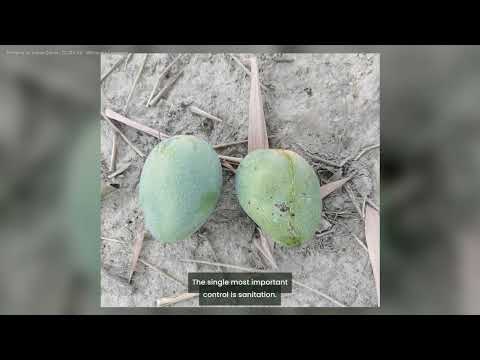
After harvest, destroy the crop residues immediately,
and leave a brassica-free break in the area, so each new crop does not inherit caterpillars from the last. Some growers plant a trap crop, such as rows of Indian mustard sown before the cabbage, to concentrate egg laying where it can be managed.
And in some systems, overhead sprinkler irrigation in the evening reduces the caterpillars and egg laying, using the same weakness that rain exploits. On small plots, simply pick the caterpillars off by hand.
The diamondback moth's most important enemies are tiny parasitic wasps. Parasitised caterpillars and the wasps' own cocoons are a sign that they are working. Where these wasps were introduced into highland brassica regions of Asia and Africa and growers cut back their spraying, the pest fell substantially.
So record parasitised caterpillars and cocoons before you decide to spray.
Bacillus thuringiensis, IRAC group eleven A, remains a key selective tool, because it kills caterpillars and spares the wasps.
Insect-killing fungi and a granulovirus also infect the caterpillars. And for loopers, watch for sluggish, discoloured caterpillars hanging limp: a natural virus often makes looper outbreaks collapse on their own.
Field resistance in the diamondback moth is documented to essentially every group used heavily against it: IRAC groups one, three A, five, six, eleven A, fifteen, twenty-two A and twenty-eight.
Even the diamides, group twenty-eight, now face high-level resistance in parts of Asia and the Americas.
So a new product will not save you. A plan will.
Spray only when the threshold is exceeded, and choose groups that spare the parasites.
Then follow a window strategy: use one group for a period equal to one pest generation, then switch to a different group for the next window,
and never use the same group on consecutive generations.
Lean on Bacillus thuringiensis and the parasites, so the chemical sprays carry less of the load.
The groups listed in Laisha's encyclopedia are eleven A, Bacillus thuringiensis; five, the spinosyns; twenty-eight, the diamides; twenty-two A; six, the avermectins; and fifteen, which acts at moulting. For loopers, group eighteen is also listed.
Sprays work best on young caterpillars. Use only products registered for your crop in your country, at the label dose, with the pre-harvest interval respected.
To recap.
Use the wriggle test: a small green caterpillar that wriggles backwards and drops on silk is the diamondback moth.
Scout twice a week at transplanting, thinning and just before heading,
at least twenty to twenty-five plants, undersides and hearts.
Tolerate more before cupping, act much earlier after it. Start with clean, netted transplants, destroy residues,
and keep a brassica-free break.
Protect the parasitic wasps, use Bacillus thuringiensis,
and rotate groups by generation windows.
For the full cabbage and cauliflower guides and the pest encyclopedia, visit laisha.ai.
And before you go: Laisha Lens number one is out, our free guide to November, for every climate zone on Earth.
North of the equator, the cool-season crops go in:
winter wheat and garlic in the temperate north,
wheat, barley and lentil on the autumn rains of the Mediterranean,
and on the plains of South Asia the whole rabi season,
wheat, mustard, chickpea and potato.
South of the equator it is spring, and the tropical south sows soybean, maize, cotton and rice on the first rains.
Lens also covers crop residue without fire, the pests worth walking the field for, and a study plan for agri students.
Open My farm's November, choose your zone and up to three crops, and it builds your field jobs, week by week, with the pests to scout for. It is free, and needs no account. Our free November Lens, with your farm's month plan, is on laisha.ai slash lens.
From all of us at Laisha: may your fields do well this season. Thank you for watching.