November is a hinge month. North of the equator the cool-season crops go in: winter wheat and garlic in the temperate north, wheat, barley and lentil on the autumn rains of the Mediterranean, and on the plains of South Asia the whole rabi season, wheat, mustard, chickpea and potato, sown into the moisture the monsoon left behind. South of the equator it is spring, and the tropical south sows its soybean, maize, cotton and rice on the first rains.
Lens is a guide to one month at a time. It does not repeat the farming calendar; it takes the calendar's November and adds what you need to act on it: the jobs in the order they come, the pests worth walking the field for, the stages where water matters most, and, for students, what to study while the fields are being sown.
Everything in these pages comes from Laisha's own guides, pest encyclopedia, Explains articles, calendar and question banks, and every section says where. Where our data does not hold a number, we do not print one: no prices, no forecasts and no exam dates. For those, your local extension office, your exam body's website and your nearest market are the right places to ask.
Two things to do with this issue. Turn to the page for your climate zone first; it is written for where you are. Then open My farm's November at laisha.ai, choose your zone and up to three crops, and it builds this month's checklist for your own fields, week by week. It is free and needs no account.
Six broad climate zones, three north of the equator and three south, from Laisha's farming calendar. Inside every zone the real dates move with latitude, altitude, rainfall, irrigation and variety, sometimes by a month or more; your national crop calendar or extension service decides. Find your zone, then turn to its two pages.
Europe, North America, northern China, Korea and Japan, Central Asia
Winter wheat and garlic are the last sowings before the ground gets cold; the maize, sugar beet and cotton harvest finishes. Winter barley and rapeseed are already up, and in a mild autumn aphids keep flying and breeding later than usual on young cereals.
Cold winters and a frost-free summer: most field crops are sown in spring and harvested by autumn; winter cereals and rapeseed are sown in autumn.
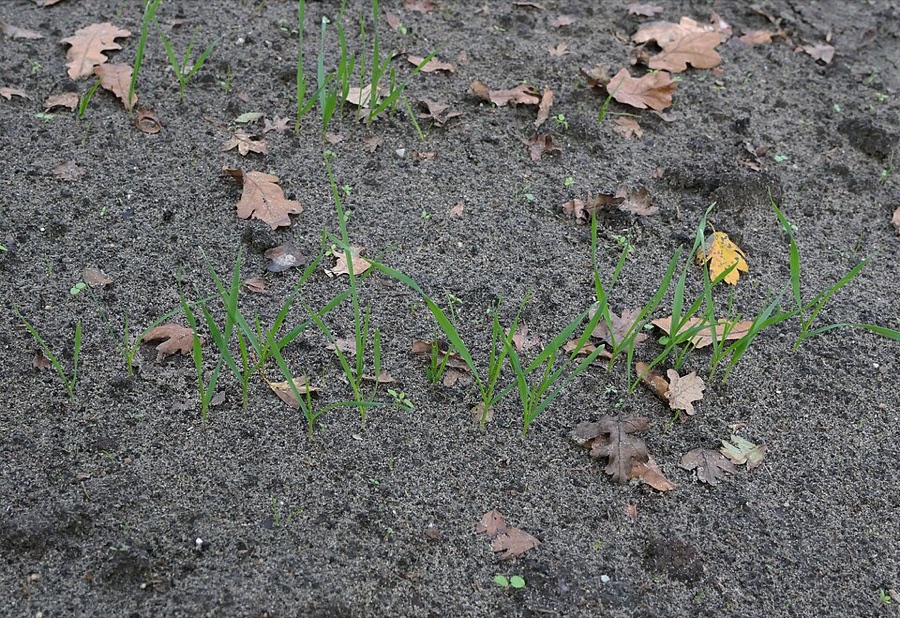
Young wheat coming up evenly. This is what a good, even stand looks like a couple of weeks after sowing.
Sow and plant now
Wheat (winter wheat)Sowing at the right time. Wheat sown late almost always gives less, no matter what else you do.
Barley (winter barley)A cool growing season, well-drained soil that is not strongly acid, and nitrogen applied in the right amount at the right time — too little limits yield, too much (or too late) ruins malting quality and causes lodging.
Rapeseed (winter rapeseed)A fine, firm, well-drained seedbed and moisture at establishment. The seed is very small and the crop's whole season is decided in the first three weeks.
Temperate north, continued
Harvest now
MaizeFor dry grain, wait until the husks are brown and the grain is hard as a stone.
Sugar beetJudge real harvest timing by root size, leaf condition and your own local season length rather than a fixed date, since a root left too long or lifted too early both cost real money.
CottonWait until a real, meaningful share of bolls across the field have opened and the exposed lint has dried, rather than picking too early into damp or unopened bolls.
CabbageJudge readiness by firmness and real expected size together, since a head can look large while still being loose and immature inside.
Fall armywormon Maize, Cotton, WheatFavoured by: Warm weather with dry spells between rains favours outbreaks; heavy rain drowns young larvae in the whorl.
Choose up to three crops and, if they are already in, the date you sowed. My farm's November turns this page into a week-by-week checklist for your fields. Free, no account.
Sources: Laisha farming calendar; tips from each crop's grow guide; pests from the Laisha pest encyclopedia, listed where a host crop is in the field and the pest's recorded distribution includes this zone.
The Mediterranean basin, North Africa, the Middle East and West Asia, California
The autumn break is sowing time for rain-fed grains and pulses: wheat, barley, lentil and faba bean go in as the winter rains begin, while the irrigated summer crops, cotton and the autumn potato, come out.
Mild wet winters and hot dry summers: rain-fed grains and pulses grow through the winter; summer crops need irrigation.
Young wheat coming up evenly. This is what a good, even stand looks like a couple of weeks after sowing.
Sow and plant now
WheatSowing at the right time. Wheat sown late almost always gives less, no matter what else you do.
BarleyGetting nitrogen timing right for malting-quality grain while avoiding lodging, and then getting the crop off the field before wet weather at maturity causes pre-harvest sprouting or Fusarium mould in the ear.
LentilInoculate seed with the correct living bacteria where the land is new to lentil, then sow shallow and early into a well-prepared bed.
Faba beanManaging chocolate spot, this crop's own most damaging real fungal disease, and making sure everyone who eats this crop, or feeds it to a child, honestly knows about favism first.
Growing: manage and protect
Nothing in the main calendar this month.
Mediterranean and dry north, continued
Harvest now
CottonWait until a real, meaningful share of bolls across the field have opened and the exposed lint has dried, rather than picking too early into damp or unopened bolls.
Potato (autumn crop)Cut or kill the tops about two weeks before digging. This is a real, standard, deliberate step, not an accident.
OliveDecide your real target product before you pick a single fruit -- pressed oil, or cured table olives.
OrangeUnderstand plainly that once cut, this fruit will not get any sweeter.
Date palmJudge readiness by real, visible ripening stage, not the calendar, and expect to return to the same palm more than once in a season, since fruit ripens unevenly across one bunch.
Cotton jassid (two-spot cotton leafhopper)on Cotton, PotatoFavoured by: Warm, humid weather; smooth-leaved (less hairy) varieties; heavy nitrogen; continuous cropping of cotton, okra and eggplant.
Cowpea aphid (black legume aphid)on Lentil, Faba beanFavoured by: Warm, dry spells, drought-stressed crops, late planting, ant attendance, wild legume hosts and loss of natural enemies after broad-spectrum sprays.
Make this plan for your own crops
Choose up to three crops and, if they are already in, the date you sowed. My farm's November turns this page into a week-by-week checklist for your fields. Free, no account.
Sources: Laisha farming calendar; tips from each crop's grow guide; pests from the Laisha pest encyclopedia, listed where a host crop is in the field and the pest's recorded distribution includes this zone.
South Asia, mainland Southeast Asia and southern China, West Africa and the Sahel, Central America and the Caribbean
The wet season is over. The kharif harvest (rice, sorghum, groundnut, cotton, cowpea) and the rabi sowing (wheat, chickpea, mustard, potato) overlap, and the weeks between them decide the season. South Asia is this zone's largest example, and the next two pages are for it.
A wet season from about June to October and a cooler dry season after it: rain-fed crops follow the rains, and a second, irrigated or residual-moisture crop follows in the cool months.
Wheat (cool dry-season wheat)Sowing at the right time. Wheat sown late almost always gives less, no matter what else you do.
ChickpeaTelling desi and kabuli seed and their two real markets apart before you sow, and staying ahead of Ascochyta blight and the pod borer, this crop's own two most globally significant real disease and pest problems.
MustardGetting an even stand from a very small seed. Mustard seed is tiny, it must be sown shallow into moisture, and a field sown too deep or into a rough seedbed will come up in patches.
Potato (cool-season potato on the plains)Getting clean, healthy seed tubers, and keeping them clean. The potato carries its own diseases inside the seed you plant, so a mistake made once repeats every season until you break it.
Onion & shallot (dry-season onion)Getting the day-length variety right for your own latitude, and giving the harvested bulbs a real, full two-to-four-week curing period before storage rather than rushing them into a sack while the neck is still soft.
Growing: manage and protect
Pigeon peaDeep soil that drains, and the right sowing date, because this plant decides when to flower by the length of the day rather than by how long it has been growing.
Cassava· harvested 8 to 24 months after plantingWarmth and a piece of healthy stem. It needs less good soil and less water than almost any other food crop.
Tropical and monsoon north, continued
Harvest now
Rice (wet-season rice)Cut when most of the grain is hard and golden, not before, not long after.
SorghumCut when the grain is hard and the head has changed colour, and do not leave it standing.
GroundnutYou cannot see the crop, so you have to go and look. Scrape a few pods and read the colour inside.
CottonWait until a real, meaningful share of bolls across the field have opened and the exposed lint has dried, rather than picking too early into damp or unopened bolls.
CowpeaCowpea pods ripen unevenly, so harvest usually happens over more than one pass, timed differently for grain than for a vegetable pick.
Sugarcane· also planted October to November; cut through the dry seasonUnderstand ripening as its own real phase, not simply 'the crop getting old'. It commonly occupies roughly the final three months before harvest.
CoffeeRemember the real, honest fact that decides this whole stage: cherries on the same branch ripen unevenly, sometimes showing green, yellow and red fruit side by side at once.
Cocoa· main crop; a smaller mid-crop follows in May to August
Scout for this month
Cotton bollworm (Old World bollworm)on Cotton, Chickpea, Pigeon pea, Tomato, SorghumFavoured by: Warm, dry weather; a landscape with a succession of flowering hosts (for example maize, sorghum and chickpea before cotton).
Cowpea aphid (black legume aphid)on Cowpea, Groundnut, Chickpea, Pigeon peaFavoured by: Warm, dry spells, drought-stressed crops, late planting, ant attendance, wild legume hosts and loss of natural enemies after broad-spectrum sprays.
Fall armywormon Sorghum, Rice, Cotton, WheatFavoured by: Warm weather with dry spells between rains favours outbreaks; heavy rain drowns young larvae in the whorl.
African armywormon Sorghum, Rice, WheatFavoured by: The first heavy rains after a dry period, when fresh grass growth and moth concentration by storm winds coincide.
Bacterial wilt (Ralstonia wilt, brown rot of potato)on Tomato, Potato, GroundnutFavoured by: Warm, wet soils; poorly drained fields; irrigation with contaminated surface water; continuous cropping of solanaceous crops.
Make this plan for your own crops
Choose up to three crops and, if they are already in, the date you sowed. My farm's November turns this page into a week-by-week checklist for your fields. Free, no account.
Sources: Laisha farming calendar; tips from each crop's grow guide; pests from the Laisha pest encyclopedia, listed where a host crop is in the field and the pest's recorded distribution includes this zone.
Argentina, Uruguay and southern Brazil, south-eastern Australia, New Zealand, the South African highveld
Spring: maize, soybean, sunflower and tomato are sown, the potato crop grows, and the winter wheat, barley, rapeseed and garlic sown in May to July come to harvest.
The northern calendar shifted by six months: spring sowing in September to December, winter cereals sown in May to July.
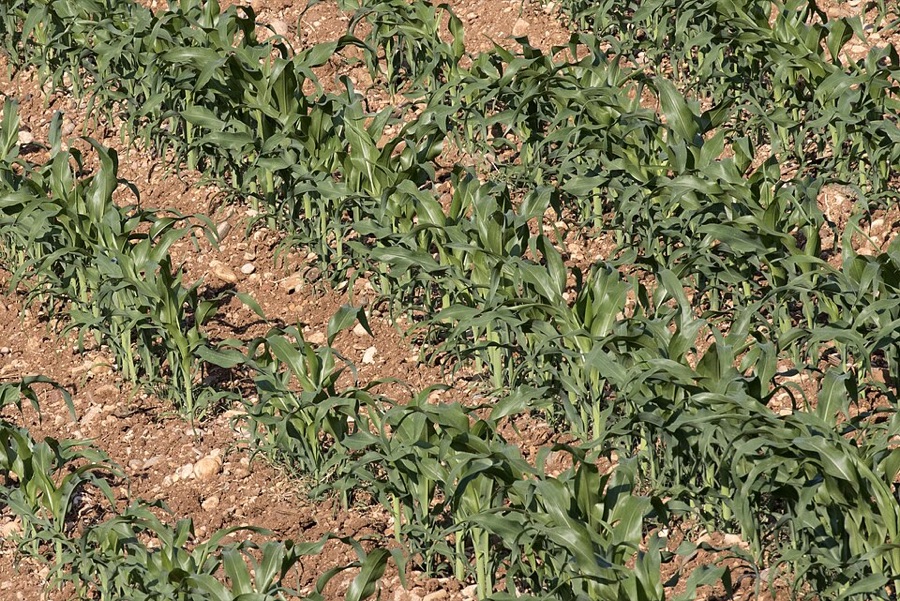
Healthy young maize, evenly spaced in rows. This is what a good stand looks like a few weeks after planting.
Sow and plant now
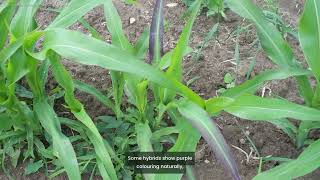
MaizeCaterpillars in the young plants, and keeping the dried grain safe from insects and mould.
PotatoCool weather and healthy seed tubers. Nights around 16 degrees Celsius are when tubers form best, and average days of 18 to 20 degrees give the best yields. Heat is the enemy, not drought.
Temperate south, continued
Harvest now
WheatCut when the whole plant has gone golden and the grain is hard, not soft.
BarleyWatch the crop through grain fill for the classic ripening sequence: the ear and straw turn from green through gold to a uniform pale straw colour.
RapeseedCut or combine as the pods turn but before they open, because this crop drops its seed on the ground the moment it is over-ripe.
GarlicThe plant tells you when it is ready, and the signal is counted in leaves rather than dates.
Scout for this month
Black cutwormon Maize, Potato, Tomato, Sunflower, Soybean
Cotton bollworm (Old World bollworm)on Tomato, Maize, Soybean, SunflowerFavoured by: Warm, dry weather; a landscape with a succession of flowering hosts (for example maize, sorghum and chickpea before cotton).
Choose up to three crops and, if they are already in, the date you sowed. My farm's November turns this page into a week-by-week checklist for your fields. Free, no account.
Sources: Laisha farming calendar; tips from each crop's grow guide; pests from the Laisha pest encyclopedia, listed where a host crop is in the field and the pest's recorded distribution includes this zone.
WheatCut when the whole plant has gone golden and the grain is hard, not soft.
BarleyWatch the crop through grain fill for the classic ripening sequence: the ear and straw turn from green through gold to a uniform pale straw colour.
RapeseedCut or combine as the pods turn but before they open, because this crop drops its seed on the ground the moment it is over-ripe.
LupinHarvest when the pods have gone dark and leathery and the seeds rattle, and do not wait for the last side branch.
Faba beanWatch the pods and the seed inside them rather than the calendar, since this crop's own real maturity window genuinely ranges from 90 to 220 days depending on variety and climate.
ChickpeaWatch the plant and pods rather than the calendar, since this guide could not independently confirm one universal days-to-maturity figure for chickpea we.
LentilWait until the whole plant dries down and turns a pale straw colour, with most pods on the plant showing the same dry, papery colour change.
Cowpea aphid (black legume aphid)on Lentil, Faba bean, ChickpeaFavoured by: Warm, dry spells, drought-stressed crops, late planting, ant attendance, wild legume hosts and loss of natural enemies after broad-spectrum sprays.
Cotton bollworm (Old World bollworm)on Chickpea, TomatoFavoured by: Warm, dry weather; a landscape with a succession of flowering hosts (for example maize, sorghum and chickpea before cotton).
Choose up to three crops and, if they are already in, the date you sowed. My farm's November turns this page into a week-by-week checklist for your fields. Free, no account.
Sources: Laisha farming calendar; tips from each crop's grow guide; pests from the Laisha pest encyclopedia, listed where a host crop is in the field and the pest's recorded distribution includes this zone.
Central and western Brazil, southern and south-eastern Africa, Madagascar, northern Australia, Java and the Lesser Sunda islands
The first rains start the main season. Soybean, maize, cotton, rice, groundnut, sorghum and beans are sown, and in Brazil a second maize crop will follow the soybean.
A wet season from about November to March: the main crops are sown on the first rains, and in Brazil a second maize crop follows soybean.
Rice (wet-season rice)Getting water at the right time, and keeping weeds out in the first month.
GroundnutTwo things. Lifting at the right time, because you cannot see the crop.
SorghumBirds. Birds are the single biggest reason sorghum farmers lose their crop.
Common bean (rainy-season beans)Two things. Keeping the seedling alive through the first three weeks, and keeping weevils out of the store afterwards.
TobaccoMove graded, healthy seedlings to their prepared field position once they have reached a workable size, and protect them through their first fragile days after the move.
Cassava· harvested 8 to 24 months after plantingGetting clean, healthy planting stems, and using the roots quickly once you dig them.
Growing: manage and protect
Nothing in the main calendar this month.
Tropical south, continued
Harvest now
Sugarcane· cut through the dry seasonUnderstand ripening as its own real phase, not simply 'the crop getting old'. It commonly occupies roughly the final three months before harvest.
MangoCount days from flowering, not from planting. Most varieties take roughly 100 to 150 days from flower opening to a fruit ready to pick.
Fall armywormon Maize, Sorghum, Rice, Sugarcane, CottonFavoured by: Warm weather with dry spells between rains favours outbreaks; heavy rain drowns young larvae in the whorl.
Cotton bollworm (Old World bollworm)on Cotton, Maize, Sorghum, SoybeanFavoured by: Warm, dry weather; a landscape with a succession of flowering hosts (for example maize, sorghum and chickpea before cotton).
Choose up to three crops and, if they are already in, the date you sowed. My farm's November turns this page into a week-by-week checklist for your fields. Free, no account.
Sources: Laisha farming calendar; tips from each crop's grow guide; pests from the Laisha pest encyclopedia, listed where a host crop is in the field and the pest's recorded distribution includes this zone.
India this month · the tropical north's largest example
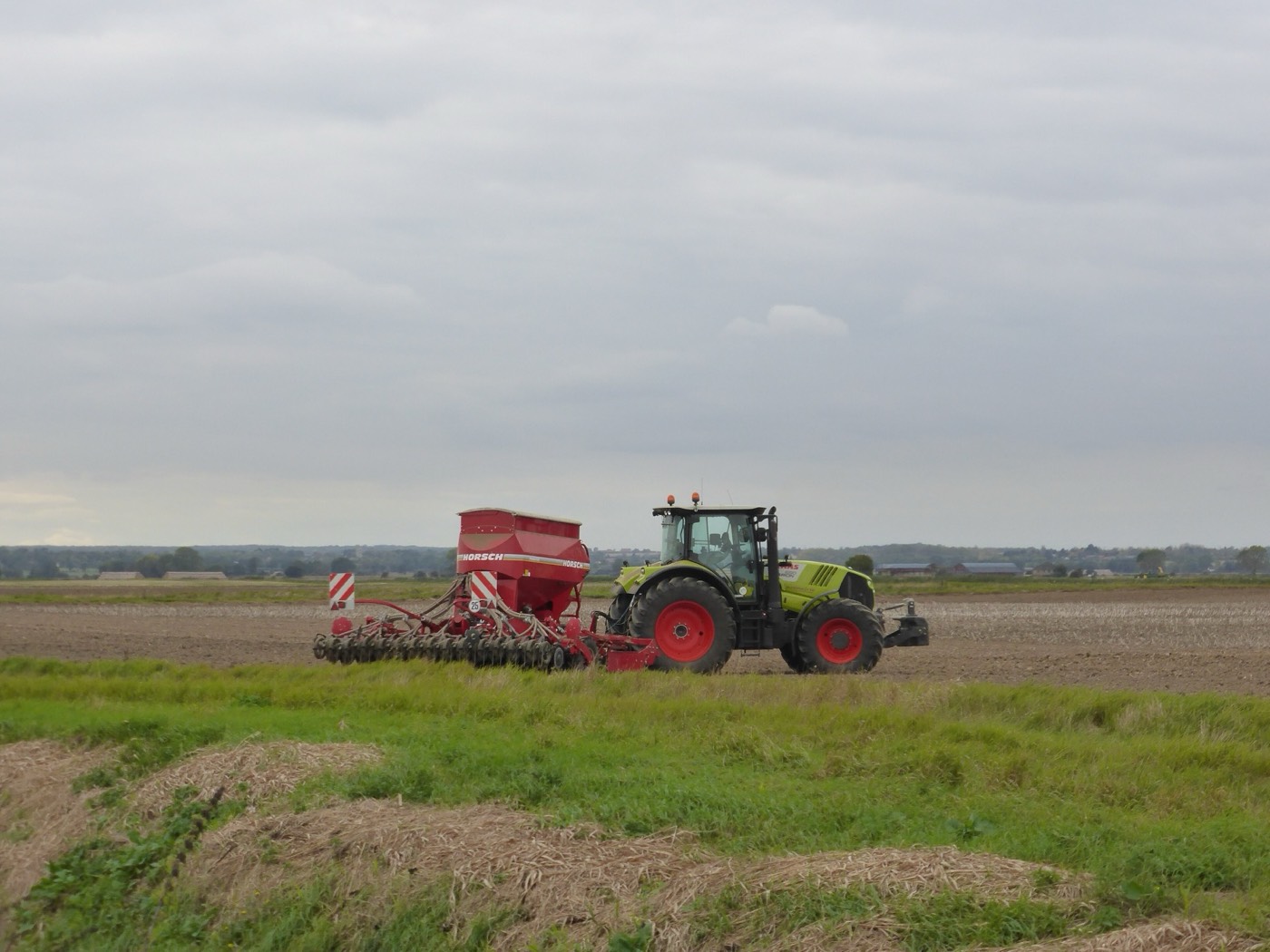
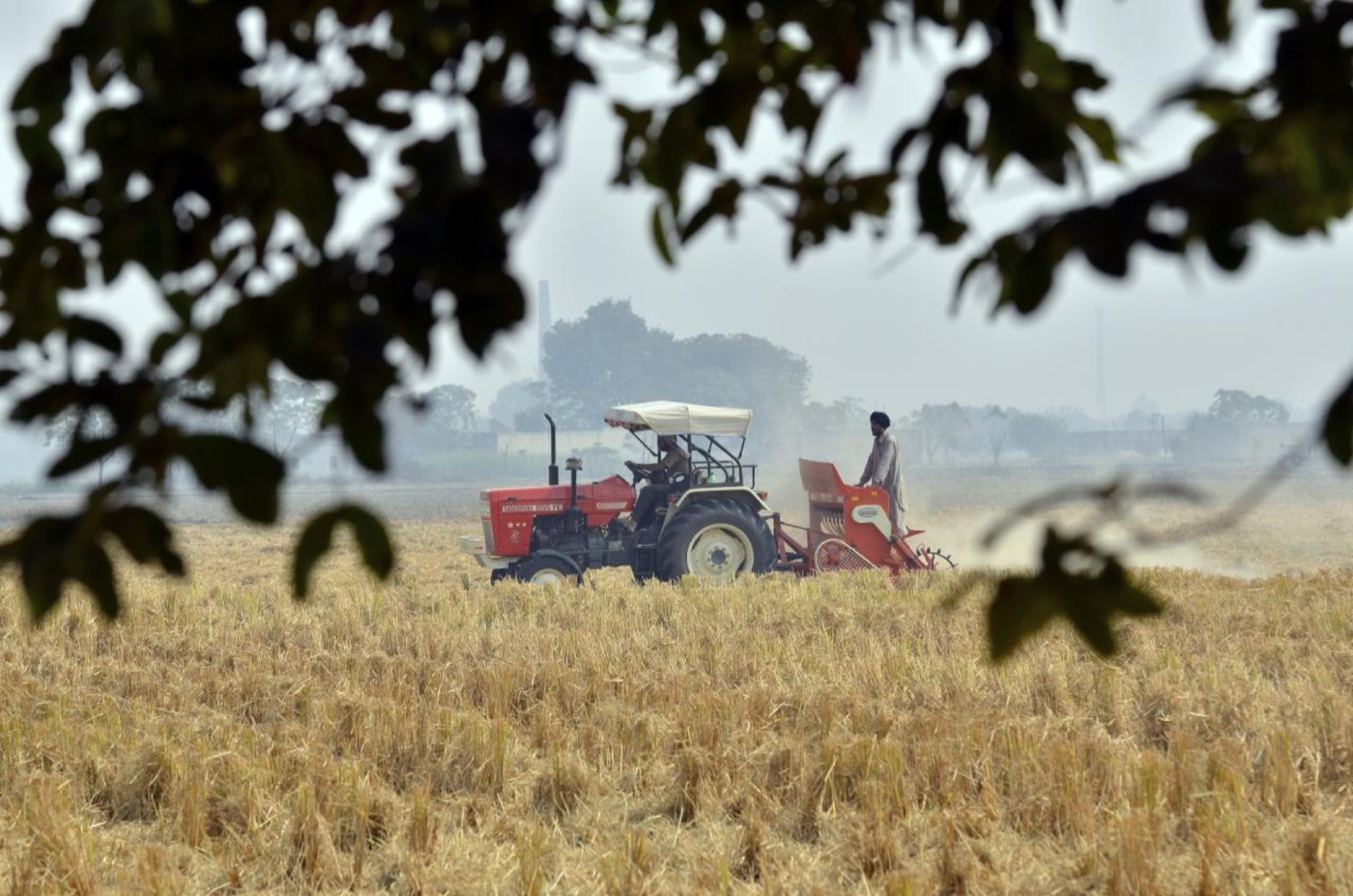
A seed drill: rows, even depth and less seed than broadcasting.
The rabi sowing window
On Laisha's calendar the tropical and monsoon north, which includes South Asia, sows its cool dry-season crops in November: wheat, chickpea, mustard, cool-season potato on the plains and dry-season tomato, with dry-season irrigated rice in the deltas. Our Explains article on crop seasons lists the rabi crops as wheat, barley, chickpea, lentil, mustard and potato, sown after the rains on stored soil moisture or with irrigation. Crop seasons
For wheat on the plains of South Asia, our sowing video gives the best window as running from the end of October to the middle of November, and our heat-stress article names sowing in the first half of November in north-west India as a key way to keep grain filling ahead of the spring heat. The reason is the same in both: when daytime temperatures during grain filling climb above about 30 °C, the grain fills for fewer days and stays smaller, and in warm wheat regions every day of delay after the best window commonly costs around one per cent of yield. How to sow wheat · Heat stress in crops and livestock
Varieties, recommended dates and seed rates are local. Your state agricultural university, Krishi Vigyan Kendra or extension office has the list for your district; this issue gives you the order of jobs and what to watch.
Punjab: a field prepared for wheat without burning the previous crop's stalks.
After the kharif harvest: residue without fire
Our calendar has the tropical north harvesting its wet-season rice, sorghum, groundnut, cotton and cowpea in November, often only days before the rabi crop must go in. That squeeze is where straw gets burned.
Our Explains articles are plain about the cost. Burning crop residues adds methane to the air, and residue removal and burning deplete soil organic matter, the store that holds much of a soil's nutrient supply, water-holding capacity and structure. In the rice–wheat system of the South Asian plains, about 25 million hectares, residue burning is listed alongside groundwater depletion and the tight turnaround as the system's main problems. Cropping systems · Soil organic matter · Greenhouse effect and agriculture
Where residue is too heavy for the seeder you can get, ask your extension office or a custom-hire centre what is available locally; machinery is the constraint our conservation agriculture article names first for smallholders.
In NovemberSown in Temperate north (winter wheat); Mediterranean and dry north; Tropical and monsoon north (cool dry-season wheat) · Harvested in Temperate south; Mediterranean south
Young wheat coming up evenly. This is what a good, even stand looks like a couple of weeks after sowing.
Planting to harvest
About 4 to 6 months, depending on the kind and how cold your winter is.
Needs most
Cool weather while it grows, and dry weather while it ripens.
Hardest part
Sowing at the right time. Wheat sown late almost always gives less, no matter what else you do.
The season, stage by stage
Get the land ready
Choose and get your seed
Sow the seed
Water
Weeds and feeding
Watch for rust
Know when to harvest
Dry it and store it so you do not lose it
Sow the seed
Sow at the start of your cool season, as soon as the soil has enough moisture in it to sprout the seed.
Do not wait for a perfect day. Sowing late loses you more than a slightly imperfect seedbed will.
Sow in rows if you can. Rows let you weed later without trampling the crop.
Leave about the width of your hand between rows. That is roughly 20 cm.
Sow the seed shallow. About as deep as your finger goes in to the second joint. That is roughly 3 to 5 cm.
If your variety is a short, modern one, sow it shallower still. Short varieties have a short shoot and cannot push up from deep down.
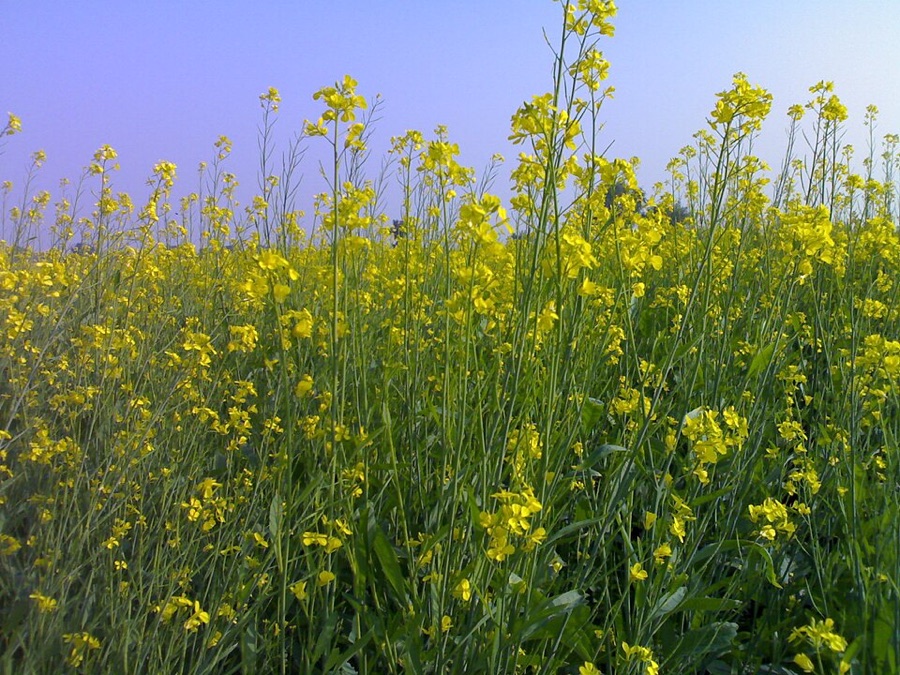
Mustard in full flower — the stage at which a single irrigation does the most good, and at which aphids do the most damage.
Planting to harvest
Roughly 110 to 140 days from sowing to a seed harvest, depending on the type and how cold the winter is.
Needs most
A cool dry growing season and enough moisture at flowering. Mustard is a cool-weather crop: it wants cool days while it is growing and dry weather while the pods fill.
Hardest part
Getting an even stand from a very small seed. Mustard seed is tiny, it must be sown shallow into moisture, and a field sown too deep or into a rough seedbed will come up in patches.
Easiest start
Sow into the moisture left in the soil after the monsoon crop, on a fine, level seedbed, shallow, in rows.
The season, stage by stage
Get the land readyMake a fine, level seedbed that still holds moisture, because a seed this small cannot push through a rough or cloddy surface.
Choose and get your seedBuy seed of a named variety suited to your own sowing date and your own water situation, from somebody who can tell you what it is.
Sow the seedSow shallow, in rows, into moisture, at the right time — this stage decides more about the crop than anything you do later.
WaterMustard needs little water, and almost all of what it needs falls in two moments — early establishment, and flowering.
Weeds and feedingKeep the field clean for the first six weeks and give the crop its nitrogen early, because after that the crop closes over and you can do very little.
Flowering, bees and aphidsThe field turns yellow for several weeks.
Know when to harvestCut when the pods have turned but before they open, because mustard sheds its seed on the ground the moment it is over-ripe.
Thresh, dry and store itDry it properly and keep it dry, because oilseed stored damp spoils faster than grain and loses the oil you are actually selling.
Mustard, continued
Water
Understand that this is a low-water crop. Many farmers grow it entirely on the moisture left in the soil after the monsoon, with no irrigation at all, and get a reasonable crop.
If you can irrigate once, do it at flowering. That is when water shortage costs the most, because the plant is deciding how many pods it can carry.
If you can irrigate twice, water once about three to four weeks after sowing when the plant is branching, and once at flowering.
Do not flood the field. Mustard roots die in standing water faster than most crops, and a field that holds water in patches will show dead patches within days.
Stop irrigating once the pods are formed and filling. Late water makes the crop stay green, delays maturity and raises the risk of lodging.
Weeds and feeding
The first four to six weeks decide the weed battle. A mustard seedling is small and slow at the start, and weeds that get ahead of it in that period are never caught up.
Weed by hand or by hoe between the rows while you still can walk in the crop without breaking it. Once the crop has branched and closed the rows, you are finished weeding for the season.
Thin the crop at the same time if it came up too thick. Plants standing too close produce thin weak stems that fall over in wind, and they compete with each other for the same light.
Give the crop its nitrogen in two parts where you can — some at sowing and the rest at first irrigation or at branching.
Problems, and what to do
If you see Large bare patches across the field a week or two after sowing, with good rows of seedlings in between them, and no obvious insect damage on the plants that did come up.
It likely means The seed was placed too deep, the seedbed was too cloddy, or the surface crusted after irrigation and the seedlings could not push through.
Dig into a bare patch and look for seed.
Resow the failed areas immediately if you are still inside your district's sowing window, shallower and into a finer surface.
If you see Dense grey-green clusters of small soft insects packed along the flowering stems and the young pods, often with a sticky coating on the leaves below and a sooty black film growing on it.
It likely means Mustard aphid, which builds up rapidly in cool weather during flowering and podding and is the most damaging insect of this crop across South Asia.
Check several places in the field, not just the edge, and look at the top of the plant where the colonies start.
If only a few plants at the field margin are affected, cut and destroy those shoots rather than treating the whole field.
If you see Raised white or cream blisters on the underside of leaves, and later swollen, distorted, thickened flowering shoots that never form proper pods and look bent and club-like.
It likely means White rust, a disease of this crop family that also produces the distorted flower heads farmers call staghead, and which spreads in cool humid weather.
Remove and destroy distorted shoots where the affected plants are few, rather than leaving them in the field to shed spores.
Do not follow mustard with mustard, or with any other crop of the cabbage family, on the same land next season.
In NovemberSown in Tropical and monsoon north · Harvested in Mediterranean south
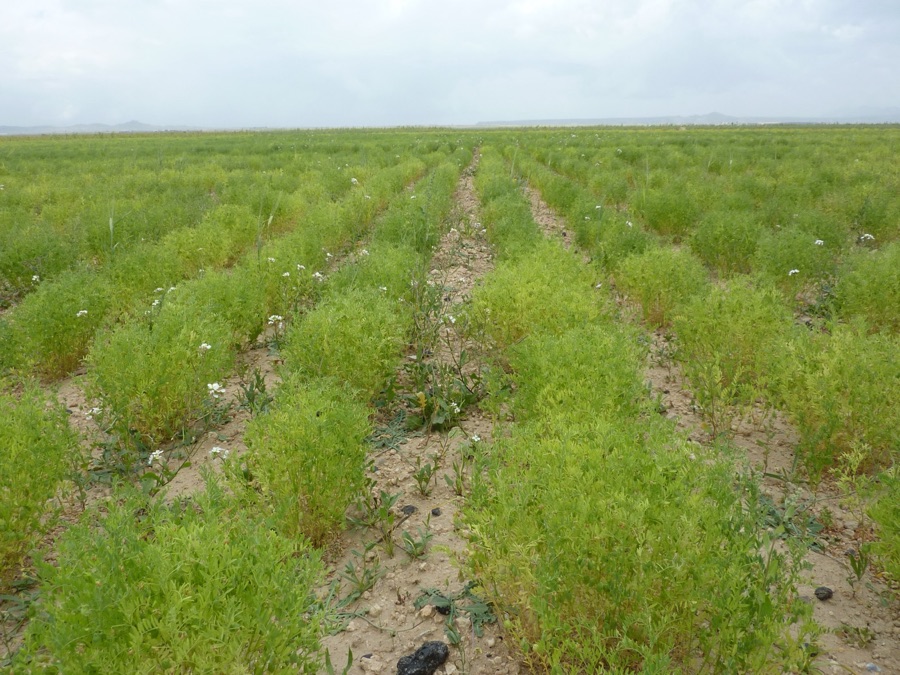
Chickpea's own real, low, bushy growth habit, photographed in a field in Tamil Nadu, India.
Planting to harvest
This guide could not independently confirm a single universal days-to-maturity figure for chickpea. Watch the plant and pods rather than the calendar, following this guide's stage 9 below.
Needs most
A genuinely dry, well-drained field more than a wet one, moderate moisture right at flowering and early pod fill, and early, careful watching for Ascochyta blight and the pod borer.
Hardest part
Telling desi and kabuli seed and their two real markets apart before you sow, and staying ahead of Ascochyta blight and the pod borer, this crop's own two most globally significant real disease and pest problems.
Easiest start
Sow clean, whole, unholed seed of the real type -- desi or kabuli -- your own buyer actually wants, once your own local dry season has genuinely settled in, and let the crop make its own nitrogen as it grows.
The season, stage by stage
Choose land, climate and rotation historyConfirm your own real climate genuinely suits a dry-season crop, and check your own field's rotation history, since chickpea's own worst diseases build up fast on land that grows it, or a close relative, too often.
Choose your market and your seedDecide honestly which real market you are growing for -- desi, kabuli or fresh green -- then choose clean, whole, unholed seed and test it before you sow.
SowSow once your own local dry season has genuinely settled in, in wide, well-spaced rows, and check for a full, even stand within a few weeks.
Feed the cropChickpea makes a real share of its own nitrogen. Feed it lightly, and never pour on nitrogen it does not need.
WaterThis crop genuinely tolerates real drought better than most food legumes, but flowering and early pod fill still reward real, careful moisture.
WeedsWeed hardest and longest in this crop's own early weeks, since its own low, slow-closing canopy leaves the ground open longer than a taller legume.
Watch for insect pests, week by weekOne real pest matters most on this crop: the pod borer, Helicoverpa armigera, which bores directly into pods and carries an extraordinary real resistance history.
Watch for disease, week by weekAscochyta blight and Fusarium wilt are this crop's own two most globally significant real diseases, and they show two genuinely different real patterns.
Know when to harvestWatch the plant and pods rather than the calendar, since this guide could not independently confirm one universal days-to-maturity figure for chickpea we.
Thresh, dry and store itGet the crop clean, dry and sealed against damp and stored-grain insects, and never lose track of which real type, desi or kabuli, a lot is before it ever reaches a household table.
Chickpea, continued
Water
Understand this crop's own real water character before deciding anything.
Do not mistake this real drought tolerance for no water need at all. A published source records that periods of drought have a real, measurable effect on this crop's own growth.
The one window where moisture shortage costs the most yield is flowering and the weeks just after it, while the first pods are filling.
If you can irrigate and must choose, water at flowering and early pod fill before any other point in the season.
Avoid standing water at all costs. This crop dislikes a waterlogged root far more than it dislikes a real dry spell.
Feeding, as our guide gives it
At or before sowing: A small amount of phosphorus, only where soil is genuinely short of it
At sowing, on the seed, where chickpea is new to that land: A Mesorhizobium ciceri inoculant
Avoided, or kept small: Nitrogen fertiliser
Problems, and what to do
If you see Small, dark lesions on leaves, stems and pods, spreading fast after rain or heavy dew, sometimes with dark marks directly on the seed coat inside a pod.
It likely means Ascochyta blight, caused by the fungus Ascochyta rabiei, recorded in 35 countries by a published source and one of this crop's own two most globally significant real diseases.
Rotate away from chickpea and close relatives for at least three years on a badly affected plot.
Remove and destroy infected plant debris straight after harvest rather than leaving it in the field.
If you see A small, round hole chewed through the side of a pod, caterpillar droppings nearby, and hollowed-out or partly eaten seed inside an opened pod.
It likely means The pod borer, Helicoverpa armigera, this crop's own single most globally significant real insect pest, feeding on the developing seed inside the pod.
Scout twice a week, checking flowers and young pods specifically, since eggs and small caterpillars feed openly before boring inside.
Act while caterpillars are still outside the pod. Once inside, they are shielded from any spray.
If you see A plant that yellows and wilts despite normal rainfall, on land that holds standing water after rain.
It likely means Root stress or root rot from waterlogging, since this crop dislikes a waterlogged root far more than it dislikes a real dry spell.
Improve drainage on the affected plot before the next season, rather than only treating individual sick plants this season.
Avoid sowing chickpea again on land that has shown this problem until real drainage improvement has been made.
In NovemberSown in Mediterranean and dry north · Harvested in Mediterranean south
A field of lentil (Lens culinaris) -- this crop's own real, low, bushy, mostly self-supporting growth habit shown at a real established stand.
Planting to harvest
This guide could not independently confirm a single universal days-to-maturity figure for lentil.
Needs most
A well-drained, moderately fertile soil around pH 7, a genuine Rhizobium leguminosarum bv.
Hardest part
Telling this crop's own real colour types and their two real markets -- whole and split-red -- apart before you sow, and staying ahead of Ascochyta blight, Fusarium wilt and Aphanomyces root rot, since lentil shares every one of these real threats with its own close relatives, field pea and chickpea, on the same land.
The season, stage by stage
Choose land, climate and rotation history
Choose your colour type, your market and your seed
Inoculate and sow
Feed the crop
Water
Weeds
Flowering and self-pollination
Watch for insect pests, week by week
Watch for disease, week by week
Know when to harvest
Thresh, dry and store it
If you see A plant that yellows and wilts from the base upward, often on just one side of the plant, without the leaf-and-pod lesions Ascochyta blight causes.
It likely means Fusarium wilt, caused by the fungus Fusarium oxysporum f.sp. lentis, which survives in the soil itself for a real, long period once established.
Rotate away from lentil for several years on a badly affected plot, since this fungus survives in the soil itself for a real, long period.
If you see Clusters of small, soft-bodied green insects on leaves, stems and pods, often with sticky honeydew and sooty mould beneath them, and sometimes curled or distorted new growth.
It likely means Pea aphid, Acyrthosiphon pisum, the same real, widespread sap-feeding pest this library's field pea guide names for its own crop.
Scout regularly, especially around flowering, rather than waiting for a visible heavy infestation.
In NovemberSown in Tropical and monsoon north (cool-season potato on the plains) · Growing in Temperate south · Harvested in Mediterranean and dry north (autumn crop)
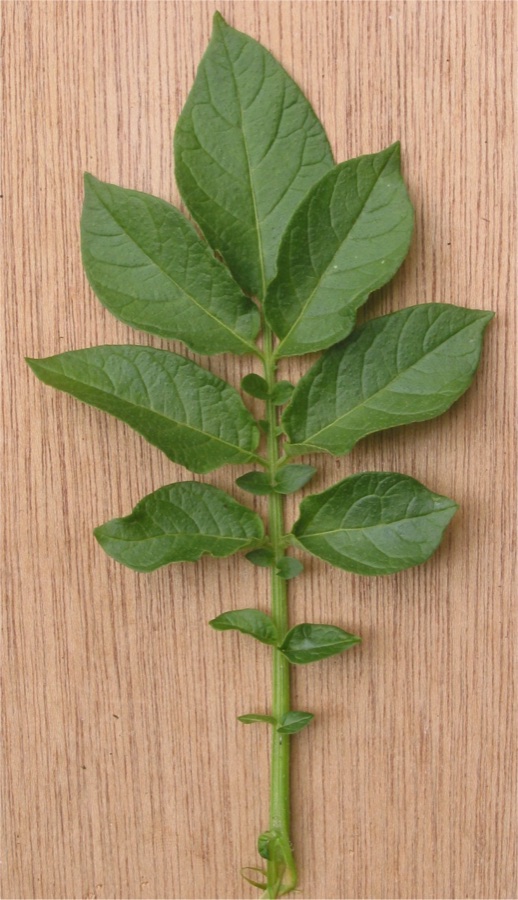
A potato leaf. One leaf is a stalk carrying several leaflets of unequal size in pairs. Learn this and you can read the crop for virus symptoms.
Planting to harvest
About 90 to 120 days for most kinds. Early kinds can be lifted from about 70 to 90 days. Late kinds can take 130 to 150 days or more. Your own variety decides this, not the calendar.
Needs most
Cool weather and healthy seed tubers. Nights around 16 degrees Celsius are when tubers form best, and average days of 18 to 20 degrees give the best yields. Heat is the enemy, not drought.
Hardest part
Getting clean, healthy seed tubers, and keeping them clean. The potato carries its own diseases inside the seed you plant, so a mistake made once repeats every season until you break it.
Easiest start
Buy or borrow a small quantity of certified or clean seed from a reliable source, plant it on ridges at the start of your cool season, and earth it up twice.
The season, stage by stage
Get the land readyLoose, deep, well-drained soil, and a field that has not grown potato or its relatives for three or four years.
Choose your seed potatoesThis is the most important decision in the whole crop. A sick seed tuber gives a sick field, every time.
Wake the seed up and cut it safelySprout the seed before you plant it, and if you must cut it, cut it early and let the wounds heal.
Plant the seed tubers in the fieldPlant into cool, moist, loose soil at the right depth, with the sprouts pointing up.
Water the crop at the right timesSteady moisture all the way through, and never let it go dry while the tubers are swelling.
Weed the crop, earth it up and feed itWeed early, earth up twice, and feed the crop in stages rather than all at once.
Watch for insect pests, stage by stageLook at the crop every week, know what you are looking at, and reach for a spray last, not first.
Watch for diseases, stage by stageLate blight is the one that can take the whole field in a fortnight. Know it, and act before it is obvious.
Kill the haulm before you lift the cropCut or kill the tops about two weeks before digging.
Harvest the tubers without damaging themLift in cool, dry-enough soil, handle every tuber as if it were an egg, and get it out of the sun.
Cure the crop and store it in the darkWarm and humid first to heal the wounds, then cool and dark to hold it.
Keep your own seed for next seasonYou can save your own seed, and millions of farmers must.
Potato, continued
Water the crop at the right times
A crop of 120 to 150 days needs 500 to 700 millimetres of water in total, counting rain and irrigation together.
The potato has a shallow root system. It cannot reach down for water the way maize or sorghum can, so it feels a dry spell much sooner.
The critical period is from when the stolons start swelling into tubers until the tubers stop growing. Water short at that time is yield lost permanently.
Water regularly rather than heavily. Frequent, even watering reduces misshapen tubers.
A dry spell followed by heavy watering is the worst pattern of all. It causes cracked tubers and hollow centres, called hollow heart, because the tuber grows in a sudden burst the skin cannot follow.
Feeding, as our guide gives it
Before ploughing, at the start of the rotation: Well-rotted farmyard manure or compost.
At or just before planting: The whole phosphorus dose, the whole potash dose, and the first part of the nitrogen.
Three to five weeks after the crop comes up: The second part of the nitrogen, if you split it.
Tuber initiation and bulking: Nothing more by way of nitrogen. Water and weed control are what the crop needs now.
Problems, and what to do
If you see Dark, wet-looking patches spreading on the leaves, often starting at the leaf edge or tip where water collects.
It likely means Late blight, caused by Phytophthora infestans.
Act immediately. A day's delay in blight weather is a real amount of crop.
Cut and remove affected plants where the infection is still in patches, and carry them out of the field rather than dropping them between the rows.
If you see Tubers with a green tinge under the skin, sometimes only on one side or on the shoulder that faced upward. They may taste bitter.
It likely means The tuber has been exposed to light.
Do not eat it and do not sell it. Cooking does not destroy glycoalkaloids.
Cut the green away generously, or throw the tuber out. If it tastes bitter at all, stop eating immediately.
If you see A tall, dark green, lush, healthy-looking crop that flowered late or is still growing when it should be dying back.
It likely means Too much nitrogen, or nitrogen given too late.
Do not add any more nitrogen. Nothing you add now will help.
Let the soil dry down more as ripening approaches. That hastens maturity and raises dry matter.
In NovemberGet ready to sow in Tropical and monsoon north (dry-season onion)
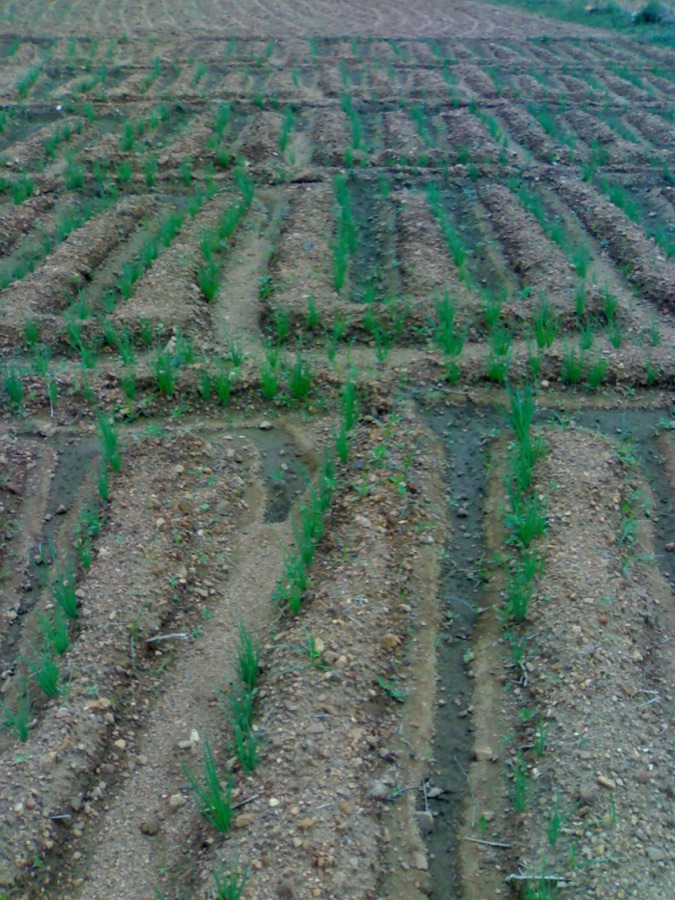
A real young onion field. The narrow, upright leaf habit shades the row far less than a broad-leaved crop, which is exactly why weeds stay a real threat longer in this crop (growthHabitAndMethod, Stage 6).
Planting to harvest
About 94 to 110 days from transplanting for an intermediate-day variety, and about 105 to 125 days for a long-day variety, with a set-grown onion typically ready faster than one grown from true seed.
Needs most
The right day-length type for your own real latitude, well-drained soil, and an honest early decision about which real market -- storage bulb, sweet bulb, shallot or processing -- this planting is actually for.
Hardest part
Getting the day-length variety right for your own latitude, and giving the harvested bulbs a real, full two-to-four-week curing period before storage rather than rushing them into a sack while the neck is still soft.
The season, stage by stage
Choose your land, your market and your day-length variety
Choose seed or sets, and prepare planting material
Plant into the field at the right spacing
Feed the crop
Water
Weeds
Insect pests, stage by stage
Diseases — downy mildew, purple blotch, white rot and neck rot
Know when it is ripe — watch the tops, not a calendar date
Harvest, cure and store the crop
If you see Silvery, streaked patches on leaves that spread and widen as the leaf grows, and in severe cases whole plants looking pale and silvery with early, poor ripening.
It likely means Onion thrips (Thrips tabaci), a tiny, real, globally significant sap-feeding insect and a documented vector for tomato spotted wilt virus and iris yellow spot virus.
Scout regularly, checking the base of leaves where thrips shelter, and act early since numbers build up quickly in hot, dry weather.
If you see Yellowing spots on leaves turning brown or black, with a grey, fuzzy fungal growth visible on the leaf surface in moist, cool conditions.
It likely means Downy mildew, caused by the real oomycete Peronospora destructor, favoured by cool, genuinely moist conditions including ordinary morning dew.
Improve airflow with wider spacing, and avoid overhead watering late in the day so foliage does not stay wet overnight.
In NovemberSown in Temperate north · Harvested in Temperate south
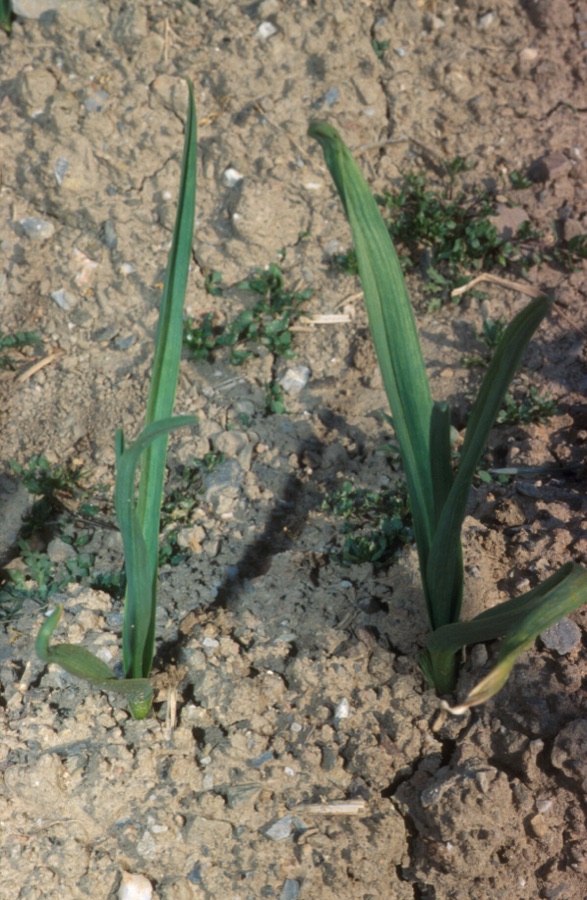
A garlic crop in the field. The leaves are flat and folded rather than round and hollow, which is the quickest way to tell garlic from onion at a glance.
Planted from
Individual cloves, broken from a bulb just before planting
Planting season
Autumn, in most growing regions
Planting depth
About 1 to 2 inches, pointed end up. 5 inches for most varieties, Oregon State gives about 2 inches — two real sources that differ, so treat it as a range rather than a single number.
The season, stage by stage
Choose your planting stock, the season before you need itDecide in summer which bulbs you are keeping back for autumn planting, and hold the best ones rather than the leftovers.
Prepare ground that drains, and get the land readyLand preparation for garlic is mostly about drainage and about what grew there before.
Plant in autumn, at the right momentPlant late enough that the cloves do not send up top growth before winter, early enough that they root first.
Mulch the bed, then keep it weed-freeA layer of loose straw laid over the bed does four jobs at once through the winter.
Feed the leaves, because the leaves build the bulbEvery leaf becomes a wrapper around the bulb, so nitrogen through leaf growth is what decides final size.
Water steadily, then stop on purposeGarlic wants even moisture while it is growing leaves, and dry ground while it finishes.
Lift at the right leaf stage, not by the calendarThe plant tells you when it is ready, and the signal is counted in leaves rather than dates.
Cure it, or it will not keepCuring is a drying process, and it is what turns a harvested bulb into one that stores for months.
Grade, store, and keep next year's seed back firstSort the crop before you sell any of it, and hold the best back for planting.
If you see Bulbs lifted at the end of the season that are a single solid round, with no separate cloves inside the skin at all.
It likely means The crop did not get the cold period it needs to divide — usually because it was planted too late, or in spring, or is a variety unsuited to that winter.
Plant in autumn rather than spring, early enough to root before the soil freezes.
If you see Plants that looked green and healthy all season, but lift as disappointingly small bulbs with thin cloves.
It likely means Small cloves were planted, spacing was too tight, weeds competed through spring, or nitrogen ran out while the leaves were still forming.
Plant only your largest cloves — clove size largely sets bulb size, and the effect compounds every year you replant.
About 7 to 12 weeks from transplanting for cauliflower's earliest real maturity, about 14 to 15 weeks total for broccoli's own whole real growth season, plus a shorter nursery stage before either goes to the field.
Needs most
Cool, steady temperatures, a genuinely early decision about which crop and which real market you are growing for, and land with no recent history of clubroot or other brassica cropping.
Hardest part
Judging cauliflower's own blanching window and broccoli's own cutting window correctly, and rotating land properly away from clubroot, whose resting spores can survive in soil for up to twenty real years.
A real, cultivated cabbage planting with heads forming. Every plant grows this low, ground-hugging way, never on a tall stem, until it is deliberately allowed to bolt for seed.
About 70 days from planting for an early, fresh-market variety, up to about 120 days for a late, storage-type variety -- most of that time in the open field after a shorter nursery stage rather than one single fixed number for the whole crop.
Needs most
Cool, steady temperatures between about 4 and 24 degrees Celsius (39 and 75 degrees Fahrenheit), a genuinely early decision about fresh, storage or processing markets, and land with no recent history of clubroot or other brassica crops.
Hardest part
Watching for the diamondback moth, a small caterpillar pest with one of the worst real insecticide-resistance records of any pest on Earth, and rotating land properly away from clubroot, whose resting spores can survive in soil for up to twenty real years.
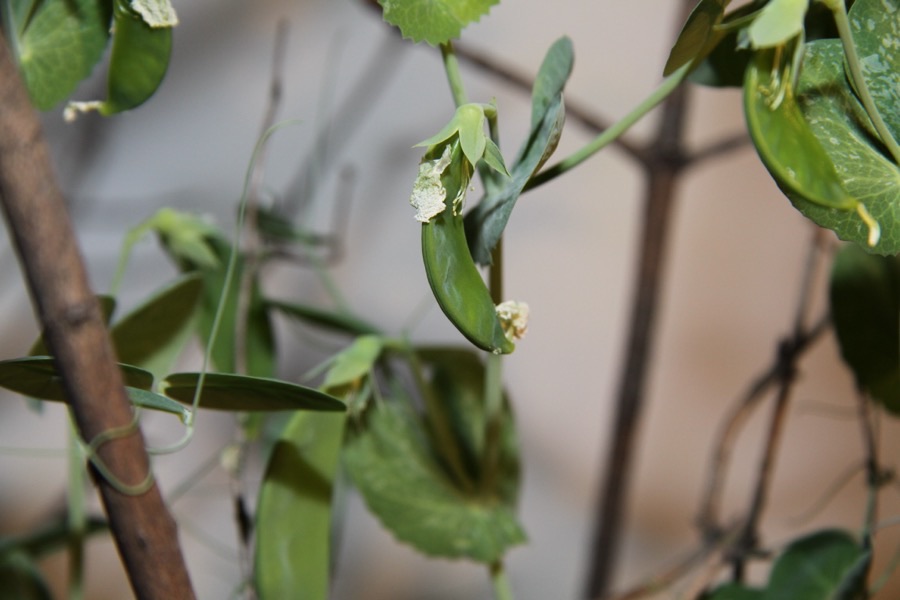
A pod just after flowering, still flat. Note the thin tendrils gripping the stake, which is the only way a pea climbs.
About sixty to ninety days to the first picking, depending on the kind and the cold.
Needs most
Cool weather. Peas fill in the cold and stop in the heat.
Hardest part
Picking at the right moment, because the picking window is two or three days and sweetness falls away after it.
Peas that are hard, dull and floury rather than sweet, although the pods looked well filled when you picked them. They were picked late. Once a pea is fully grown, the sugar in it starts turning to starch, and the change is quick.
Flowers dropping off, and pods that stay flat and empty on plants that otherwise look healthy. Heat during flowering. Peas set and fill in cool weather and simply stop when it turns hot.
Winter vegetables, continued
A real, cultivated carrot field. This crop is direct-seeded and thinned in place, never raised in a nursery and transplanted (growthHabitAndMethod).
About 70 to 80 days from direct seeding to harvest under good conditions, with no nursery stage at all, unlike this library's cabbage and tomato guides.
Needs most
Deep, loose, stone-free soil so the single taproot can grow straight, cool temperatures between about 16 and 21 degrees Celsius (61 and 70 degrees Fahrenheit), and careful thinning of a direct-seeded stand rather than transplanting.
Hardest part
Watching for carrot fly, this crop's single most damaging real pest worldwide, and Alternaria leaf blight, described in real published sources as this crop's most devastating disease.
Ready to pick, and still growing. As long as the centre is a low tight cluster of small leaves, the crop has not started to finish.
Three to five weeks for salad radish, and two to three months for daikon and winter types.
Needs most
To grow fast without a check, in cool weather, in loose stone-free soil.
Hardest part
Pulling it in time. A radish left a few days too long goes woody, hollow and fiercely hot.
Fine healthy leaves and roots that never swell beyond a thin string. Almost always crowding, or too much nitrogen. Radishes left too close together compete and put everything into leaf.
Plants shooting up a tall flowering stem with a thin woody root below it. Bolting, which means running to flower.
A pest is on this list when our calendar has one of its host crops in the field this month in a zone where our encyclopedia records it, and when it matters to the November crops in this issue. Each page gives what to look for, the conditions that favour it, the action threshold where our encyclopedia has one, and the controls in the order integrated pest management uses them.
Chemicals are named here only by mode-of-action group, as the encyclopedia names them. What is registered, and at what dose, differs by country and changes; the product label and your local extension office decide. Integrated pest management
Puccinia striiformis f. sp. tritici · Fungus (rust fungus, a basidiomycete)
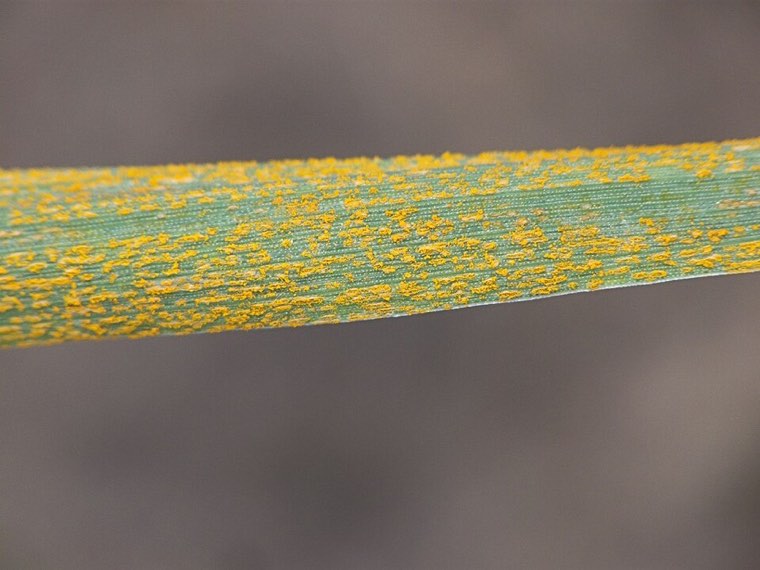
Yellow rust (Puccinia striiformis) stripes on a triticale leaf
Yellow rust, or stripe rust, is a cool-weather rust that covers wheat leaves with stripes of bright yellow-orange powdery spores. It can start early in the season and destroy much of the leaf area before grain filling.
Scout for it this month in: Temperate north; Mediterranean and dry north; Tropical and monsoon north; Temperate south; Mediterranean south
How to spot it
Seedling and tillering (autumn and winter): Pustules in patches rather than stripes on young leaves; small 'hot spots' of infected plants in a field.
Stem elongation to flag leaf: Yellow-orange pustules in long stripes along the veins, often on both leaf surfaces; leaves turn yellow and dry from the tips.
Heading to grain filling: Pustules on ears and glumes; black stripes of telia appear; crops look yellow from a distance; shrivelled grain.
Favoured by
Mild winters that allow survival on green leaves, cool and wet springs, dew, early sowing in autumn, susceptible varieties grown widely, and nearby volunteer wheat.
Action threshold
There is no general numeric economic threshold.
Monitor
Walk fields from late winter or early spring and look for patches ('foci') of yellowing plants with pustule stripes, especially on susceptible varieties.
Follow national and international rust surveillance (for example the Global Rust Reference Center and RustWatch) for race changes.
Prevent
Grow resistant varieties and diversify varieties across farms.
Destroy volunteer wheat and grass hosts before sowing.
All-stage resistance genes such as Yr5, Yr10 and Yr15 are effective against many races, while widely used genes such as Yr9, Yr17 and Yr27 have been overcome in many regions.
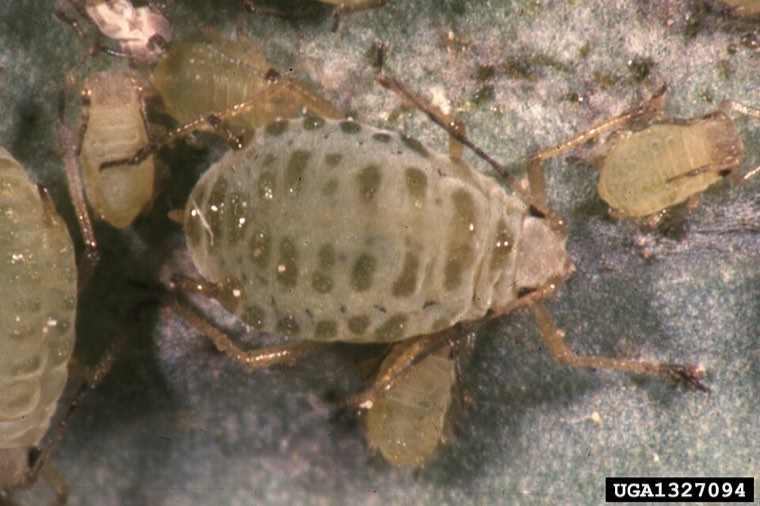
Mustard aphids (Lipaphis erysimi), grey-green with a waxy coating, magnified
The mustard aphid is a small grey-green aphid with a waxy coating that forms dense colonies on the flowering shoots, pods and stems of rapeseed, mustard, cabbage, radish, turnip and other crucifers.
Scout for it this month in: Temperate north; Tropical and monsoon north; Temperate south; Mediterranean south
How to spot it
Vegetative stage: Colonies on the undersides of leaves; curling and yellowing of leaves.
Flowering: Dense grey-green colonies covering flower stalks and buds; flowers drop and the inflorescence stops growing.
Pod stage: Colonies on pods and stems; small, shrivelled pods with few seeds; honeydew and sooty mould.
Favoured by
Late sowing, cool and cloudy weather with high humidity during flowering, heavy nitrogen fertilisation, and loss of natural enemies after broad-spectrum sprays.
Action threshold
There is no single international threshold.
Monitor
From flower bud formation, check the central shoot tips of a set number of plants twice a week and count aphids or infested plants.
Watch for ladybirds, hoverfly larvae and parasitised aphids, which can keep populations down.
Prevent
Sow at the recommended early date so that flowering is over before aphid numbers peak.
Use balanced fertilisation and avoid excessive nitrogen.
Varieties differ in tolerance.
Biological and physical
Ladybirds (such as Coccinella septempunctata), hoverflies, lacewings, the parasitoid Diaeretiella rapae and entomopathogenic fungi are important natural enemies.
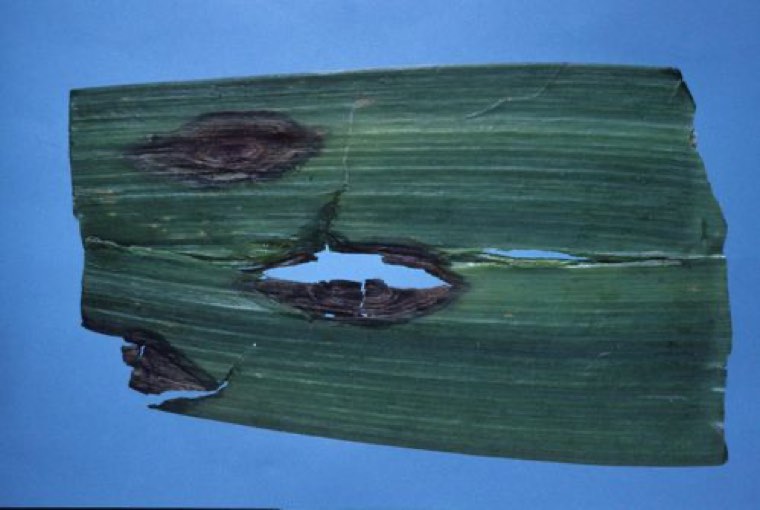
Alternaria brassicae and Alternaria brassicicola · Fungus (ascomycete)
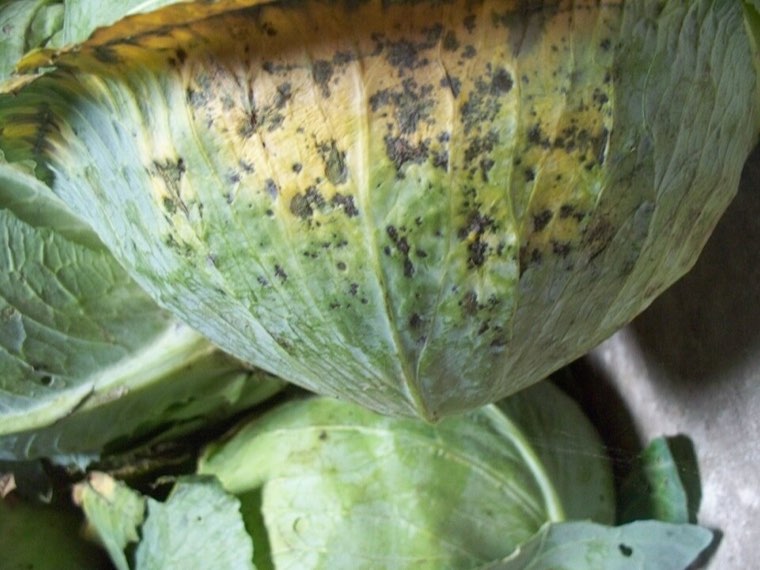
Cabbage head with dark Alternaria leaf spots
Alternaria blight causes dark brown to black spots with concentric rings, often with a yellow halo, on the leaves, stems and pods of mustard, rapeseed, cabbage, cauliflower, broccoli and other crucifers.
Scout for it this month in: Temperate north; Tropical and monsoon north; Temperate south; Mediterranean south
How to spot it
Leaves: Small dark spots that enlarge into round brown to black lesions with concentric rings and often a yellow halo; older leaves affected first.
Stems and pods: Dark, elongated lesions on stems; dark spots on pods that cause early ripening, shattering and shrivelled seeds.
Heads and curds of vegetables: Dark spots on cabbage heads and cauliflower and broccoli curds; spots can develop further in storage.
Favoured by
Infected seed, crop residue and cruciferous weeds, frequent rain or dew, dense crops, late sowing of rapeseed-mustard in South Asia, and nutrient-stressed plants.
Action threshold
There is no numeric economic threshold; protection begins when the first spots appear on susceptible crops under humid weather, following local advice.
Monitor
Inspect lower leaves from early growth and pods from the pod-filling stage for ringed dark spots.
Check seed lots for infection where testing is available.
Prevent
Use healthy, treated seed; rotate with non-cruciferous crops and remove or bury crop residues.
Sow rapeseed-mustard at the recommended time, as late-sown crops suffer more in South Asia.
High resistance is rare in cultivated brassicas; some varieties and wild relatives are more tolerant.
Biological and physical
Some Trichoderma and Bacillus products have reduced Alternaria blight in trials, with variable field results.
Hot-water seed treatment is used for some vegetable brassica seed.
If a chemical is needed: by group
FRAC M03 Dithiocarbamates and relatives (multi-site)
FRAC 3 Demethylation inhibitors (DMI)
FRAC 7 Succinate dehydrogenase inhibitors (SDHI)
FRAC 11 Quinone outside inhibitors (QoI)
Protectant and systemic fungicides applied from the first symptoms reduce leaf and pod infection.
Albugo candida · Oomycete (water mould), not a true fungus
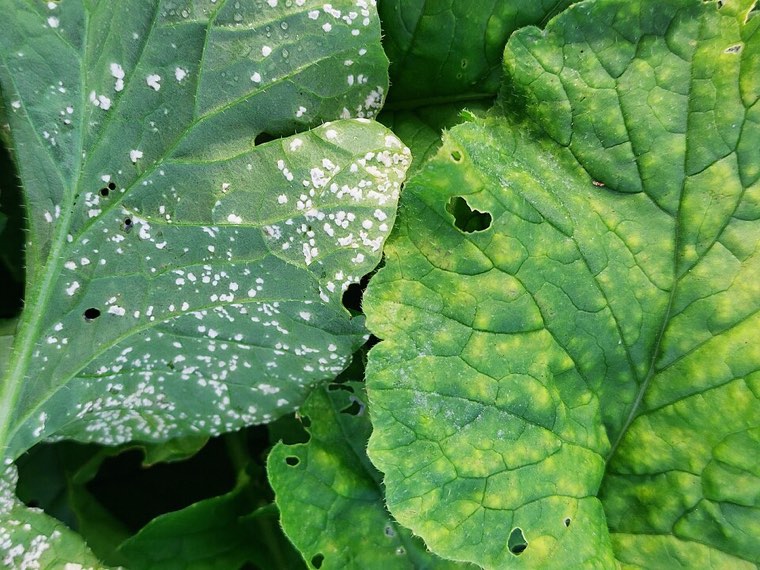
Radish leaves with white rust: yellow patches above raised white pustules
White rust produces raised, chalky-white blisters on the undersides of the leaves of mustard, radish, turnip, cabbage and other crucifers, with yellow patches above them.
Scout for it this month in: Temperate north; Tropical and monsoon north; Temperate south; Mediterranean south
How to spot it
Leaves: Raised, white to cream, blister-like pustules mainly on the lower surface, with yellow patches above; pustules may merge.
Stems and flowering shoots: Swollen, twisted, fleshy flower stalks and flowers ('stagheads'), which do not produce seed.
Pods: Distorted pods on infected racemes; reduced seed set.
Favoured by
Cool, humid or foggy weather; infected seed and debris; continuous cropping of mustard; susceptible varieties; and dense crops.
Action threshold
There is no numeric economic threshold; management is preventive with resistant varieties and seed treatment, and foliar sprays follow local advice when pustules appear.
Monitor
Inspect the undersides of leaves for white pustules from the seedling stage, especially after foggy or dewy periods.
During flowering, look for swollen, twisted stagheads.
Prevent
Use healthy seed treated as recommended; rotate with non-crucifers.
Remove and destroy stagheads and crop debris; control cruciferous weeds.
Resistant varieties are the most effective control.
Biological and physical
No biological controls are widely used.
If a chemical is needed: by group
FRAC 4 Phenylamides
FRAC M03 Dithiocarbamates and relatives (multi-site)
FRAC 40 Carboxylic acid amides (CAA)
Oomycete-specific seed treatments and foliar fungicides reduce infection.
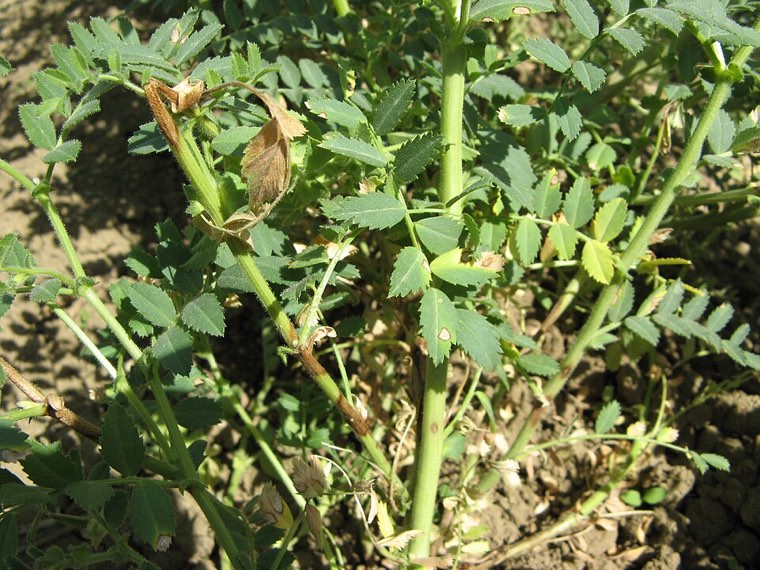
Chickpea plant with Ascochyta blight: brown lesions on stems and dead leaflets
Ascochyta blight is the most destructive disease of chickpea worldwide.
Scout for it this month in: Tropical and monsoon north; Mediterranean south
How to spot it
Seedlings: Brown lesions at the stem base of seedlings grown from infected seed; seedlings collapse.
Leaves and stems: Round to oval tan or brown spots with dark borders and concentric rings of black dots; stem lesions girdle and break stems.
Pods and seed: Round lesions with black dots on pods; shrivelled, discoloured seeds that carry the fungus.
Favoured by
Infected seed, chickpea stubble from previous seasons nearby, cool and wet weather especially at flowering and podding, dense canopies, and susceptible varieties.
Action threshold
There is no numeric economic threshold; protection is preventive, with fungicide timing linked to the first lesions and forecast rain in susceptible varieties.
Monitor
Inspect crops within a few weeks of emergence and after each rain event, looking for lesions with rings of black dots.
Check patches first, especially near last year's chickpea stubble.
Prevent
Plant tested, disease-free seed treated with a fungicide seed dressing.
Rotate chickpea with other crops, leaving at least three to four years between chickpea crops in the same field, and plant away from last year's chickpea stubble.
Varieties with moderate resistance are available and greatly reduce the number of sprays needed.
Biological and physical
Some biological agents have reduced Ascochyta blight in trials, but none is reliable alone.
If a chemical is needed: by group
FRAC M05 Chloronitriles (multi-site)
FRAC M03 Dithiocarbamates and relatives (multi-site)
Helicoverpa armigera · Insect (moth); larva is the damaging stage
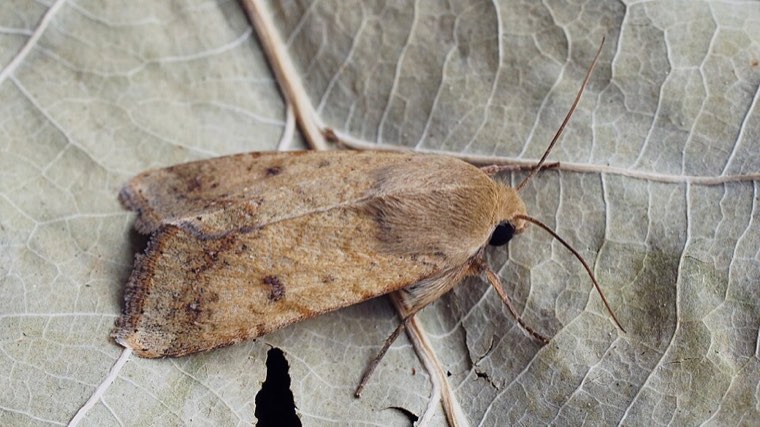
Adult cotton bollworm moth (Helicoverpa armigera)
A moth whose caterpillars bore into the fruiting parts of cotton, chickpea, pigeon pea, tomato, maize and dozens of other crops: squares and bolls, pods, fruit and cobs.
Scout for it this month in: Temperate north; Mediterranean and dry north; Tropical and monsoon north; Temperate south; Mediterranean south; Tropical south
How to spot it
Vegetative growth: Young larvae feed on tender shoots and leaves, leaving small holes; damage is usually minor.
Flowering and squaring (cotton) / flowering (legumes): Bored flower buds and squares, often flared, yellowed and shed.
Boll, pod and fruit set: Round, clean-edged holes with frass at the entrance; the larva's head and front body inside a pod, boll or fruit; one larva damages several fruits.
Favoured by
Warm, dry weather; a landscape with a succession of flowering hosts (for example maize, sorghum and chickpea before cotton); high nitrogen and lush crops.
Action threshold
Thresholds are set as larvae per metre of row or per plant during the fruiting period, or as a percentage of fruiting parts damaged.
chickpea: About 1 larva (0.7-1.6 in field studies) · Podding (South Asia)
chickpea: Calculated from control cost and grain price; 1 larva per m² ≈ 20 kg/ha loss · Podding (Australia)
Monitor
Pheromone or light traps track moth flights and the start of egg laying; they do not on their own justify a spray.
Check plants for eggs and small larvae twice weekly during flowering and fruiting, counting larvae by size class per metre of row or per plant.
Prevent
Plant at the recommended time and in a short window across a district, so crops avoid peak moth flights.
Deep tillage or cultivation after harvest destroys diapausing pupae.
Transgenic cotton (and in some countries other crops) expressing Bacillus thuringiensis Cry proteins controls this pest where approved; field resistance to single-protein cotton has evolved in parts of Asia, and two- or three-protein stacks with refuges are now the standard.
Biological and physical
Egg parasitoids (Trichogramma species), larval parasitoids (Campoletis chlorideae and others) and predators such as lacewings, predatory bugs and spiders kill a large share of eggs and young larvae when not disrupted.
Helicoverpa armigera nucleopolyhedrovirus and Bacillus thuringiensis are effective on young larvae.
Hand-collect large larvae in small vegetable plots; shake chickpea plants over a sheet.
If a chemical is needed: by group
IRAC 28 Ryanodine receptor modulators (diamides)
IRAC 5 Nicotinic acetylcholine receptor allosteric modulators, site I (spinosyns)
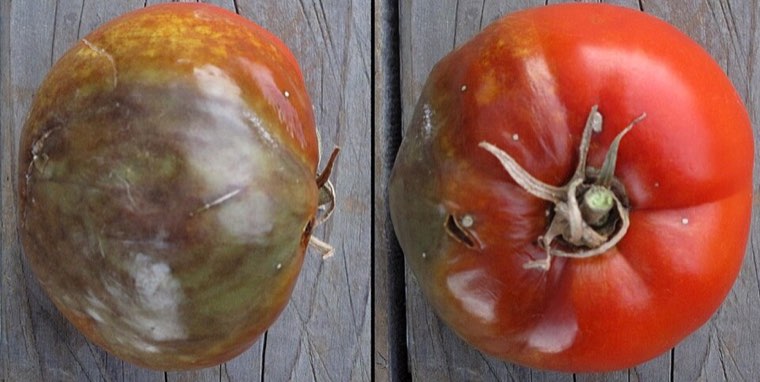
Phytophthora infestans · Oomycete (water mould), not a true fungus
Tomatoes with late blight
Late blight is the disease that caused the Irish potato famine in the 1840s, and it is still the most destructive disease of potato and a major disease of tomato worldwide.
Scout for it this month in: Mediterranean and dry north; Tropical and monsoon north; Temperate south; Mediterranean south
How to spot it
Foliage (any stage, usually from canopy closure): Pale green to dark brown, water-soaked spots, often at leaf tips and edges, that expand rapidly.
Stems and petioles: Dark brown to black lesions that girdle stems, causing them to collapse; whole plants can die within days.
Tubers (potato): Irregular, slightly sunken reddish-brown to purplish patches on the skin.
Favoured by
Cool to mild temperatures with long periods of high humidity (above 90%), fog, dew or rain; dense canopies; infected seed tubers and cull piles nearby; and susceptible varieties.
Action threshold
There is no numeric economic threshold based on disease levels, because the disease can go from first lesion to field loss within days.
Monitor
Follow national blight warnings or a local forecast model, and start protection when risk criteria are met.
Walk fields at least twice a week in risk periods, especially low, sheltered and wet corners, and look at the undersides of leaves for downy growth.
Prevent
Plant certified, disease-free seed tubers and destroy or cover cull piles and volunteer potatoes.
Hill (earth up) potatoes well so tubers are covered by soil, and destroy haulms two to three weeks before harvest in wet seasons to protect tubers.
Major resistance genes from wild potatoes (R1 to R11 from Solanum demissum) were overcome quickly.
Biological and physical
Several microbial antagonists (for example some Bacillus and Trichoderma strains) have reduced late blight in trials, but none is reliable on its own under high disease pressure.
Harvest only after skins have set, in dry conditions, and store tubers cool and dry; discard rotten tubers.
If a chemical is needed: by group
FRAC M03 Dithiocarbamates and relatives (multi-site contact)
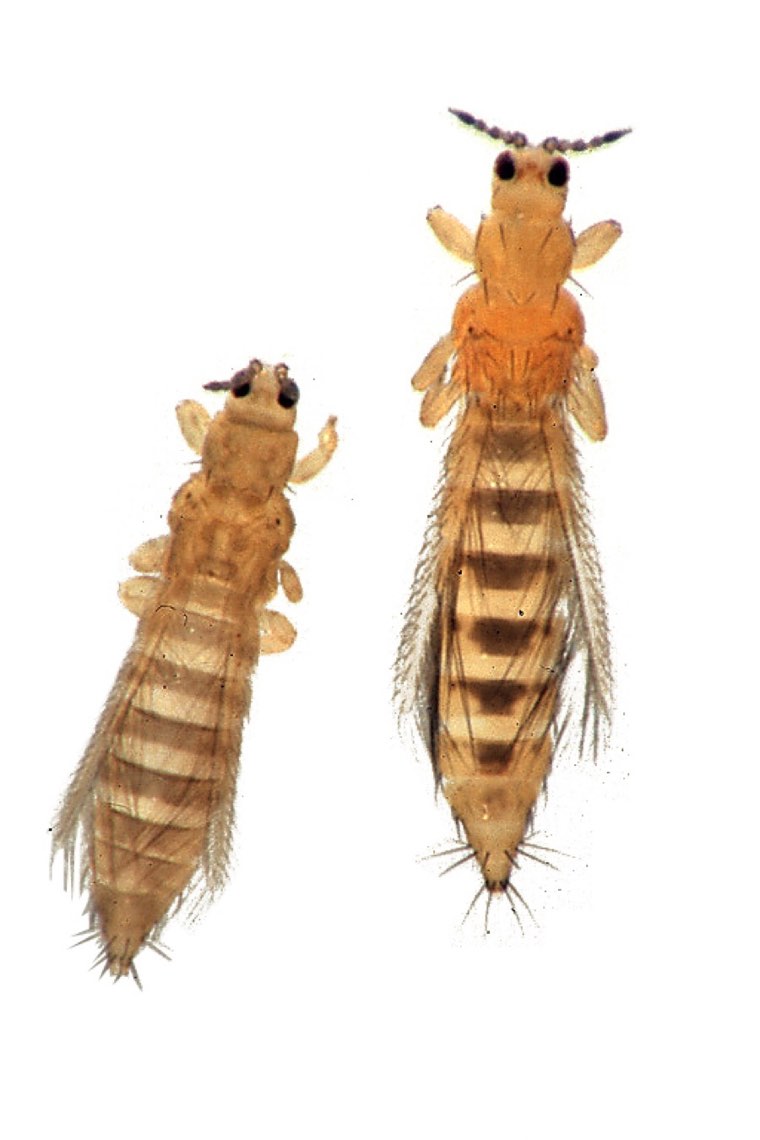
Thrips tabaci · Insect (thrips, a tiny rasping-sucking insect)
Onion thrips compared with western flower thrips under magnification
A tiny thrips that rasps the surface of onion, garlic and leek leaves, leaving silvery streaks that reduce bulb size, and that also attacks cabbage, cotton seedlings and many other crops.
Scout for it this month in: Temperate north; Mediterranean and dry north; Tropical and monsoon north; Temperate south; Tropical south
How to spot it
Seedling and early leaf growth: Silvery-white flecks and streaks on leaves, often with tiny black specks of excrement; seedlings of cotton show crinkled, cupped leaves.
Bulb initiation and bulking (onion, garlic): Leaves become silvery, then brown and dry from the tips; plants look 'blasted'; bulbs remain small.
Cabbage heading: Bronzed, warty patches on inner leaves of the head, which make heads unsaleable.
Favoured by
Hot, dry weather; drought-stressed plants; onion fields next to cereals or weeds that dry down and release thrips; staggered onion plantings; and over-use of a few insecticides.
Action threshold
Onion thresholds are counts of thrips (adults plus larvae) per leaf, which allows for plant size; growers count all leaves on a sample of plants and divide by the number of leaves.
onion: About 1 (0.6-1.0) · Early season to pre-bulbing (North America (New York, Great Lakes))
onion: About 1-4, increasing with plant size and depending on the product group · Bulbing (North America (Michigan, New York))
Monitor
From the 3-4 leaf stage, examine 20-50 plants across the field weekly, opening the leaf folds at the neck to count adults and larvae.
Blue or yellow sticky cards at field edges show adult movement into fields when neighbouring crops are harvested.
Prevent
Avoid planting onions next to cereals, alfalfa or weedy areas that dry down in mid-season.
Keep plants well watered; sprinkler irrigation reduces populations, while drought stress worsens damage.
Onion varieties with glossy (low-wax) leaves and an open neck are less attractive to thrips and are used in some regions, although they may be more prone to other problems.
Leek leaf with a sunken purple blotch lesion caused by Alternaria porri
Purple blotch is a leaf disease of onion, garlic, leek and shallot that produces sunken, purple-brown blotches with pale rings on leaves and flower stalks.
Scout for it this month in: Temperate north
How to spot it
Early leaf infection: Small, water-soaked spots with white centres on older leaves, often where thrips have fed.
Developing lesions: Spots enlarge into oval, sunken blotches several centimetres long, purple to brown with concentric light and dark rings and a yellow halo.
Advanced disease: Blotches merge or girdle leaves and flower stalks, so the parts above them yellow, fall over and die; leaf tips blacken and hang down.
Favoured by
Warm days with cool nights that give heavy dew, frequent rain or overhead irrigation, dense crops, high thrips populations, excess nitrogen, and onion debris, volunteers or cull piles near the field.
Action threshold
There is no published numeric economic threshold. Protective sprays are started when weather favours infection or at the first lesions, and are often combined with thrips control.
Monitor
Inspect at least 50 plants across the field weekly, looking at the older leaves for white-centred spots and purple blotches.
Keep records of dew, rain and leaf-wetness hours; long wet periods in warm weather signal high risk.
Prevent
Use healthy seed and transplants; discard nursery seedlings with leaf spots.
Rotate so there are at least three years between onion or other Allium crops in the same field.
Partial resistance has been reported in some onion and garlic lines.
Biological and physical
Antagonists such as Trichoderma species and some Bacillus bacteria have reduced purple blotch in experiments, but are not yet reliable field controls.
If a chemical is needed: by group
FRAC M03 Dithiocarbamates and relatives (multi-site)
FRAC M05 Chloronitriles (multi-site)
FRAC 3 Demethylation inhibitors (DMI, triazoles)
FRAC 7 Succinate dehydrogenase inhibitors (SDHI)
Foliar fungicides are applied protectively when the weather favours disease, alternating groups.
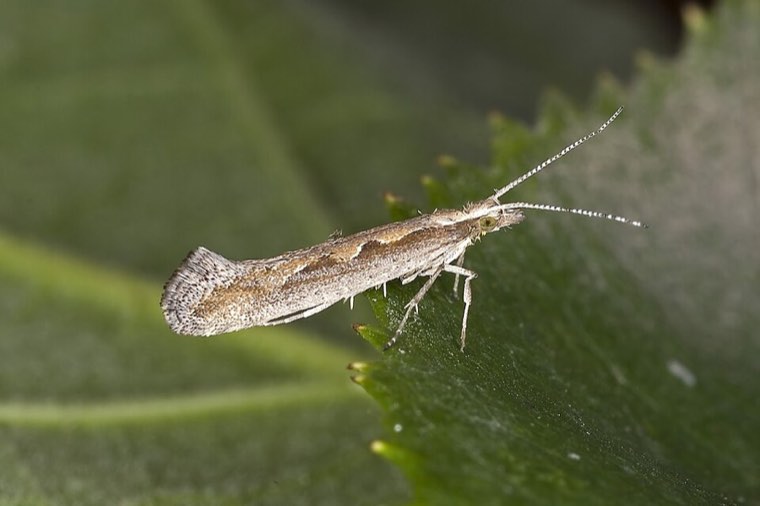
Plutella xylostella · Insect (small moth); larva is the damaging stage
Adult diamondback moth on a leaf
The most destructive insect of cabbage, cauliflower, broccoli, mustard and other brassicas worldwide.
Scout for it this month in: Temperate north; Tropical and monsoon north; Temperate south; Mediterranean south
How to spot it
Seedling: First instars mine inside the leaf; later 'windows' of transparent epidermis; growing points of seedlings may be destroyed.
Vegetative (before heading or cupping): Irregular holes and windowpanes on outer leaves; larvae and cocoons on leaf undersides.
Heading, curd or pod stage: Larvae and frass inside cabbage heads and broccoli or cauliflower florets; contamination makes produce unsaleable.
Favoured by
Dry, warm weather (heavy rain washes larvae off and drowns them), continuous brassica production with overlapping plantings, infested transplants, and broad-spectrum sprays that destroy parasitoids.
Action threshold
Thresholds use the percentage of plants with larvae, and are higher before heading or cupping, when outer leaves can be lost without yield loss, than afterwards, when larvae contaminate the marketable part.
cabbage: 50% of plants with 5 or more larvae each · Before cupping (North America (Upper Midwest))
cabbage: 10% of plants with 1 or more larvae · After cupping to harvest (North America (Upper Midwest))
Monitor
Check at least 20-25 plants per field weekly, examining leaf undersides and the heart of the plant for larvae and pupae.
Pheromone traps show the onset and peaks of moth flights and help time scouting.
Prevent
Raise transplants free of the pest, under netting, away from production fields.
Destroy crop residues immediately after harvest and leave a brassica-free period in the area.
Glossy-leaved brassica lines show some resistance; no commercial variety is strongly resistant.
Biological and physical
Parasitoid wasps such as Diadegma semiclausum, Cotesia vestalis (syn. C.
Bacillus thuringiensis (subspecies kurstaki and aizawai) remains a key selective tool.
Fine-mesh netting or row covers on seedbeds and high-value crops.
If a chemical is needed: by group
IRAC 11A Microbial disruptors of insect midgut membranes (Bacillus thuringiensis)
IRAC 5 Nicotinic acetylcholine receptor allosteric modulators, site I (spinosyns)
Spodoptera frugiperda · Insect (moth); larva is the damaging stage
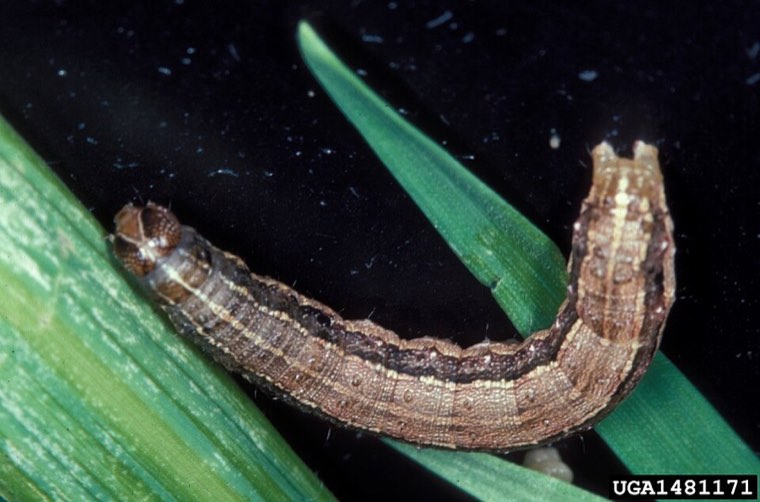
Fall armyworm caterpillar
Fall armyworm is a moth whose caterpillars eat into the funnel of young maize and other grasses, leaving ragged leaves and wet, sawdust-like droppings.
Scout for it this month in: Temperate north; Mediterranean and dry north; Tropical and monsoon north; Temperate south; Mediterranean south; Tropical south
How to spot it
Seedling (emergence to about 4 leaves): Small 'windowpanes' where young larvae scrape away the leaf surface but leave the transparent membrane.
Early to late whorl (vegetative): Ragged, elongated holes in leaves that appear as the whorl unrolls; moist, sawdust-like frass packed in the funnel.
Tasselling and silking: Larvae feed on the tassel before it emerges and on silks, which can reduce pollination.
Favoured by
Warm weather with dry spells between rains favours outbreaks; heavy rain drowns young larvae in the whorl.
Action threshold
Thresholds are based on the percentage of plants with fresh feeding damage, scouted by stage, not on moth counts.
maize: About 20% (range 10-30%) · Emergence to early whorl (first 2-3 weeks) (Sub-Saharan Africa (smallholder guidance))
maize: About 40% (range 30-50%) · Mid to late whorl, before tasselling (Sub-Saharan Africa (smallholder guidance))
Monitor
Pheromone traps baited with the fall armyworm sex pheromone detect the arrival of moths and show when egg laying is about to rise.
Scout fields at least weekly from emergence to tasselling: walk a W-shaped path and inspect 10 consecutive plants at each of 5 stops (50 plants), recording the percentage with fresh damage (moist frass, fresh windowpanes) and live larvae.
Prevent
Plant early in the rainy season and synchronise planting with neighbours so the crop passes its most vulnerable stage before moth numbers build up.
Intercropping with legumes and keeping diverse field margins reduced infestation in several African studies.
Public breeding programmes have released maize with partial native resistance in the Americas, Africa and Asia.
Biological and physical
Egg parasitoids (Telenomus remus, Trichogramma species) and larval parasitoids (Cotesia, Chelonus, tachinid flies) attack the pest in both native and invaded ranges; conserving them is the cheapest control available.
Microbial agents active on young larvae include Spodoptera frugiperda nucleopolyhedrovirus, Bacillus thuringiensis and the fungi Metarhizium rileyi and Beauveria bassiana, applied into the whorl.
Hand-pick and crush egg masses and young larvae on small plots, up to about early whorl.
If a chemical is needed: by group
IRAC 28 Ryanodine receptor modulators (diamides)
IRAC 5 Nicotinic acetylcholine receptor allosteric modulators, site I (spinosyns)
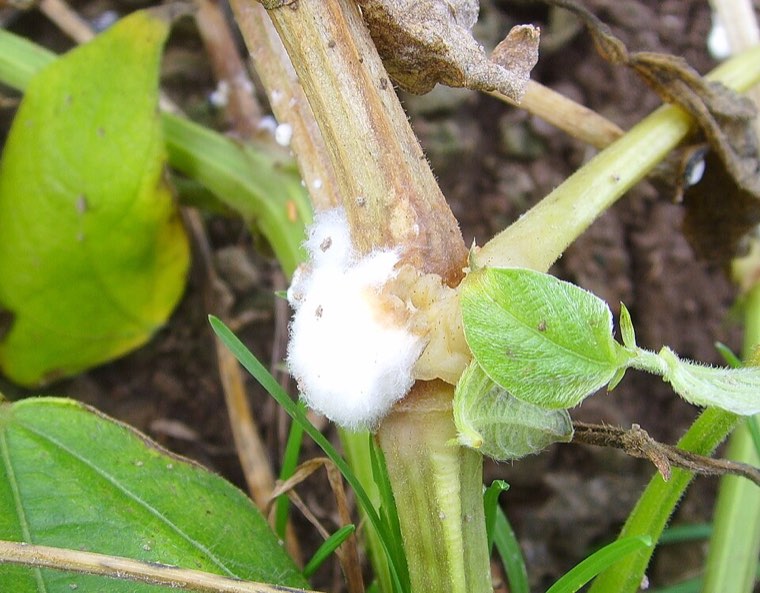
White cottony mould of Sclerotinia sclerotiorum on a bean stem
Sclerotinia white mould is a fungal disease that rots the stems, heads, pods and fruit of more than 400 plant species, including soybean, oilseed rape, sunflower, beans, lettuce, carrot, potato and many vegetables.
Scout for it this month in: Temperate north; Mediterranean and dry north; Tropical and monsoon north; Temperate south; Mediterranean south; Tropical south
How to spot it
Flowering crops (soybean, beans, oilseed rape): Water-soaked lesions on stems and branches, often starting at nodes where petals have fallen; lesions turn pale or bleached.
Advanced infection: White cottony mould on stems and pods in humid conditions; stems shredded and bleached; wilting and death of branches.
Lettuce, sunflower and vegetables: Lettuce plants collapse ('lettuce drop'); sunflower heads rot and stem bases wilt.
Favoured by
Frequent susceptible crops in the rotation, dense canopies and narrow rows that keep the soil surface moist, irrigation or rain during flowering, and high soil inoculum from previous crops.
Action threshold
There is no numeric economic threshold.
Monitor
Look for apothecia on the soil surface under the canopy from just before flowering in fields with a history of white mould.
Inspect stems and nodes for water-soaked or bleached lesions at and after flowering.
Prevent
Rotate with non-host crops such as cereals or maize for several years, and avoid planting susceptible crops one after another.
Use wider rows or lower plant densities, and avoid irrigation during flowering where possible.
Varieties differ in susceptibility, often because of plant architecture and flowering time.
Biological and physical
The fungus Coniothyrium minitans, applied to soil or residue, parasitises and destroys sclerotia.
Deep ploughing buries sclerotia below the depth at which they form apothecia, though later tillage can bring them back up.
If a chemical is needed: by group
FRAC 7 Succinate dehydrogenase inhibitors (SDHI)
FRAC 3 Demethylation inhibitors (DMI)
FRAC 2 Dicarboximides
FRAC 12 Phenylpyrroles
Fungicides are applied at early to full flowering to protect petals and stems; timing matters more than the number of sprays.
Most of a wheat crop's yield is decided before you see a single ear. Here is the first month and a half, week by week, from our wheat guide, our sowing video and our new weed-control and seed-treatment videos.
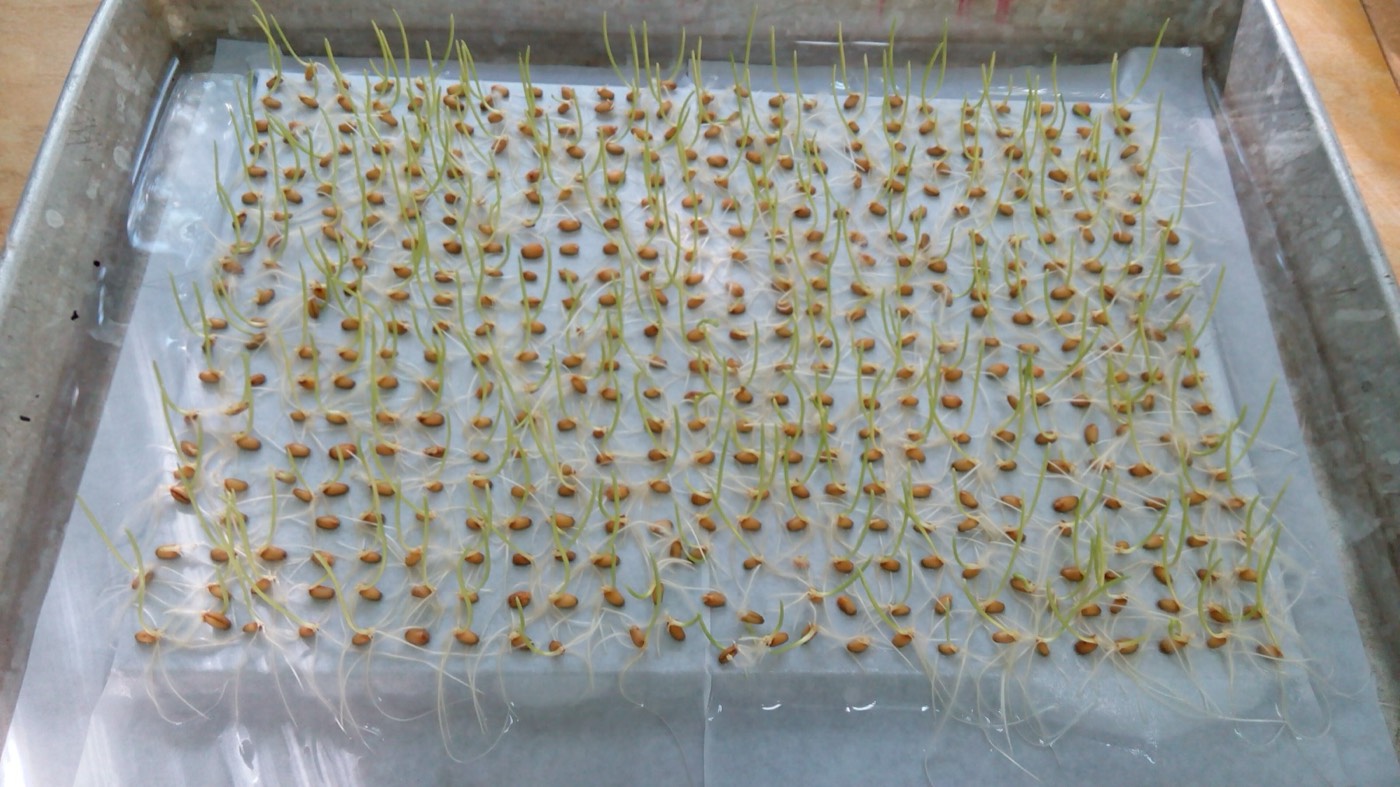
Three-day-old wheat seedlings
Before sowing: the date, the bed and the seed
The date you sow, how much seed goes in, how deep it sits and how evenly it comes up set a ceiling for everything that follows. Fertiliser, irrigation and spraying can help the crop reach that ceiling; they cannot raise it. How to sow wheat
The bed: firm below, fine and moist at seed depth, a few small clods on top. Level it: if you water the field, high spots stay thirsty and low spots drown. Do not work soil that is very wet; it sets like brick. Wheat guide
Into residue: in rice–wheat areas a zero-till drill sows straight into the stubble, saves fuel and time, holds moisture, lets you sow earlier and replaces burning the straw.
Moisture: a wheat seed must soak up roughly a third to a half of its own weight in water before it germinates. In irrigated systems a pre-sowing irrigation brings the soil to the right moisture.
Wheat in its first six weeks, continued
Phalaris minor in Jalalpur, Patiala district
Seed treatment, done in the right order
Seed treatment protects against diseases that start in or on the seed, such as loose smut, common bunt and some seedling blights. Our videos name fungicide seed treatments only by FRAC group (group 3, the triazoles or demethylation inhibitors; group 7, the carboxamides; group 12, the phenylpyrroles; M03, multi-site dithiocarbamates). Use only a product registered for wheat in your country, at the label dose, and wear gloves. Seed treatment basics
Treated seed carries the pesticide with it: never eat it or feed it to animals, and do not leave spilled seed on the surface, where birds can be poisoned.
Chemical first, living product last: many fungicide seed treatments kill Trichoderma, so apply a chemical treatment first and a biological one just before sowing, or use products whose labels say they are compatible.
Calibrate the drill with the treated seed; a coating can change how seed flows. Seed drill calibration
Sowing day: count plants, not kilograms
Decide how many plants you want on each square metre and let seed size and germination decide the kilograms. Our sowing video's formula:
Seed rate (kg/ha) = target plants per m² × thousand-grain weight (g) ÷ expected establishment (%)
Its worked example: 250 plants/m² × 40 g ÷ 85 per cent ≈ 118 kg/ha; with 50 g seed the same stand needs about 147 kg/ha. Targets vary: many irrigated crops aim for roughly 200 to 350 plants/m², dry low-rainfall crops for around 100 to 150, and late sowing needs a higher target because late plants make fewer tillers. Seed rate and plant population
Depth: about 3 to 5 cm, into moist soil. Short modern varieties have a short coleoptile; sown too deep, it runs out before reaching the surface.
Rows: commonly 15 to 25 cm apart; our guide's rule of thumb is a hand's width, about 20 cm.
Feeding: be guided by a soil test. Place phosphorus near the seed at sowing; give only part of the nitrogen at sowing and the rest later. Our guide puts half to two-thirds of the fertiliser in at sowing and the rest with the first watering. Keep urea out of direct contact with the seed.
Wheat in its first six weeks, continued
Week 3: the watering that matters most
In irrigated wheat the first watering after sowing falls at crown root initiation, about three weeks after sowing, when the plant grows the ring of permanent roots at its base. Our guide: in South Asia that first watering is treated as the most important of the season. If you only have water for one irrigation, give it here. Water gently; wheat that lies flat does not get up. Crop water requirement
Weeks 3 to 6: the weed window
Weeds hurt wheat most in the first six to eight weeks, and weeds that come up with the crop do far more damage than those that come up weeks later. A thick, even, on-time crop is the first weed control: bare gaps are where weeds live. Critical period of crop–weed competition
Weed by hand or with a small hoe about 3 to 4 weeks after the crop comes up, and again about 3 weeks later if weeds are still coming.
Learn the grass weeds that look like wheat when young: little seed canary grass (Phalaris minor) in the rice–wheat fields of north-west India, wild oats in many countries. Ask an experienced farmer to show you once.
Pull weeds before they set seed. One weed left to seed gives thousands next year.
What not to do in the first six weeks
Do not spray a crop stressed by drought, frost or waterlogging; it breaks a herbicide down more slowly and is more easily injured.
Do not put nitrogen on very late. It makes tall, soft plants that fall over and gives no more grain.
Do not double a dose when a product stops working; switch to an effective product from a different group, and do not let survivors set seed.
From about six weeks, as the stems start to grow, the job changes: walk the field once a week and turn over leaves for rust. See the yellow rust page in this issue's pest watch.
Cold months change what a dairy cow needs and what a poultry house risks. From Laisha's livestock manuals, Explains articles and our new dairy and poultry videos.
Sahiwal cows at a dairy unit, Ludhiana, Punjab
The dairy cow: feed the rumen first
A cow can live on grass and straw that people cannot digest at all because she carries a fermentation vat in front of her true stomach. The rumen's microbes turn fibre into volatile fatty acids, which supply most of her energy, commonly 60 to 80 per cent. Chewing the cud makes saliva rich in bicarbonate, the rumen's main buffer against acid; that is why a cow needs long fibre, not only grain. Dairy cow nutrition (video)
Intake sets the ceiling. Adult cattle eat roughly 2 to 3 per cent of body weight as dry matter a day, high-yielding cows more at peak. Intake falls with very fibrous feed, heat stress and around calving.
Water. A lactating cow drinks roughly 3 to 5 litres for every kilogram of dry matter she eats, plus several litres per kilogram of milk. In drought, water is often the first limiting nutrient.
Forage plus concentrate. Legume fodders such as berseem, lucerne and cowpea are rich in protein and calcium; cereal fodders such as maize, sorghum and oats supply energy; wheat and rice straws are low in protein and digestibility.
Minerals reflect the local soil. A calcium to phosphorus ratio of about 1:1 up to 2:1 is generally recommended; area-specific mineral mixtures beat one generic mix. Never give a cattle mineral mixture to sheep: they are unusually sensitive to copper.
Winter on the livestock farm, continued
Milking the buffalo
Calving season: the transition cow
Milk yield peaks roughly six to eight weeks after calving while intake peaks later, so for the first weeks the cow burns body fat to fill the gap. The dry period, usually about 45 to 60 days, prepares her; aim for a body condition score of about 3 to 3.5 on a five-point scale at calving, and correct condition in late lactation, not in the dry period. Milk fever, ketosis and other production diseases
Milk fever is a sudden fall in blood calcium near calving; close-up diets low in potassium with a negative cation–anion balance help prevent it. A cow with milk fever needs a veterinarian at once.
Ketosis follows severe negative energy balance: avoid over-fat cows and get intake up quickly after calving.
Read the cow: most resting cows chewing the cud, porridge-like dung, steady milk fat and protein. A fat-to-protein ratio above about 1.4 in early lactation points to heavy fat mobilisation; a herd whose milk fat falls below its protein suggests acidosis.
Winter on the livestock farm, continued
Raising young chicks in a wooden brooder
The poultry house in the cold
Cold weather brings chilled chicks, stale air, wet litter, and viruses that survive longer: Newcastle disease virus lasts weeks in cool droppings and litter. Laisha's poultry manual puts it plainly: most disease in commercial flocks is a management failure before it is a microbiological one. Walk the house before you handle a bird. Poultry diseases to watch in winter (video) · Major poultry diseases
Brood on a warm floor. Preheat long enough that the floor and litter are warm, not only the air. Strain guides typically start in the low to mid 30s °C at chick level under spot brooders and fall by about 2 to 3 °C a week; keep humidity around 60 to 70 per cent in the first days.
The chicks are the thermometer. Comfortable chicks spread evenly; cold chicks huddle under the heat and cry; hot chicks pant and move away; chicks crowded to one side are avoiding a draught. A few hours after placement, most crops should be full and soft.
Ventilate even in the cold. Ammonia above about 20 to 25 ppm is widely cited as harmful to airways and eyes; cold, poorly ventilated houses also raise the risk of ascites in fast-growing broilers.
Keep litter dry. Deep litter is commonly 5 to 10 cm of shavings, rice husk or chopped straw. Spilt water is the commonest cause of wet litter, and wet litter favours coccidiosis.
Daily deaths are your early warning. Biosecurity is the foundation: all-in, all-out with cleaning, disinfection and a rest period; control people, vehicles and equipment; keep out rodents and wild birds. Vaccines fail for avoidable reasons: a broken cold chain (most must be kept at 2 to 8 °C), chlorinated water, the wrong timing. Antibiotics treat only bacterial disease, only under veterinary guidance, with the withdrawal period respected. Poultry production
Soil & water
Irrigating wheat by hand: water the stage, not the calendar.
Winter irrigation: water the stage, not the calendar
A crop's water requirement is the depth of water it needs to replace evapotranspiration. The FAO-56 method splits it in two: ETc = Kc × ET0, where ET0 is the weather's demand and Kc scales it to the crop at its stage. In cool, cloudy weather ET0 is typically only about 1 to 2 mm a day, against 6 to 8 mm or more in hot, dry, windy weather; that is why a winter crop needs far less water than the same field in summer, and why over-watering is the commoner winter mistake. Crop water requirement
Where water is short, concentrate it at the most sensitive stages, usually flowering and early grain or fruit set. Our guides name them crop by crop:
Wheat: about 3 weeks after sowing (crown roots), at heading and flowering, and during grain filling. One irrigation only: the first. Two: the first and the grain-filling one.
Mustard: one irrigation at flowering; if two, the first at 3 to 4 weeks (branching). Stop once pods are filling, and never irrigate just before an expected cold night: wet soil and frost together damage flowers.
Chickpea and lentil: flowering and early pod fill, before any other point. Avoid standing water at all costs.
Potato: a crop of 120 to 150 days needs 500 to 700 mm in total, rain and irrigation together.
Garlic: about one inch of water a week in dry periods; even moisture matters more than large amounts, then stop on purpose before harvest.
Surface methods (basin, border, furrow) run at about 40 to 70 per cent efficiency, sprinklers 70 to 85 and drip 85 to 95; level land is what makes surface irrigation work. Irrigation methods
Sample before sowing or fertilising, at the same time of year each time, and repeat every two to four years for phosphorus, potassium, pH and organic matter. Most errors in the soil-testing chain come from sampling, not from the laboratory. Soil testing and fertiliser recommendation
Read the report the day it arrives: Laisha's Soil Test Report tool classifies each reading against published standards and says what to do about it. A test read weeks later has already cost you the decision it was for. Soil test report tool
Tool spotlight
Irrigation Scheduler
November is when over-watering does quiet damage: cool days, low evaporation, and a crop that does not need the pump to run. This tool works out a day-by-day schedule for the next 7 to 16 days from the forecast for your location, using the same FAO-56 method our soil and water pages describe.
November is a good month to study what is happening in the fields around you: sowing, seed rates, weeds, irrigation scheduling, soil testing and the pests of a cool season are all standard exam topics, and you can see them outside. This plan uses Laisha's free Explains articles and exam-practice pages. It gives no exam dates: check your exam body's own website for those.
Original practice questions from Laisha's question banks, written to each exam's published syllabus; not past papers. Answers and explanations follow each one.
1. Crop Production & Protection for Engineers
A herbicide applied after sowing but before the crop and weeds emerge is described as:
APost-emergence
BDirected post-emergence
CPre-emergence
DPre-plant incorporated
Answer C. Pre-emergence herbicides are applied to the soil surface after sowing and before emergence. Post-emergence products go on emerged weeds; pre-plant incorporated products are mixed into soil before sowing; a directed spray is a post-emergence spray aimed below the crop canopy.
2. Crop Production & Protection for Engineers
A farmer irrigates a prepared field, lets the first flush of weeds emerge, kills them with a shallow pass or a non-selective herbicide, and then sows. This practice is called:
ASoil solarisation
BSmother cropping
CA stale seedbed
DAllelopathic mulching
Answer C. The stale seedbed technique depletes the surface weed seed bank before sowing. Solarisation heats moist soil under clear plastic; smother cropping uses a competitive crop to suppress weeds; allelopathic mulching relies on chemicals released by residue.
3. Crop Production & Protection for Engineers
Which group of weeds is generally hardest to control with grass herbicides used in rice and wheat?
AAnnual grasses such as Phalaris minor
BSedges such as Cyperus species
CWild oats in wheat fields
DAnnual grasses such as Echinochloa
Answer B. Sedges differ botanically from grasses (triangular stems, often tubers) and are not controlled by most grass-specific herbicides. Echinochloa, Phalaris minor and wild oats are grasses targeted by those products.
4. Crop Production & Protection for Engineers
A pest density of 8 larvae per plant causes damage worth exactly the cost of spraying. Field scouting shows 5 larvae per plant and rising. Which statement is consistent with IPM?
A8 per plant is the ETL, so no action is needed until counts exceed 8 and keep rising for a week
B5 per plant is above the EIL, because any visible larvae mean that losses exceed control costs
CSpraying should start immediately at any count, since IPM aims to keep pests at zero density
D8 per plant is the EIL; spraying is justified once counts reach the lower ETL, set to act before 8 is reached
Answer D. The density at which damage equals control cost is the economic injury level. The economic threshold is set below it so that control acts before the EIL is reached; with counts rising, action at the ETL is justified. Waiting beyond 8 lets damage become uneconomic; IPM does not aim for zero; and 5 is below the EIL by definition.
A wheat scheduling recommendation is an IW/CPE ratio of 0.8 with an irrigation depth of 50 mm. At what cumulative pan evaporation since the last irrigation should the next irrigation be given?
A40 mm
B80 mm
C50 mm
D62.5 mm
Answer D. CPE = IW / ratio = 50 / 0.8 = 62.5 mm. 40 mm multiplies instead of dividing; 50 mm ignores the ratio; 80 mm confuses the ratio with the CPE.
A wheat crop yields 6,000 kg/ha of grain with a seasonal ET of 500 mm. What is its crop water use efficiency?
A1.2 kg/m³
B12 kg/m³
C0.12 kg/m³
D120 kg/m³
Answer A. 500 mm on 1 ha = 0.5 m × 10,000 m² = 5,000 m³. WUE = 6,000 / 5,000 = 1.2 kg/m³. The others are factor-of-ten or hundred slips in converting mm·ha to m³. 12 and 0.12 kg/m³ are factor-of-ten slips, and 120 kg/m³ a factor-of-hundred slip.
Which opener is best suited to sowing through heavy surface residue?
ADouble-disc opener
BShoe opener
CHoe opener without coulter
DRunner opener
Answer A. Discs cut through residue instead of dragging it; tined, hoe and shoe openers bunch residue and block.
8. Soil & Water Conservation Engineering
In US usage, a tillage and planting system counts as conservation tillage when, after planting, crop residue covers at least:
A30% of the soil surface
B50% of the soil surface
C10% of the soil surface
D75% of the soil surface
Answer A. The accepted US definition is at least 30% residue cover after planting. No-till, strip-till, ridge-till and mulch-till usually qualify.
9. Applied Animal Nutrition I: Ruminants
In early lactation, the dairy cow is usually in negative energy balance because:
Adry matter intake peaks before milk yield does
Bmilk yield peaks before dry matter intake does
Cmilk energy is lowest in the first weeks
Dmaintenance need falls sharply after calving
Answer B. Milk peaks at about 6 to 8 weeks while DMI peaks later, so the cow mobilises body fat to fill the gap. Colostrum and early milk are not low in energy, and maintenance needs do not fall.
10. Veterinary Clinical Medicine II: Metabolic, Production and Deficiency Diseases
Which description best fits type II ketosis in dairy cows?
AOnset 1 to 2 weeks after calving in over-conditioned cows, with insulin resistance and fatty liver
BOnset at 3 to 6 weeks after calving in thin cows that are underfed at peak milk yield
CCaused by feeding poorly fermented silage high in butyric acid, with no link to body condition or liver fat
DOccurs only in dry cows in the last month of pregnancy that are carrying twin calves
Answer A. Type II ketosis is associated with fat cows, heavy fat mobilisation and fatty liver early in lactation, and responds less well to treatment. Type I (underfeeding) ketosis occurs at 3 to 6 weeks near peak yield. Butyric silage causes alimentary ketosis.
11. Avian and Poultry Production Management
20,000 broiler chicks were placed and 900 died or were culled before sale. What is the liveability?
A4.5%
B95.5%
C4.7%
D104.7%
Answer B. Liveability = (placed − dead) ÷ placed × 100 = 19,100 ÷ 20,000 × 100 = 95.5%. 4.5% is the mortality; dividing by survivors gives 4.7%; inverting (placed ÷ survivors) gives 104.7%.
12. Environment & Environmental Hygiene
Why does high atmospheric ammonia increase respiratory disease in housed pigs and poultry?
AIt damages the mucociliary escalator, so inhaled pathogens are cleared less well
BIt neutralises antibodies circulating in the plasma
CIt suppresses appetite, so animals receive less vitamin A from the feed
DIt is a direct primary pathogen that colonises the lower airways
Answer A. Ammonia irritates and damages the respiratory epithelium and slows ciliary clearance, so organisms such as Mycoplasma and Pasteurella establish more easily. It is a chemical irritant, not an infectious agent, and does not neutralise antibodies.
Practise all 996 questions in these eight subjects
Twelve here, all of them in the app with full working, timed papers and progress by unit. Try Laisha Smarter free for 10 days, no card needed.
The South Asian wet-season crop season: rice, maize, sorghum, millets, cotton, groundnut, soybean and pigeonpea, sown with the rains and harvested as they end.
Choose your zone and up to three crops. If they are already sown, add the date. In a second you get November week by week: field jobs from our guides, the irrigation that matters at your crop's stage, and the pests to scout for each week, with links. Free, and no account needed.
A dated season plan for your crop and location, pest and disease alerts, Ask Laisha about what you see in your field, every calculator and every practice question. No card needed; subscribe only if it earns its place.
Lens comes out at the start of every month; the December issue follows at the start of December.
If this issue helped, the next step is to make it about your own fields. My farm's November is free and needs no account. If you want a dated season plan for your crop and location, pest alerts, answers about what you see in your field, and every practice question in the banks, Laisha Smarter can be tried free for 10 days, no card needed.
Pass it on
Lens is free to share whole and unchanged. Send the link to your farmer group or your class: laisha.ai/lens/2026-11. The web edition has a share button on every zone and pest, and the at-a-glance and pest watch are also in Hindi at laisha.ai/lens/2026-11/hi.
Get next month's Lens in your inbox: sign up free at laisha.ai/lens. One email when a new issue is out; confirm once, unsubscribe in one click.
Laisha Review · Monthly
Get next month's Lens in your inbox
One email when a new issue of Lens or Laisha Review is out, from Laisha's free monthly magazine list. Lens comes at the start of each month.
We will first email you a link to confirm; nothing is sent until you do. Every email has a one-click unsubscribe link. We use your address only to send the magazine. Privacy
Credits & sources
Where everything in this issue comes from
Sources, section by section
At a glance and zone pages
Laisha farming calendar (seasonalCalendar.json, built from the USDA FAS, FAO and GEOGLAM crop calendars); crop tips from the Laisha grow guides; pests by the calendar's rule from the Laisha pest encyclopedia.
India this month
Laisha Explains: crop seasons, heat stress, cropping systems, soil organic matter, conservation agriculture, sustainable intensification, greenhouse effect and agriculture; the Laisha video "How to sow wheat"; the grow guides.
Crop spotlights
The Laisha grow guides for each crop, quoted from their quick facts, stages, troubleshooting and feeding sections.
Pest & disease watch
The Laisha pest encyclopedia entries (identification, favourable conditions, economic thresholds, monitoring and management, chemicals by IRAC/FRAC group only); Laisha Explains: integrated pest management.
Features
Wheat guide; Laisha videos on wheat sowing, wheat weed control and seed treatment; Explains on weeds, herbicides, seed rate and sprayer calibration. Livestock: Laisha veterinary manuals, Explains on ration formulation, production diseases and poultry, and the Laisha dairy and poultry videos.
Soil & water
Explains: crop water requirement, soil water constants, irrigation methods, soil testing; the Laisha soil-testing video; the grow guides' water stages.
Student corner
Laisha question banks (public practice pool only) and Explains articles.
No prices, minimum support prices, weather forecasts or exam dates appear in this issue, because none of them is in our data in a form that would still be true when you read it. Ask your local extension office, market or exam body. Every pesticide decision follows the product label and local law.
Punjab: preparing a field for wheat without burning the previous crop's stalks — CIAT, CC BY-SA 2.0, source
A mustard crop in full flower, thousands of small yellow four-petalled flowers on branching stems against a clear sky. — Shemaroo at English Wikipedia, Public domain, source
A chickpea field in Tamil Nadu, India, showing the crop's low, bushy growth habit. — PJeganathan, CC BY-SA 4.0, source
A field of lentil plants (Lens culinaris) in rows, low and bushy with scattered small white flowers, under an overcast sky. — Abdullah Sarhan, CC BY-SA 4.0, source
A potato plant leaf, made of several pairs of unequal leaflets along one stalk with a single leaflet at the tip. — Rasbak, CC BY-SA 3.0, source
Rows of young onion plants with narrow green leaves emerging from freshly tilled soil in a field. — Shanmugamp7, CC BY-SA 3.0, source
A garlic crop growing in the field, with upright flat leaves rising from each plant. — Perito Francesco, CC BY-SA 3.0, source
A large, open field of broccoli plants growing in even rows under an overcast sky. — Rodney Burton, CC BY-SA 2.0, source
Rows of cabbage plants growing in a field, each forming a rounded head of blue-green leaves close to the ground. — Forest and Kim Starr, CC BY 3.0 us, source
A young flat green pea pod on the plant with the spent flower still attached at its tip, surrounded by pale green leaves and thin curling tendrils gripping a wooden stake and wire. — Chmee2, CC BY 3.0, source
A field of carrot plants with feathery green tops growing in even rows. — Anne Burgess, CC BY-SA 2.0, source
A spinach plant growing in a bed, its broad dark green slightly puckered leaves spreading low and outwards over bare soil, each leaf on its own stalk rising from a single point at ground level. — Victor M. Vicente Selvas, Public domain, source
Rows of Japanese radish growing in a dry-season garden in the KwaZulu-Natal Midlands, with a person crouching beside them and cabbages nearby. — Alandmanson, CC BY 4.0, source
Yellow rust (Puccinia striiformis) stripes on a triticale leaf — Rasbak, CC BY-SA 3.0, source
Mustard aphids (Lipaphis erysimi), grey-green with a waxy coating, magnified — Alton N. Sparks, Jr., University of Georgia, Bugwood.org, CC BY 3.0 US, source
Cabbage head with dark Alternaria leaf spots — Agronom, CC BY-SA 3.0, source
Radish leaves with white rust: yellow patches above raised white pustules — Schlaghecken Josef, CC BY-SA 4.0, source
Chickpea plant with Ascochyta blight: brown lesions on stems and dead leaflets — Weidong Chen, USDA ARS, Public domain, source
Adult cotton bollworm moth (Helicoverpa armigera) — Ilia Ustyantsev from Russia, CC BY-SA 2.0, source
Tomatoes with late blight — Downtowngal, CC BY-SA 3.0, source
Onion thrips compared with western flower thrips under magnification — Alton N. Sparks, Jr., University of Georgia, Bugwood.org, CC BY 3.0 US, source
Leek leaf with a sunken purple blotch lesion caused by Alternaria porri — New Zealand Fungal and Plant Disease Collection (PDD) - Landcare Research, CC BY 3.0, source
Adult diamondback moth on a leaf — Please report references to [email protected] ., CC BY-SA 2.5, source
Fall armyworm caterpillar — Frank Peairs, Colorado State University, Bugwood.org, CC BY 3.0 US, source
White cottony mould of Sclerotinia sclerotiorum on a bean stem — Jymm, Public domain, source
Three-day-old wheat seedlings — Oksana Lastochkina, CC BY-SA 4.0, source
Phalaris minor in Jalalpur, Patiala district — Satdeep Gill, CC BY-SA 4.0, source
Sahiwal cows at a dairy unit, Ludhiana, Punjab — Harvinder Chandigarh, CC BY-SA 4.0, source
Milking the buffalo — Mike Prince, CC BY 2.0, source
Raising young chicks in a wooden brooder — Abdulybature, CC BY-SA 4.0, source
A Moroccan farmer irrigates his wheat field — مصطفى ملو, CC BY-SA 4.0, source
Laisha Lens No. 1, November 2026. Published by Laisha at laisha.ai. Free to share whole and unchanged.